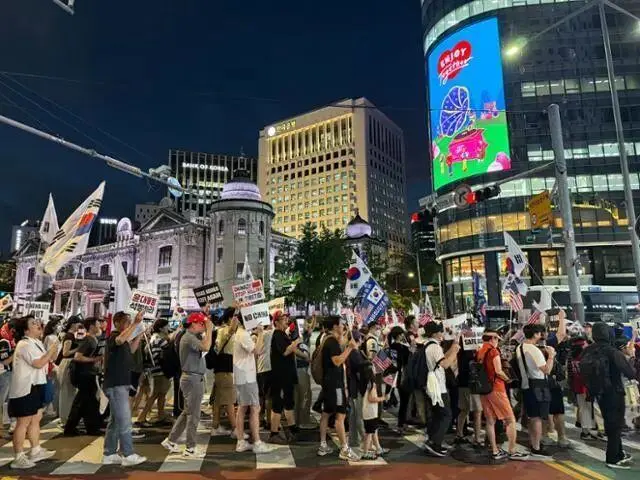
Blogger’s Note: From what I gather, China started visa-free travel to the PRC for groups of South Korean tourists. In the light of this development, South Korea reciprocated by granting groups of Chinese tourists visa-free entry into the ROK. These visas are highly regulated and a no-nonsense approach to facilitating efficient tourist exchanges. Just like in Hong Kong, however, groups of suspiciously well-organised “protestors” have gathered in the ROK protesting the visiting of Chinese tourists – holding-up placards (sometimes in English as well as Korean and Chinese) making anti-China racist statements. I did see video of these protests whilst scrolling through Chinese-language news feeds – but did not appreciate what I was seeing at the time (in fact, I thought it was Hong Kong – as it looked and felt identical). The South Koreans acted like Falun Gong cultists and appeared to be the product of a pro-Western insert. Such demonstrations come out of nowhere, are perfectly timed and orchestrated. As these demos are not genuine or popular, no one else in the vicinity joins in or show supports. Then, at a given signal, the protests suddenly “end” – and everyone departs – taking all their rubbish with them, leaving a perfectly clean street. Indeed, after spewing-forth their (often self-hating) racist rhetoric, the demo simply “dissolves” quite naturally with no police interference. There is no “moving-on” and no “arrests”. The some reason, the ROK State has decided that this obvious “racist” outburst (which has its oigins in a smoke-filled room in Washington) – is not in the best interests of South Korean people. Normally, the ROK State says nothing – but has unleashed the Riot Squad from time to time. ACW (6.10.2025)
China Daily 2025-10-04
South Korean President Lee Jae-myung has struck a right note by ordering a crackdown on protests and demonstrations against foreigners within the country, as such acts are “self-destructive”, as he called them, according to analysts.
“Rumours and hate speech targeting specific countries and their people are being spread indiscriminately, and racially discriminatory rallies continue,” Lee said on Thursday, as quoted by the Yonhap News Agency.
He said the “utterly harmful, self-destructive acts” damage South Korea’s national interests and must be completely eradicated.
Lee’s remarks came amid concerns that the ongoing protests in downtown Seoul could harm the country’s tourism industry, after a visa-free entry programme for Chinese group tourists began on Sept 29.
“At a time when we should be grateful, encouraging and welcoming, how can we instead engage in hatred, insults and abusive behaviour?” Lee said, noting that Seoul’s Myeong-dong tourist area has become more vibrant following the visa-free policy.
Lee urged relevant ministries to intensify efforts to combat activities that jeopardize the safety of foreign visitors and to implement stringent measures to eradicate racially discriminatory acts.
Large anti-China protests were held in downtown Seoul on Friday. Although local police had urged organizers to exercise restraint, banners demeaning China were still seen.
Ahead of the rallies, the Chinese embassy in Seoul expressed regret on Thursday that some politicians in South Korea are spreading disinformation. Certain far-right groups are holding demonstrations targeting China in areas such as Myeong-dong and Daerim-dong in Seoul, where Chinese tourists gather. The embassy is located in Myeong-dong.
In a statement, the embassy said that the planned rallies were ill-intentioned and against public sentiment. It noted that they were held on a festive occasion when Chinese people celebrate National Day and the Mid-Autumn Festival, while South Koreans celebrate the National Foundation Day and Chuseok holidays.
The embassy urged the South Korean government to guarantee the safety and lawful rights and interests of Chinese citizens in the country.
It also stated that the China-South Korea strategic cooperative partnership is expected to see positive and sound growth, and attempts by a small number of political forces will not succeed in affecting this path.
Woo Su-keun, head of the Institute of East Asian Studies of Korea in Seoul and president of the Korea-China Global Association, said that protests may harm tourism and cultural exchanges in the short term.
“This is because Chinese tourists might feel a psychological distance,” Woo told China Daily.
However, Woo said the protests will not have any substantial influence since the vast majority of South Koreans view the protests negatively.
“The issue will not escalate into a diplomatic problem,” said Woo, adding that he believes the South Korean government will deal with the issue properly, and the protesters will eventually lose their footing and fade away.
In an earlier interview with the Korea JoongAng Daily newspaper, Hong Sung-soo, a law professor at Sookmyung Women’s University in Seoul, said the sentiment currently seen in South Korea has become “a direct social threat”.
“It is necessary to launch awareness campaigns to clearly show that this is not the prevailing public mood in (South) Korea,” said Hong.
Merchants near Myeong-dong also voiced concern that the protests, if they become more frequent, will stop Chinese tourists from visiting the area, according to local media.
Editor: Mo Honge
 SANGHA KOMMUNE (SSR)