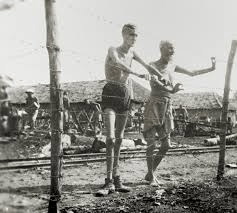
Blogger’s Note: Following the US War of Aggression in Korea (1950-1953) – the Americans were shocked that their armies could not defeat Korean or Chinese People’s Armies. This led to a dramatic about turn with regards to Japan – that was immediately rehabilitated into a staunch ally of the US. As long as Japan remained loyal to the alien ideologies of predatory capitalism and liberal democracy, Japan could keep many of its wartime (anti-China and anti-Socialist) fascist attitudes. In return, the US spread Japanese Zen and Japanese martial arts around the Europe and the Americas as a means to isolate and disempower the Chinese diaspora. Distorted Japanese Zen obscured the genuine teachings of Chinese Ch’an – and Japanese Karate replaced Chinese gongfu. Both Zen and Budo were linchpins of brutal Japanese imperialism over many decades – with both used to commit atrocities on the battlefields and to torture and murder Western POWs. Later, the descendants of the victims of Japanese imperialism ended-up indoctrinated with the very evil Japanese ideology that had inflicted so much suffering upon their ancestors. Furthermore, during the 1950s, Japanese film directors were allowed by their US overlords to make fictional and semi-biographical films about the fighting in Manchuria between the Red Army and Imperial Japan (this was in late 1945 and also involved the Mongolian People’s Army as an ally of the Soviets) – depicting the Japanese as the “victims” of Soviet aggression! This is how the US deployed anti-intellectualism and tried to engineer society by brainwashing its inhabitants. Even today – lies are routinely used in place of the truth. ACW (17.8.2025)
Source: Xinhua Editor: huaxia 2025-08-17
TOKYO, Aug. 17 (Xinhua) — This year marks the 80th anniversary of Japan’s unconditional surrender in World War II, a moment that should serve as an occasion for sober reflection on the immense suffering Japanese militarism inflicted on many countries, particularly in Asia.
Instead, the milestone has exposed how far the country remains from a full reckoning with its past. Right-wing forces continue to blur historical responsibility, glorify wartime crimes, and cast Japan as a victim, all while advancing along the path of military expansion.
What ought to be a commemoration of accountability risks becoming another exercise in historical revision.
RIGHTWARD DRIFT
In 1995, on the 50th anniversary of Japan’s surrender, then-Prime Minister Tomiichi Murayama issued the landmark “Murayama Statement,” acknowledging that Japan’s colonial rule and aggression had caused “tremendous damage and suffering” to many countries, and expressed “deep remorse and heartfelt apology.”
Subsequent prime ministers echoed similar sentiments on the 60th and 70th anniversaries, but their wording gradually weakened. Prime Minister Junichiro Koizumi’s 2005 statement retained terms like “colonial rule and aggression,” “remorse,” and “apology,” yet omitted acknowledgement of “erroneous national policy.”
In 2015, Shinzo Abe’s statement sought to turn the page on historical issues, asserting Japan had already expressed remorse multiple times and that future generations should not be “burdened with the fate to continue apologizing.”
This year, debate swirled over whether Prime Minister Shigeru Ishiba would issue a formal statement on Aug. 15. Right-wing conservatives opposed any official anniversary statement, claiming Abe’s words had already settled the matter.
Under pressure, Ishiba opted not to deliver a cabinet-endorsed address, instead planning a personal opinion statement later, deliberately avoiding the symbolic anniversary date.
The caution reflects a broader rightward tilt. A populist party, Sanseito, made gains in July’s upper-house elections by championing a “proud history” and denouncing Japan’s pacifist constitution as imposed from outside. Revisionist narratives are seeping further into the political mainstream.
FROM PERPETRATOR TO VICTIM
At the Aug. 15 national memorial service for the war dead, Ishiba did include the word “remorse” in his remarks — the first prime minister in 13 years to do so at the ceremony.
However, as Japanese media noted, his “remorse” referred to Japan’s path to war, not to the harm inflicted on Asian neighbors.
Earlier this month, Hiroshima and Nagasaki held their annual atomic bombing commemorations. From Ishiba to local officials and citizens, speeches focused overwhelmingly on Japan’s suffering under nuclear attack, with little mention of Japan’s wartime aggression abroad. In Nagasaki, residents interviewed stressed the horrors of the bombings but rarely acknowledged Japan’s role as an aggressor.
The emphasis has shifted public perception. An NHK poll found only 35 percent of Japanese now see the war as one of aggression, compared with 52 percent in a 1994 survey.
In contrast, 67 percent of respondents said they “still cannot forgive” the atomic bombings, up 18 percentage points from a decade ago.
At Nagasaki’s Atomic Bomb Museum, limited displays on Japanese atrocities such as the Nanjing Massacre and the bombing of Chongqing have faced right-wing criticism, with some groups denying these events and demanding their removal.
“Many Japanese see the war mainly as their own suffering, symbolized by Hiroshima and Nagasaki, while the fact of aggression against China and other Asian nations is not confronted, or even avoided,” said Atsushi Koketsu, emeritus professor at Yamaguchi University.
MILITARY BUILDUP
Constrained by its postwar pacifist constitution, Japan once adhered to a “defense-only” policy and maintained a cautious approach to military power. But conservative leaders have long harbored ambitions of building a “normal” military power, and recent years have seen Japan rapidly loosen restrictions and boost defense spending.
In 2022, Japan adopted new national security documents aiming to raise defense expenditures to around 43 trillion yen (about 292 billion U.S. dollars) between fiscal years 2023 and 2027.
Japan is also acquiring offensive weapons. It plans to purchase 400 Tomahawk cruise missiles from the United States and deploy upgraded Type 12 missiles with a range of 1,000 kilometers by 2025.
To rally public support, the government repeatedly invokes “security threats” in its annual defense white paper. The 2025 edition again claimed Japan faces its “most severe postwar security environment.”
For the first time, the Defense Ministry even distributed a children’s version of the white paper to elementary schools, prompting concerns it could foster hostility toward neighboring countries.
And on August 5, Australia selected Japan’s upgraded Mogami-class frigate as its next-generation warship — the first time since WWII that Japan will export advanced naval vessels. Professor Koketsu warned that if Japan begins to see war, weapons production, and arms exports as economic drivers, its economy and military could dangerously merge.
 SANGHA KOMMUNE (SSR)