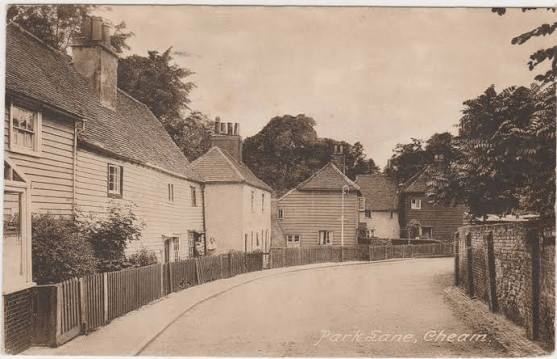
Blogger’s Note: We live in the exact area where West Sutton and East Cheam geographically overlap. This is why the Post Office advises that we can use either “Cheam” or “Sutton” in our postal address (technically – we live in both areas simultaneously). As there was so much opposition to “East Surrey” becoming a borough of London in 1965 – the Post Office also stated residents could carry-on using “Surrey” in their postal addresses – or switch to the new “London” designation, whichever is preferred. As it is, we now live in the London Borough of Sutton and Cheam. East Cheam was an old (feudal) designation owned by the Archbishop of Canterbury in ancient times (there used to be monasteries around here). The area that constituted “East Cheam” is literally outside our front-door. The suburb of West Sutton developed out of the empty farmer’s fields that originally surrounded where the “Sutton West” Train Station stands today (opened in 1930) – a branch-line from Sutton Train Station (which opened in 1847). After the 1539 Dissolution of the monasteries, the aristocracy brought, sold, and inherited land all around this place (Henry VIII built a Palace here – and preferred the area). Eventually, dairy farmers acquired the land and built-up vast dairy herds of cows. The milk (and meat) served London for hundreds of years until the rise of supermarkets. The Local Council eventually purchased the land and built middle-class dwellings to accommodate the well-off who worked in and around London. Many houses, built in the early 1920s, catered to car-owners, which were only for the rich at that time. Each house possessed an ample front and back garden, with a covered garage to park the family conveyance – usually on the property or nearby. As there was ample space – these houses were large and roomy. Sutton was only forced to build rental properties for workers post-1945 – although people like Thomas Wall, did use his own money to build workers’ cottages for his employees – but these were few and far between. Today, such cottages are worth millions on the free market and are highly sought after (ironically). The British comedian – Tony Hancock (1924-1968) – was famous for a fictional character he created whose back-story had him living in “East Cheam” – but East Cheam has not be used for probably hundreds of years – despite the odd campaign here and there. In 2022, Sutton Council renamed the “Electoral Ward” where we live into “West Sutton and East Cheam” – thus bringing the designation back to life. Tony Hancock must have really researched this area very well to come-up with this obscure name – making it famous. ACW (14.9.2026)

15th August 1998
According to ancient deeds Tony Hancock was right – East Cheam does exist.
East Cheam or Lower Cheam, as it is referred to in old deeds, was made up of East Cheam Manor and a few houses in the area between Cheam and Sutton, west of Gander Green Lane.
The estate stretched north from Cheam Road up to what is now Tate Road and the manor house stood approximately where Carlisle Road now runs.
The manor of East Cheam was held by the Archbishop of Canterbury from the time of the Domesday Book until Thomas Cranmer sold it to Henry VIII in 1538, and it was annexed to the honour of Hampton Court.
This was the period when Henry was amassing land for his sumptuous Nonsuch Palace which was nearby.
The manor was then granted to Viscount Montagu by Mary I. He in turn sold it to Earl of Arundel in 1575 who already owned the whole of Cheam. Cheam was reunited.
John, Lord Lumley, Arundel’s son in law, inherited all this land on the death of Arundel in 1579. The name of Lumley is still commemorated in Cheam, most notably by the Lumley Chapel in St Dunstan’s Churchyard, which contains two magnificent monuments to Lord Lumley and his two wives.
In the time of Cranmer the manor was leased to John Yerde. This tenancy passed to Thomas Fromond, his son in law, who built the manor house of East Cheam.
This was pulled down by a subsequent owner, Philip Antrobus, around 1800, who had the new mansion Lower Cheam House built on the site. A portrait of Philip in a velvet coat and powdered wig used to hang in the house.
The Antrobuses were made baronets during the Napoleonic wars, and lived at Cheam for many years. This was until the death of Hugh Antrobus in 1899, when the house and estates were sold to Ralph Beck of Cheam.
One wing of the house, which had been built on three sides of a square was pulled down and the smaller building sold to the Bainbridge family.
According to the late artist Frank Worker who painted the mansion in the early 1930s, the grounds of Lower Cheam House were “much used for fetes and garden parties when Miss Bainbridge the last occupier lived there.”
The estate was sold and the house demolished in 1933 and new roads and houses constructed on the land.
Converted for the new archive on 30 June 2000. Some images and formatting may have been lost in the conversion.

