Blogger’s Note: Whereas the West continuously attacked the science of the USSR as being “deficient” and “fake” – despite its obvious superiority – China forestalls this eventuality by ensuring all its humanitarian science is open to world scrutiny and international co-operation. The CPC has freed the power of production in all areas of scientific progress devoid of any limitations due to profit-seeking. Lenin once said that every Soviet citizen should go back to their kitchens and “think” – as every citizen’s thoughts were of equal value. The West would not recognise the Soviet achievement – but with China the situation is a little different. I think the West intends to steal Chinese science and attempt to use it to bring-down Socialism in that country. We shall see. ACW (6.4.2026)
By Emma Caton – First published 2 April 2026
The early explosion of complex life may have happened earlier than we thought.
The discovery of a new fossil site in China has revealed exceptionally well-preserved specimens from the Ediacaran Period, pushing back the timeline for when many major animal groups evolved by at least four million years.
The transition from simple organisms to more complex animals marks one of the most important turning points in the history of life on Earth.
This event has long been considered to have occurred in the Cambrian Period during an event known as the Cambrian explosion around 535 million years ago. It was thought that during this event many of the major animal groups first appeared.
This view has largely been shaped by the abundance of well-preserved fossils from that time.
But hundreds of new fossils found in southwest China suggests this evolutionary leap may have happened at least four million years earlier. This was towards the end of the Ediacaran Period and before the Cambrian even began.
A new study examining these new fossils shows that many key animal groups had already evolved before the Cambrian explosion. The research has been published in the journal Scienceopens in a new window.
Dr Imran Rahman, one of our researchers who wasn’t involved in the study, says, “This latest Ediacaran fossil assemblage is exciting because it includes taxa that were previously known only from the Cambrian Period, and it therefore serves to push back their origins deeper in time.”
“In recent years, the Ediacaran has emerged as a critical interval for understanding the earliest evolution of animals. This new discovery further reinforces the importance of Ediacaran fossils for uncovering the origins of the major animal groups we see today.”
What fossils have been discovered at the site?
Researchers unearthed more than 700 fossils from Jiangchuan in the Yunnan Province, China, dating from between 554 and 539 million years ago.
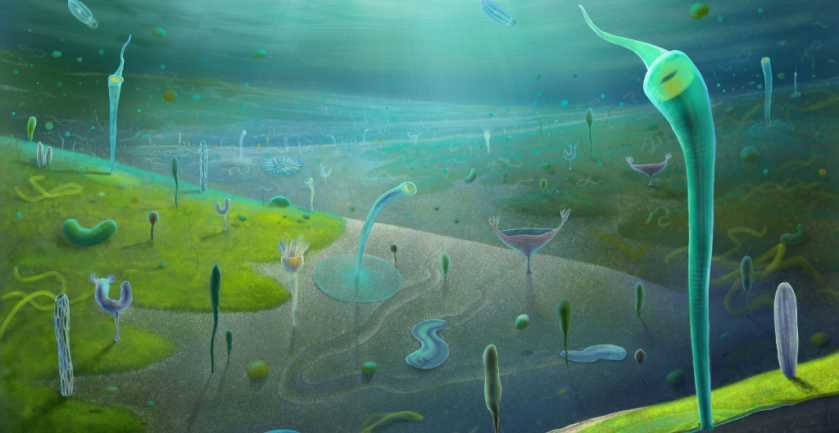
The site preserves a rich and varied community of Ediacaran animals. Some fossils represent entirely new, previously undescribed forms, while others resemble species previously known from Cambrian rocks.
Among the most striking finds are fossils that may represent the oldest known relatives of deuterostomes. This is a major branch of the animal kingdom that includes invertebrates, such as starfish and wasps, but also all vertebrates including us.
“This assemblage preserves the oldest fossil evidence for deuterostomes,” says Imran.
“That makes it vital for understanding the origin and earliest evolution of the larger animal group to which humans belong.”
Many of the fossils display unusual combinations of features not seen in Ediacaran or Cambrian species before, including tentacles, stalks and even feeding structures that could’ve be turned inside out.
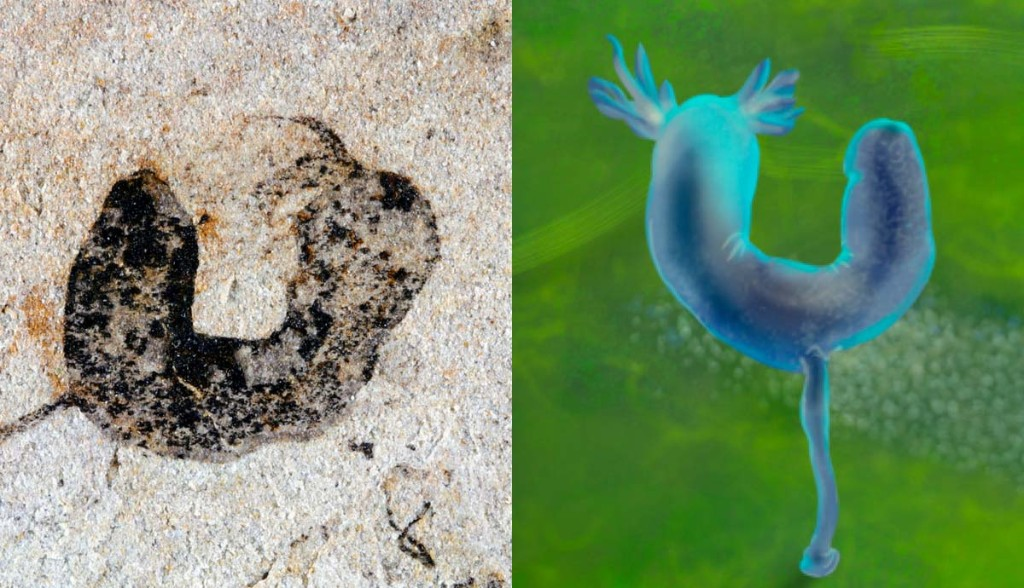
Among the finds are bizarre fossils of early Ambulacraria, ancestors of modern starfish and their close relatives, such as acorn worms. These ancient invertebrates had U-shaped body, were attached to the seafloor by stalks and had a pair of tentacles on their head, which they likely used to capture food.
Other fossils include early bilaterians, or worm-like animals with bilateral symmetry. Some of these show signs of complex feeding adaptions. Researchers also identified fossils that may represent early comb jellies.
Rethinking the evolution of complex life
Molecular studies and trace fossils have previously shown that animal lineages diversified well before the Cambrian explosion. But fossil evidence from the earlier Ediacaran Period has been hard to find.
But after nearly a decade of searching, the research group from Yunnan University in China find found what they were looking for.
Associate Professor Fan Wei, a leader of the group, says, “After years of fieldwork, we finally found several sites with the right conditions where animal fossils are preserved together with abundant algae.”
Unlike most Ediacaran sites, where organisms are preserved as impressions in sandstone, the Jianchuan fossils are preserved as thin carbon-rich films. This is type of preservation is more typical of famous Cambrian sites such as the Burgess Shale in Canada.
This exceptional preservation reveals anatomical details rarely seen in Ediacaran fossils, including feeding structures, digestive systems and organs used for movement.
Associate Professor Ross Anderson, a co-author of the study from the Oxford Universities Museum of Natural History, says, “Our results indicate that the apparent absence of these complex animal groups from other Ediacaran sites may reflect differences in preservation rather than true biological absence.”
“Carbonaceous compressions like those at Jiangchuan are rare in rocks of this age, meaning that similar communities may simply not have been preserved elsewhere.”
 SANGHA KOMMUNE (SSR)