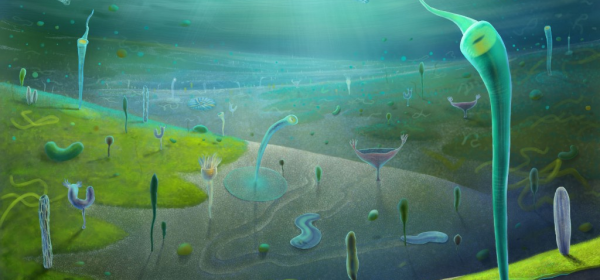
The explosion of complex life may have occurred four million years earlier than previously thought. © Xiaodong Wang

China: The Origins of Complex Life Pushed Back to Before the Cambrian! (6.4.2026)

Associate Professor Fan Wei, a leader of the group, says, “After years of fieldwork, we finally found several sites with the right conditions where animal fossils are preserved together with abundant algae.”

Unlike most Ediacaran sites, where organisms are preserved as impressions in sandstone, the Jianchuan fossils are preserved as thin carbon-rich films. This is type of preservation is more typical of famous Cambrian sites such as the Burgess Shale in Canada.

This exceptional preservation reveals anatomical details rarely seen in Ediacaran fossils, including feeding structures, digestive systems and organs used for movement.

Associate Professor Ross Anderson, a co-author of the study from the Oxford Universities Museum of Natural History, says, “Our results indicate that the apparent absence of these complex animal groups from other Ediacaran sites may reflect differences in preservation rather than true biological absence.”

“Carbonaceous compressions like those at Jiangchuan are rare in rocks of this age, meaning that similar communities may simply not have been preserved elsewhere.”
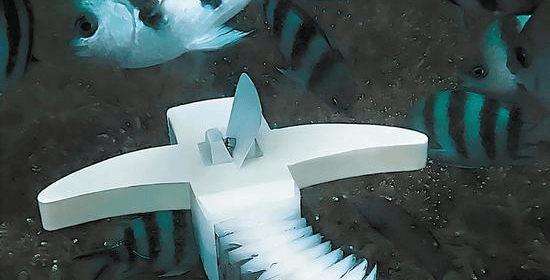
The soft robot is tested in the sea. (CHINA DAILY)

China: Breakthrough Enhances Deep-Sea Research! (6.9.2025)

Their latest research, titled “Plasticized electrohydraulic robot autopilots in the deep sea”, was published in the journal Science Robotics. Conducted in collaboration with Zhejiang University and the China Ship Scientific Research Centre, the research team has developed an electrohydraulic-driven soft robot which has been applied to deep-sea exploration.

As the largest unexplored frontier on the earth, the deep sea holds the key to understanding life origins, resource exploration and climate evolution.

However, scientists face significant challenges due to extreme conditions such as high pressure and low temperatures during their exploration. There is also another obstacle: balancing the high costs of exploration and equipment reliability with the protection of fragile deep-sea ecosystems, according to the research team.

The Cell of Ethiopean Monasticism!

Egypt: Nag Hammadi Gnostic Library, Moasticism and Primitive Tribal Behaviour! (18.4.2024)

Furthermore, it is alarming to read of the primitive blood feuds described as forming the general historical context surrounding this important and epoch-changing discovery – being every bit as brutal and primitive as the murders routinely carried-out by ISIS and Al Qaeda today – behaviour very different from that of moderate, economically developed and well-educated Muslims. These are people who inhabit a pre-modern mode of behaviour and corresponding mind-set – and although I am not a theist – it is interesting to consider why the Christian God would choose to deliver his texts into the hands of such people. But perhaps that is the point. The Christian God speaks of unqualified love and forgiveness (as does the Holy Qur’an of Allah) – whilst the Jewish God is vengeful, vindicative and quite often demanding of blood. Perhaps the essence of Gnosticism has survived right in the middle of Christian theology – and it has done so without being seen – waiting for the moment when the ceramic jar holding its teachings is found!

1 2