Blogger’s Note: If I could meet with – and question these wonderful scientists as a Journalist – this is the question I would ask:
“Why is it that the PRC can design and build the most advanced interstellar machines the Earth has ever seen – and yet the News Media of the PRC cannot write its articles in British English?”
I thank you. I have altered said articles into proper English. ACW (10.7.2025)
Source: Xinhua Editor: huaxia 2025-07-09
BEIJING, July 9 (Xinhua) — A series of research findings by Chinese scientists on the samples collected by the Chang’e-6 mission from the moon’s far side have unveiled the volcanic activity, ancient magnetic field, water content and geochemical characteristics of the moon mantle, shedding the first light on the evolutionary history of its dark side.
Four studies by the research teams from the Institute of Geology and Geophysics (IGG), the National Astronomical Observatories, both under the Chinese Academy of Sciences (CAS), Nanjing University, and other institutions were published in the latest issue of Nature.
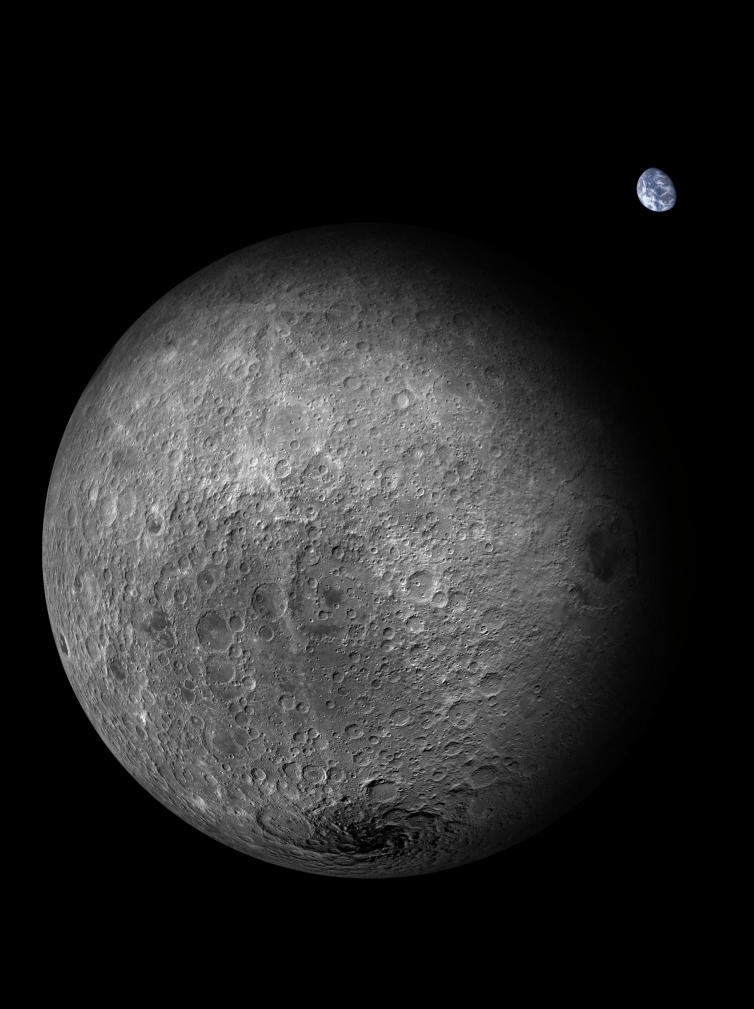
As the moon’s revolution cycle is the same as its rotation cycle, the same side always faces Earth. The other face, most of which cannot be seen from Earth, is called the far, or dark, side of the moon. This term doesn’t refer to visible darkness, but rather the mystery shrouding the moon’s largely unexplored terrain.
The moon’s near and far sides exhibit significant differences in morphology, composition, crustal thickness and magmatic activities. However, the mechanisms behind these disparities remain unresolved, representing a key issue in lunar science. Previously, scientific understanding of the far side relied primarily on remote sensing studies, scientists say.
In 2024, Chang’e-6 made history by bringing 1,935.3 grams of lunar far-side samples back to Earth. These samples were collected from the South Pole-Aitken (SPA) Basin, the largest, deepest and oldest basin on the moon, which provided a rare opportunity to clarify the compositional differences between the near and far sides andgrams, to unravel the long-standing mystery of their asymmetry.
“The SPA Basin is one of the moon’s three major tectonic units, measuring approximately 2,500 kilometers in diameter. The energy from the impact that formed this crater is estimated to be 1 trillion times greater than that of an atomic bomb explosion. Yet, the exact influence of such a massive collision on the moon’s evolution has remained an unsolved mystery,” Wu Fuyuan, an academician of CAS and a leading researcher with the IGG, said at a CAS press conference on Wednesday.
The four papers published in Nature systematically reveal, for the first time, the effects of this colossal impact, which is the core highlight of these findings, said Wu.
Over the past year, Chinese scientists have achieved multiple pioneering breakthroughs through the study of the Chang’e-6 samples.
They found the evidence of volcanic activity on the moon’s far side approximately 4.2 billion and 2.8 billion years ago, indicating such activity had persisted for at least 1.4 billion years.
For the first time, scientists obtained the ancient magnetic field information from the far side of the moon, revealing a possible rebound in the moon’s magnetic field intensity around 2.8 billion years ago. This discovery indicates the presence of fluctuations in the driven power of the lunar dynamo.
Scientists have found that the water content in the lunar far-side mantle is significantly lower than that of the near side, indicating a significant difference in water distribution between the two hemispheres.
“We found that the mantle source of basalt from the SPA basin is extremely depleted in incompatible elements, which are commonly used to reveal the geological processes that rocks have undergone,” said Yang Wei, a researcher with IGG.
This depletion could mean either the original lunar mantle was very low in the incompatible elements, or the massive impact event melted the rocks and carried these elements away. This discovery underscores the profound influence of large impacts on the evolution of the moon’s deep interior, Yang said.
“The new discovery marks humanity’s first direct access to key evidence of the deep interior material properties on the far side of the moon. It provides us with unique information to understand how the moon’s early interior became layered, cooled and evolved, representing a crucial step toward unravelling the mystery behind the dramatic differences between the lunar near and far sides,” said Li Chunlai, a researcher at the National Astronomical Observatories of CAS and deputy chief designer of the Chang’e-6 mission.
Additionally, Chinese scientists have made other discoveries. They unveiled the physical, mineralogical and geochemical characteristics of the Chang’e-6 lunar samples.
Meanwhile, Chinese scientists precisely determined for the first time that the SPA Basin formed 4.25 billion years ago, providing humanity with a more accurate anchor point for studying the history of large-scale impacts in the early solar system.
Mahesh Anand, a professor at the Open University in the UK, said, “We have had samples from the moon for over 50 years, samples collected by the Apollo and Luna missions. And we have many lunar meteorites.”
“But there are lots of new findings that are coming out based on the work that has been done on Chang’e-6 samples that are actually turning many of the well established hypotheses and theories in the field of lunar science upside down, necessitating reexamination of many of those theories,” Anand said.
He Hongping, vice president of CAS, said that upon receiving the Chang’e-6 lunar samples, CAS has placed high priority on related research efforts, and has yielded a series of high-level research achievements.
Guan Feng, director of the Lunar Exploration and Space Engineering Center of the China National Space Administration, expressed the hope that the comprehensive development of space science, space technology and space applications will be further promoted, urging more scientists to make use of the extraterrestrial samples and scientific data obtained from China’s lunar and deep space exploration missions to achieve more results and make more discoveries.
Previously, Chinese scientists analysed the samples collected by the Chang’e-5 mission from the moon’s near side, and found evidence of young volcanic activity dating back just 2 billion years, extending the moon’s volcanic timeline by 1 billion years. This discovery was hailed by international peers as changing humanity’s understanding of lunar evolution.
The success of China’s lunar exploration program is a prime example of the deep integration between science and engineering, said Li of the National Astronomical Observatories.
Chang’e 6 samples show moon’s asymmetry
chinadaily.com.cn 2025-07-10 08:42:28
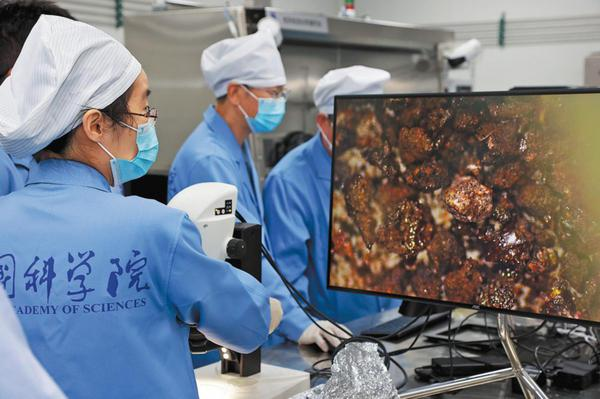
Chinese scientists have shed light on the geochemical characteristics of the basalt samples from the lunar far side brought back by the Chang’e 6 robotic probe last year, providing crucial insights into the early crust-mantle evolutionary history of the moon.
The study, led by the National Astronomical Observatories and the Institute of Geology and Geophysics of the Chinese Academy of Sciences, was published in Nature journal on Wednesday.
Wu Fuyuan, an academician of the CAS and a corresponding author of the study, said the moon displays an asymmetry between its near and far sides, characterized by pronounced differences in topography, composition, crustal thickness and volcanic activity.
However, due to the lack of samples from the far side until the mission, the origin of this asymmetry and the history of the far side remained poorly understood and was the central unresolved question in lunar science, he said.
Wu emphasized the ground-breaking achievement of the Chang’e 6 mission in successfully returning with 1,935.3 grams of samples from the lunar far side — the first time such materials were brought back to Earth.
The samples, which were collected from the South Pole-Aitken Basin, the moon’s largest, deepest and oldest impact structure, presented an unprecedented opportunity to analyze compositional differences between the two hemispheres, he said.
The research team conducted a thorough analysis of the 2.8-billion-year-old basalt samples from the lunar far side, which involved examining rock texture and mineral compositions, as well as investigating strontium and neodymium isotopes.
“The geochemistry of the basalt samples indicates that they originated from an ultra-depleted mantle source, which suggests a lack of easily meltable elements that would rise with magma,” Wu said.
The research team has put forward two potential models to explain the ultra-depleted characteristics.
One model suggests a highly depleted primordial mantle. In the initial phases of lunar formation, the moon existed as a vast magma ocean, where dense minerals sank to form the mantle while lighter minerals rose to create the crust. During the process, easily meltable elements were extracted, leaving behind only ultra-depleted elements in the deep mantle.
If this model proves to be accurate, the basalt samples could have originated from the deep mantle and should exhibit similar characteristics to deep mantle substances from the near side of the moon. The asymmetry observed may arise from surface manifestations of subsequent lunar processes, according to the study.
The other model suggests substantial melt extraction caused from large-scale impact events.
The South Pole-Aitken Basin, which is around 2,500 kilometres in diameter, was formed by an impact that unleashed a staggering amount of energy, estimated to be about 1 trillion times greater than that of an atomic bomb explosion.
Subsequently, intense volcanic activities further reshaped the region. These led to the remodelling of the shallow mantle, where a large amount of magma was extracted and it reached the surface or intruded the crust, leaving behind the incompatible and ultra-depleted elements in the mantle source.
If this model proves to be valid, it signifies how large-scale impact events not only reshaped the moon’s surface but also altered its internal composition, resulting in the depletion of volatile elements such as water.
The study also offers new insights into the early crust-mantle evolutionary history of other terrestrial bodies within the solar system.
Zhu Rixiang, an academician of CAS, said that as Earth is a very active planet, it is difficult to “determine the characteristics of the early Earth, whether it was ultradry or depleted”.
“However, since Earth and the moon share a common origin, we can speculate about the early Earth by studying the mantle conditions of the comparatively inactive moon 4.2 billion years ago,” Zhu said.
Mahesh Anand, a professor of planetary science and exploration at The Open University in the United Kingdom, congratulated the research team for the first results from the analysis being published in Nature.
“We have had samples from the moon for over 50 years, samples collected by the Apollo and Luna missions … but the Chang’e 6 samples are actually revealing many new things and forcing us to rethink the theories that we have developed over the past 50 to 60 years about the origin of the moon, the evolution of the moon, and the history of water inside the moon,” he said.
Anand added that this study has provided valuable insights into the asymmetry of the moon and voiced his expectations for more discoveries.
 SANGHA KOMMUNE (SSR)