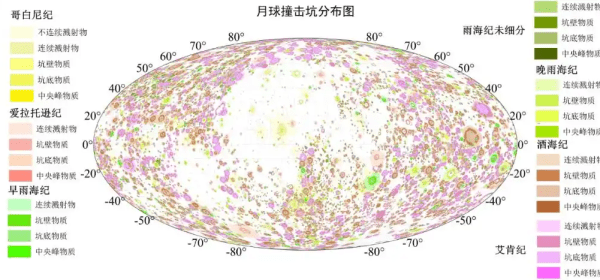
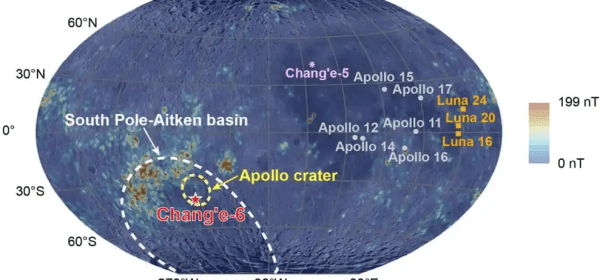
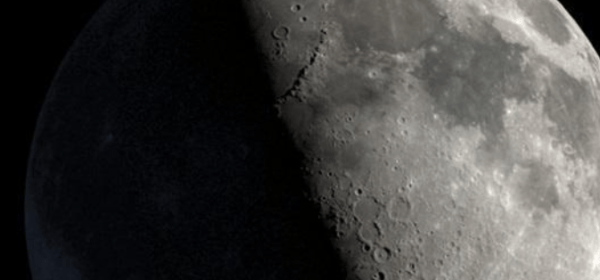
Global lunar crater distribution map. (Photo provided by the Institute of Geology, Chinese Academy of Geological Sciences)

China: PRC Develops Independent “Lunar Surface Map” for Future Missions! (7.8.2026)

A Chinese research team has completed an updated geologic map of the entire moon featuring a scale of 1:5 million, the Institute of Geology, Chinese Academy of Geological Sciences (IGCAGS), said on Thursday.

Representing a significant scientific iteration from the 2024 version, this map effectively rewrites the moon’s geologic history based on the latest research findings. “The lunar geologic history has indeed been rewritten — more precisely, refined and systematized,” said Yang Zhiming, director of the IGCAGS.

Specifically, a primary achievement of this update is the recalibration of the moon’s ancient geologic eras. The new map systematically updates the age boundaries of the moon’s three ancient geologic periods, namely the Aitkenian, Nectarian and Imbrian periods, drawing on recent advances in international chronology.

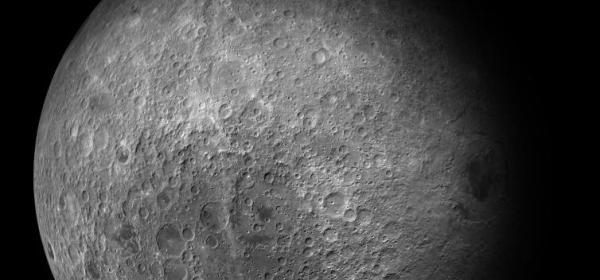
This image created by Chinese researchers shows the moon's far side.

China: Chang’e-6 Sheds First-Light on Evolution History of Moon’s Dark-Side! (10.7.2025)

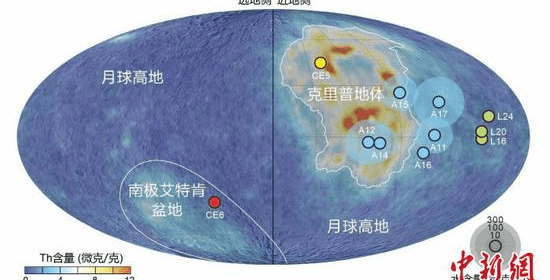
In 2024, Chang’e-6 made history by bringing 1,935.3 grams of lunar far-side samples back to Earth. These samples were collected from the South Pole-Aitken (SPA) Basin, the largest, deepest and oldest basin on the moon, which provided a rare opportunity to clarify the compositional differences between the near and far sides and to unravel the long-standing mystery of their asymmetry.

“The SPA Basin is one of the moon’s three major tectonic units, measuring approximately 2,500 kilometers in diameter. The energy from the impact that formed this crater is estimated to be 1 trillion times greater than that of an atomic bomb explosion. Yet, the exact influence of such a massive collision on the moon’s evolution has remained an unsolved mystery,” Wu Fuyuan, an academician of CAS and a leading researcher with the IGG, said at a CAS press conference on Wednesday.

The four papers published in Nature systematically reveal, for the first time, the effects of this colossal impact, which is the core highlight of these findings, said Wu.

Socialist China - Space Science!

China: Lunar Sample Reveals Far-Side Drier Than Near Side! (11.4.2025)

For nearly 20 years, there has been a debate over whether the water content in the Moon’s mantle, the middle layer between its surface and core, is abundant or scarce, while all published estimates were derived from near-side samples.

China’s Chang’e-6 lunar probe retrieved the first-ever lunar far-side samples from the Apollo crater within the South Pole–Aitken Basin, providing the first opportunity to determine the water content of the lunar mantle in this region.

The study revealed that a unique volcanic event dating back 2.8 billion years had not been observed in previous samples obtained from the near side.

Lunar Magnetic Field

China: Chang’e 6 Samples Shed Light on Lunar Magnetism! (23.12.2024)

They discovered that the Moon’s magnetic field may have experienced a rebound around 2.8 billion years ago, suggesting that the Moon’s generator may have been reinforced after an early sharp decline.

“The reason for this rebound could be a change in the primary energy source of the generator or a restrengthening of the initial driving mechanism,” Cai said.

“The data fill in a billion-year gap in the evolution of the lunar paleomagnetic record and provide the first paleomagnetic measurements from the lunar far side,” a reviewer for the journal Nature said. “The authors are to be congratulated on a historic study that provides a major advance in our understanding of lunar magnetism.”

The evolution history of the Moon’s magnetic field is markedly different from that of the Earth’s, the research team said.

Dark Side Moon

PRC: Lunar Samples Indicate Previous Magma Activity! (19.11.2024)

am lunar soils.

The study published on Science, conducted by a team led by Xu Yigang, an academician of the CAS and a researcher at the Guangzhou Institute of Geochemistry of the CAS, also confirmed magma activity on the lunar far side 2.8 billion years ago.

The study also indicates that the eruption of lunar mare basalt is influenced by the internal composition of the moon, explaining why the South Pole-Aitken Basin on the lunar far side lacks abundant volcanic activity.

“These samples are the first to be collected on the lunar far side so it provided a unique view to the moon’s global geological history. The results are novel and are deserving of publication in Science. They will be of interest to a broad readership,” Science reviewer Katherine Joy said.

This photo shows lunar samples retrieved by the Chang'e-6 mission at the lunar sample laboratory in the National Astronomical Observatories of the Chinese Academy of Sciences (CAS) in Beijing, capital of China, Sept. 24, 2024. (Xinhua/Jin Liwang)

China: Research on Chang’e-6 [Dark-Side] Lunar Samples Underway! (11.10.2024)

A research paper published in September on the lunar samples brought back by the Chang’e-6 mission says that the Chang’e-6 samples exhibit “distinct characteristics” compared to previously obtained lunar samples.

The Chang’e-6 probe was launched from China on May 3, 2024. On June 25, its returner made a landing in north China, bringing back 1,935.3 grams of samples from the far side of the moon. (Xinhua/Jin Liwang)

1 2