The Global Consciousness Project Meaningful Correlations in Random Data Working from the simple scientific observation that human bodies move physical objects – but that disembodied

Proletariat Blogging in the Heart of (UK) Predatory Capitalism! Exploring the Interface between Matter and Perception, Chinese Buddhism, Daoism, Hakka Ethnography, and All Aspects of Radical Politics, History, Psychology and Philosophy – 全世界无产者联合起来!
Exploring the paranormal and so-called psychic phenomena! Is it real? Let’s find out!
The Global Consciousness Project Meaningful Correlations in Random Data Working from the simple scientific observation that human bodies move physical objects – but that disembodied

Today, through the use of advanced technology and mathematics we know that this is scientifically correct. This would suggest that Democritus had an experience no less important than the enlightenment of the Buddha, as it radically redefined humanity’s perception of reality and existence, and yet generally speaking, there are no temples containing statues of Democritus, or people applying a meditative method to replicate his mode of thought.
The natural ‘distance’ the net creates prevents an appreciation of beauty falling into ordinary lust and desire – which are absolutely fine within their proper context. Beauty has many levels of appreciation that can be obscured b the immediacy of sexual desire – which necessarily exists to perpetuate the species!

Whatever the case, I suspect Plotinus fully understood that the world of matter was primary for biological life, and that through this biological existence, the rarefied state of conscious awareness that Plotinus undoubtedly experienced, could only be realised if the physical body (and the mind it contains) was trained in the right way.
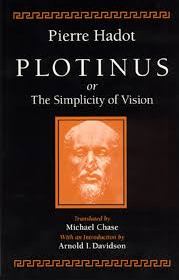
Therefore, it must be truthfully stated (as Plotinus does), that a continuously changing beauty exists beyond any concepts of ‘static’ beauty, and that such a beauty with regards to that which lives is ‘beautiful’, but that even that which is ‘dead’ is also ‘beautiful’ when viewed in a certain way. Although Plotinus advocates (for a time) a ruthlessly ‘looking within’, he does not permanently ‘reject’ the physical world he strives to ‘look beyond’.

Alan Watts, I suspect, is mixing Western notions of Japanese Zen with modern, Western concepts of science, and he does this very well, but the point he is missing is that from the perspective of Chinese Ch’an, there is a stage of development he does not know about and therefore is missing in his analysis.

