René Tamayo León – May 2, 2026
The First Secretary of the Central Committee of the Party and President of the Republic, Miguel Díaz-Canel Bermúdez, attended the delivery of the first two houses completed in the capital according to technology based on maritime containers. The members of the Political Bureau participated, Manuel Marrero Cruz, Prime Minister; Roberto Morales Ojeda, Secretary of Organization of the Central Committee; Army Corps General Lázaro Alberto Álvarez Casas, Minister of the Interior; and Major General Amado Ricardo Guerra, secretary of the Council of Ministers.
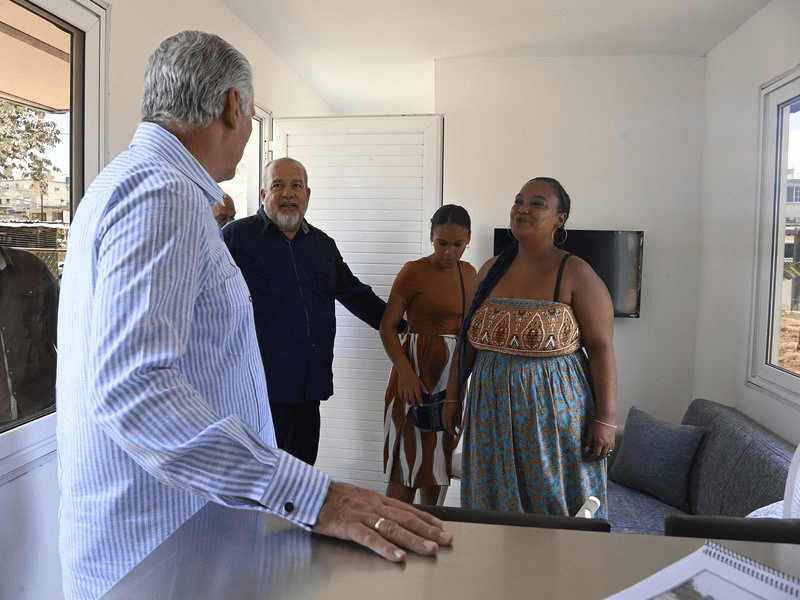
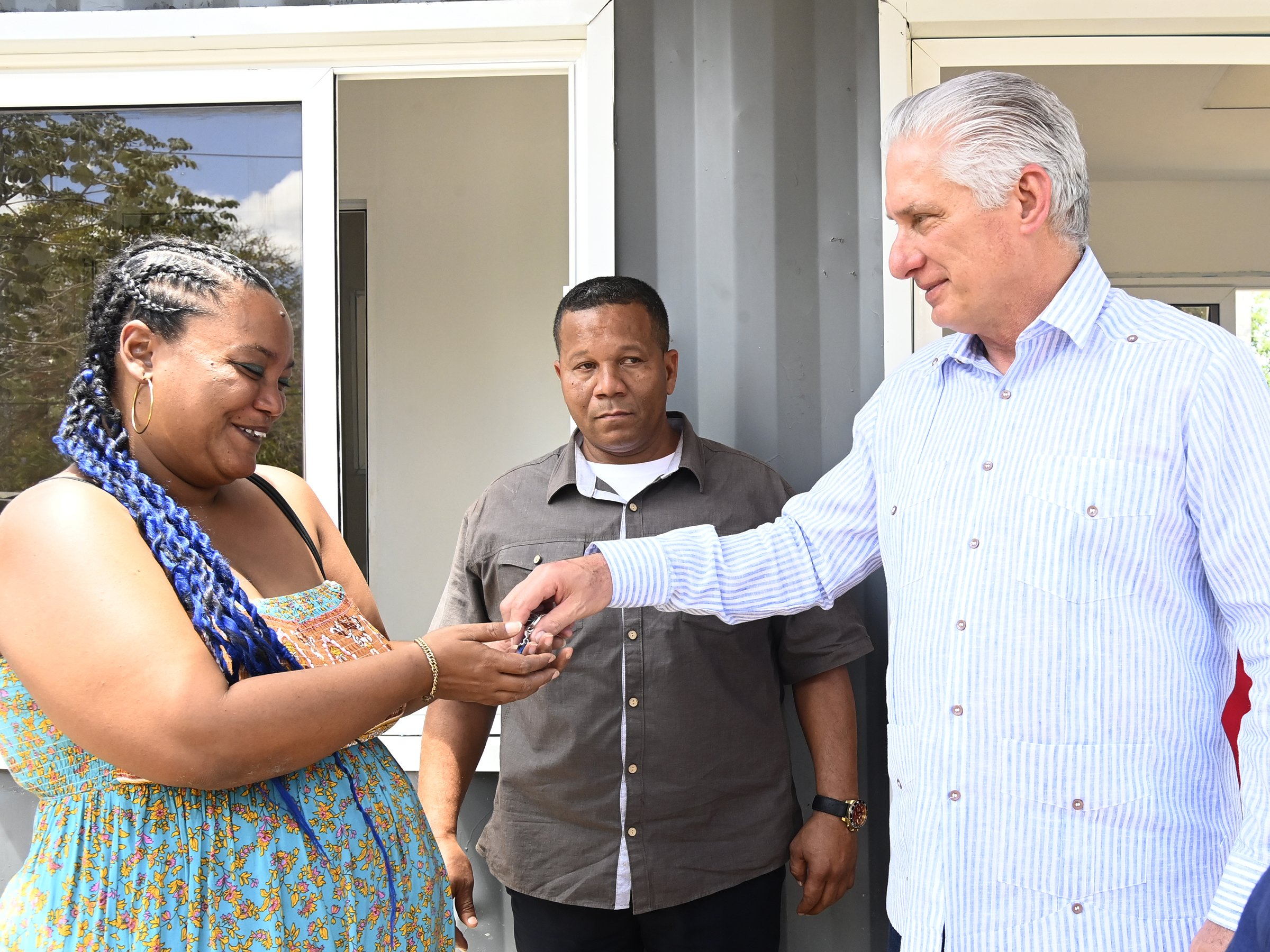
Alina and Nerelys, two young workers, single mothers and heads of households, were awarded this Saturday afternoon the first two houses completed in Havana by the Programme of modular housing from maritime containers of last use, which is implemented throughout the country and which demonstrate the viability of this alternative to respond in the short term to the growing housing needs of our people.
Alina Hinojosa Cardona is the mother of two teenagers; until now they lived in a room in poor condition and in overcrowded conditions, a situation that never limited her to, in addition to educating and guiding her children with care, have an outstanding work performance and lead the base committee of the UJC in her workplace, an organization she joined since she was 14 years old.
Nerelys Madan Catalá, a secretary by trade and who from the age of 22 served as a delegate of her constituency for two terms, had lived for more than 13 years in a shelter with numerous families; She now has a comfortable home for the greater well-being of her child and her elderly mother.
The two young women thanked with few words and many tears, for the emotion, the delivery of their homes, located in Nuevo Vedado, whose inauguration was attended by the First Secretary of the Central Committee of the Party and President of the Republic, Miguel Díaz-Canel Bermúdez, who at the end of the simple act went to meet the neighbors of Nuevo Vedado who wanted to greet him and with whom he shared the victorious days led by the Cuban people in these days with the May Day March and the massive movement of Mi Firma por la Patria.
A PROGRAMME THAT EXCITES
The inauguration of the first two modular homes from maritime containers completed in Havana, where awards were given to the executing entities, were also attended by the members of the Political Bureau, Manuel Marrero Cruz, Prime Minister; Roberto Morales Ojeda, Secretary of Organization of the Central Committee; Army Corps General Lázaro Alberto Álvarez Casas, Minister of the Interior; and Major General José Amado Ricardo Guerra, secretary of the Council of Ministers, among other authorities.
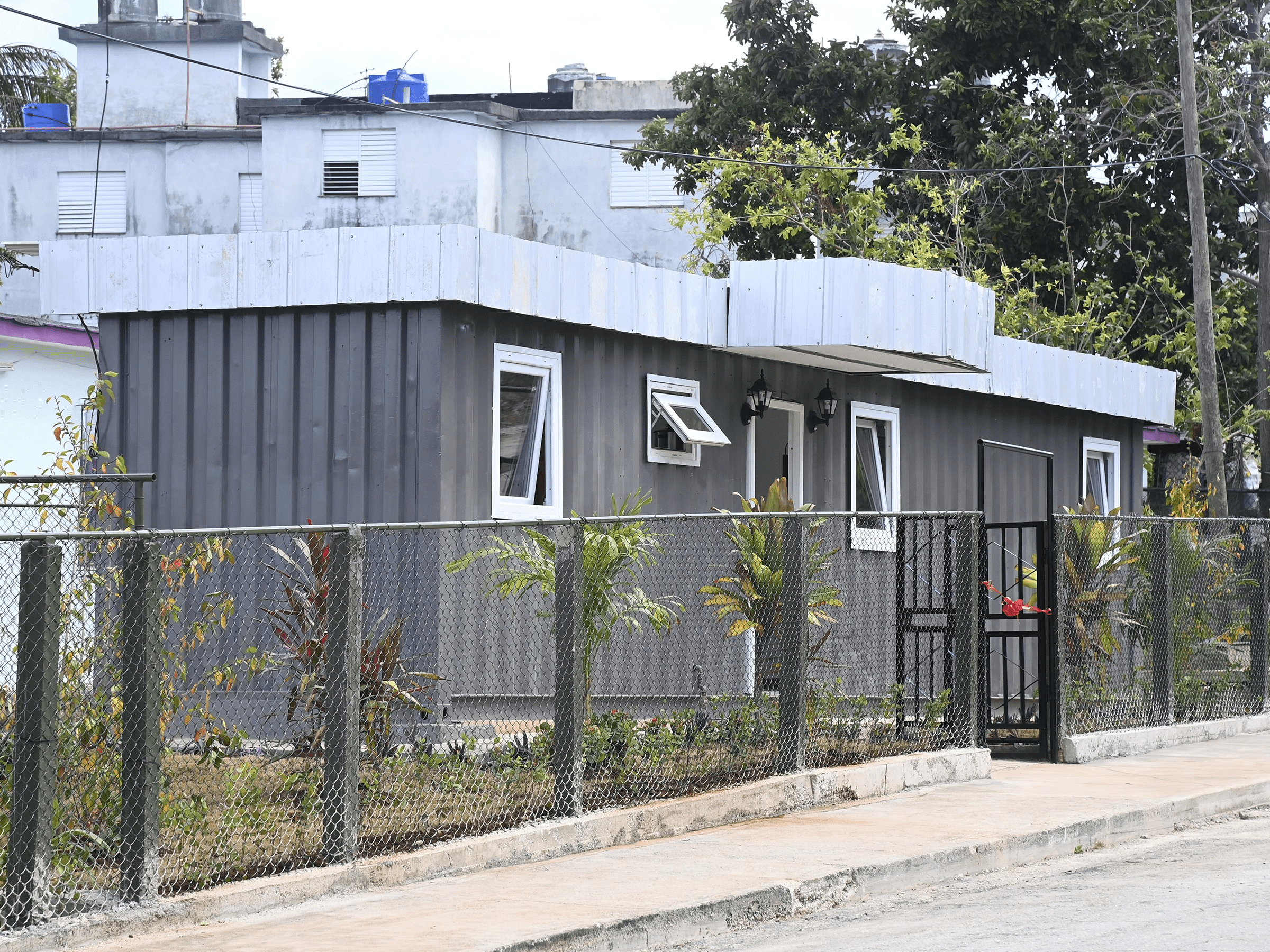
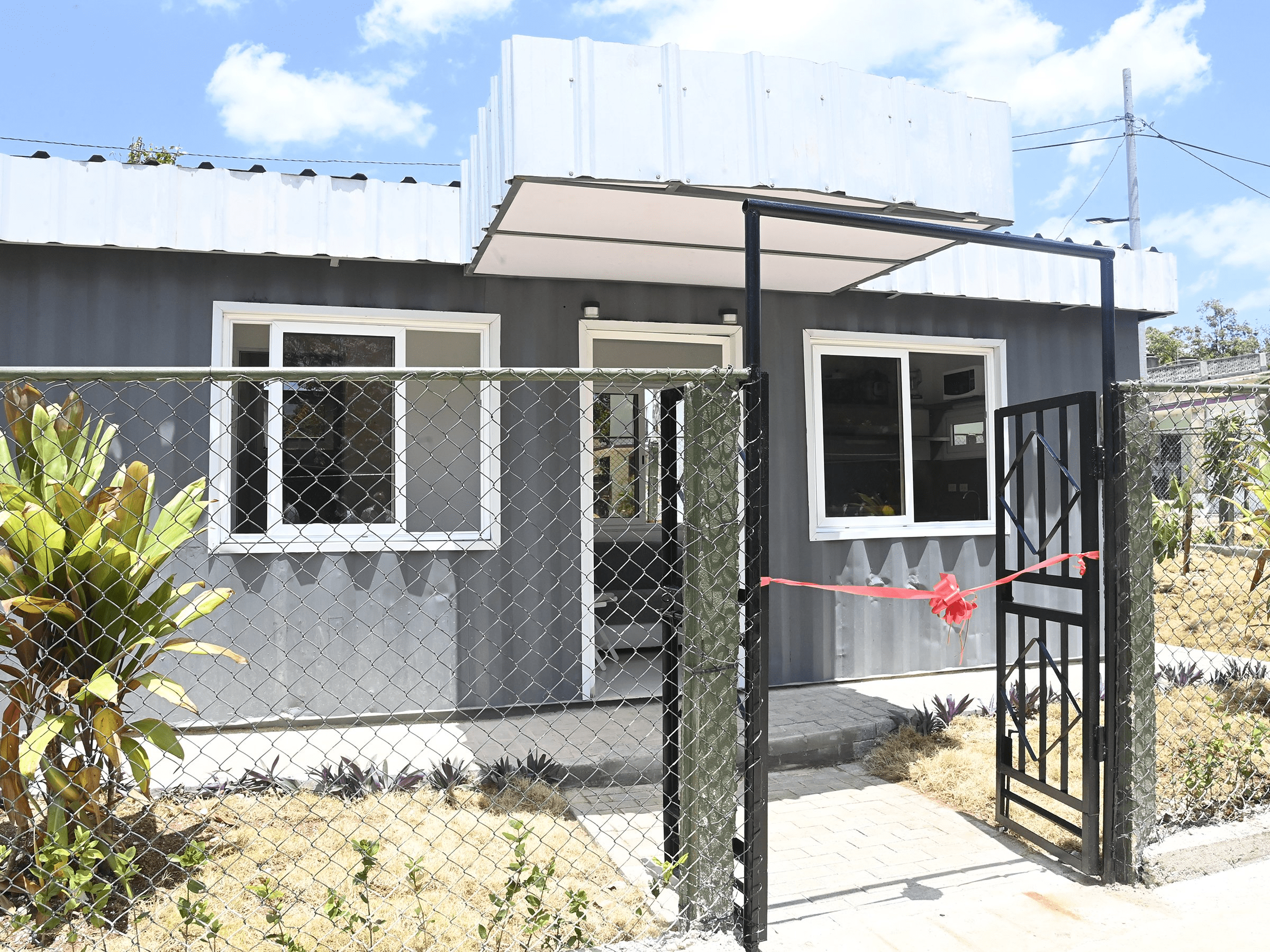
Both houses, one adjacent to the other, are different designs and equipped with different materials, in their construction were used remnants of investment processes from tourism and technologies developed by the Revolutionary Armed Forces, whose minister, Army Corps General Álvaro López Miera, also a member of the Political Bureau, supervised the completion of the works earlier.
In the simple ceremony, the head of the Government of the Republic, Manuel Marrero Cruz, recalled the genesis of the programme, triggered by suggestions from the Commander of the Revolution Ramiro Valdés Menéndez and which resulted in the reuse of the maritime containers in which the parts and pieces of the photovoltaic solar panel parks sent by the People’s Republic of China are imported.
The two modular homes delivered this Saturday are also a demonstration that these can be made with taste and aesthetics, integrate into the communities and the urban environment, contributing to their beautification, in addition to helping with induced works to the neighborhood and serving as a stimulus to women, many of them alone and in charge of their families.
The Prime Minister pondered the potential of the Modular Housing Programme from maritime containers of last use, although, he said, “it is not going at the speed that is wanted; it is being done, but it can be done faster,” he said.
Marrero Cruz said the homes, which were built in just a month, were built on a corner that, as Cubans say, “was almost lost,” but has now been revitalized by an urbanization that included benefits for the community, including the extension of gas service from the street to neighboring homes, gardening and planting fruit trees.
These two houses, he said, have broken with several myths about the use of maritime containers for the construction of houses in Cuba, a technology that is in international practice.
One of them is that although they are modest, small homes, they can be beautiful and comfortable; also, that they can be done within the cities without breaking the established rules; and third, that this is a viable policy.
The project and construction of these two homes, said Marreró Cruz, commits us and excites us to continue with this programme.
CONTAINERS ARE HERE TO STAY
In an aside with the press, comrade Delilah Díaz Fernández, general director of Housing of MICONS, commented that “the Program for the construction of modular homes from maritime containers of last use is a program that has been designing, developing and implementing the Cuban State, the Ministry of Construction and the General Directorate of Housing based on the potential offered by having this material that is generally an environmental problem, and the situation that our country has with the housing deficit, which amounts to around 806,000 homes.
“The maritime containers of last use,” the expert recalled, “are used throughout the world to transform them into homes. This is not our own initiative; there is a consolidated experience at the international level, and based on that experience and some specific developments that we had in different places, we decided to implement the program.”
Díaz Fernández reported that in the country there are already more than two thousand containers that will have this destination; Around 700 are currently being transformed into different workshops. It is a strategy, he added, where the main builder has been MICONS, although other entities have also intervened, including forms of non-state management.
The experiences in this development, said the director, include more than one hundred solutions designed by our Project Front, from the construction of buildings to thermal comfort, based on the temperatures that exist in the country at the times of greatest sunshine and in the hottest months.
The programme – reiterated the General Director of Housing of MICONS – is a potential and is here to stay. Thus, once we have consumed the total number of containers available today for this, which are more than eight thousand, we plan to continue it with others that arrive at our ports in the condition of last use.
Among the main beneficiaries of this programme, Díaz Fernández added, will be people who have lost their homes due to extreme weather events; girls and boys graduated from homes and homes for children, adolescents and young people without parental care; those who have lost their homes due to landslides, and people in vulnerable situations.
The expert pointed out that the programme conceives that the architectural layout of the homes obeys the structure of the family nucleus, for example, that the number of rooms is a function of what the family composition is like.
For the implementation of the strategy, he clarified, operation and maintenance manuals have also been developed, because although these are durable structures, like traditional houses they have paint every certain period of time, attention to the humidity that could arise due to the changes between the moments of higher and lower temperature, and other problems.
Spanish Language Text:
Dos jóvenes madres son las beneficiarias de las primeras casas modulares a partir de contenedores inauguradas en La Habana
- René Tamayo León
- 2 de Mayo de 2026
Asistió el Primer Secretario del Comité Central del Partido y Presidente de la República, Miguel Díaz-Canel Bermúdez, a la entrega de las dos primeras viviendas concluidas en la capital según la tecnología basada en contenedores marítimos. Participaron los miembros del Buró Político, Manuel Marrero Cruz, primer ministro; Roberto Morales Ojeda, secretario de Organización del Comité Central; el general de Cuerpo de Ejército Lázaro Alberto Álvarez Casas, ministro del Interior; y el general de División Amado Ricardo Guerra, secretario del Consejo de Ministros.
Asistió el Primer Secretario del Comité Central del Partido y Presidente de la República, Miguel Díaz-Canel Bermúdez, a la entrega de las dos primeras viviendas concluidas en la capital según la tecnología basada en contenedores marítimos. Participaron los miembros del Buró Político, Manuel Marrero Cruz, primer ministro; Roberto Morales Ojeda, secretario de Organización del Comité Central; el general de Cuerpo de Ejército Lázaro Alberto Álvarez Casas, ministro del Interior; y el general de División Amado Ricardo Guerra, secretario del Consejo de Ministros.
Alina y Nerelys, dos jóvenes trabajadoras, madres solteras y jefas de familia, fueron acreedoras la tarde de este sábado de las dos primeras casas concluidas en La Habana por el Programa de viviendas modulares a partir de contenedores marítimos de último uso, que se implementa en todo el país y que demuestran la viabilidad de esta alternativa para dar respuesta a corto plazo a las necesidades crecientes de vivienda de nuestro pueblo.
Alina Hinojosa Cardona es madre de dos adolescentes; vivían hasta ahora en un cuartico en mal estado y en condiciones de hacinamiento, situación que nunca la limitó para, además de educar y guiar a sus hijos con esmero, tener un destacado desempeño labor y liderar el comité de base de la UJC en su centro de trabajo, organización a la que ingresó desde los 14 años de edad.
Nerelys Madan Catalá, de oficio secretaria y que desde los 22 años se desempeñó como delegada de su circunscripción por dos mandatos, residía desde hacía más de 13 años en un albergue junto a numerosas familias; ahora dispone de un hogar confortable para el mayor bienestar de su niño y su anciana madre.
Las dos jóvenes agradecieron con pocas palabras y muchas lágrimas, por la emoción, la entrega de sus viviendas, ubicadas en Nuevo Vedado, a cuya inauguración asistió el Primer Secretario del Comité Central del Partido y Presidente de la República, Miguel Díaz-Canel Bermúdez, quien al final del sencillo acto fue al encuentro de vecinos de Nuevo Vedado que querían saludarlo y con quienes compartió las victoriosas jornadas protagonizadas por el pueblo cubano en estos días con la Marcha del Primero de Mayo y el movimiento masivo de Mi Firma por la Patria.
UN PROGRAMA QUE ENTUSIASMA
En la inauguración de las dos primeras viviendas modulares a partir de contenedores marítimos concluidas en La Habana, donde se hizo entrega de reconocimientos a las entidades ejecutoras, también participaron los miembros del Buró Político, Manuel Marrero Cruz, primer ministro; Roberto Morales Ojeda, secretario de Organización del Comité Central; el general de Cuerpo de Ejército Lázaro Alberto Álvarez Casas, ministro del Interior; y el general de División José Amado Ricardo Guerra, secretario del Consejo de Ministros, entre otras autoridades.
Ambas casas, una contigua a la otra, son diseños diferentes y habilitadas con materiales diferentes, en su construcción se utilizaron remanentes de procesos inversionistas del turismo y tecnologías desarrolladas por las Fuerzas Armadas Revolucionarias, cuyo ministro, el general de Cuerpo de Ejército Álvaro López Miera, también miembro del Buró Político, supervisó más temprano la terminación de las obras.
En la sencilla ceremonia, el jefe del Gobierno de la República, Manuel Marrero Cruz, recordó la génesis del programa, desencadenado por sugerencias del Comandante de la Revolución Ramiro Valdés Menéndez y que derivó en el reuso de los contenedores marítimos en los que se importan las partes y piezas de los parques de paneles solares fotovoltaicos enviados por la República Popular China.
Las dos viviendas modulares entregadas este sábado también son una demostración que estas pueden hacerse con gusto y estética, integrarse a las comunidades y el entorno urbano, contribuyendo a su embellecimiento, además de ayudar con obras inducidas al vecindario y servir de estímulo a mujeres, muchas de ellas solas y a cargo de sus familias.
El Primer Ministro ponderó las potencialidades del Programa de viviendas modulares a partir de contenedores marítimos de último uso, aunque –dijo— “no va a la velocidad que se quiere; se está haciendo, pero se puede realizar más rápido”, aseguró.
Marrero Cruz comentó que las viviendas, que se construyeron en apenas un mes, se levantaron en una esquina que, como dicen los cubanos, “estaba casi perdida”, pero que ahora ha sido revitalizada por una urbanización que incluyó beneficios para la comunidad, incluido la extensión del servicio de gas de la calle a casas vecinas, la jardinería y la siembra de árboles frutales.
Estas dos viviendas –expresó- han roto con varios mitos en torno al uso de contenedores marítimos para la construcción de viviendas en Cuba, una tecnología que es en una práctica internacional.
Uno de ellos es que si bien son hogares modestos, pequeños, pueden ser bellos y cómodos; también, que pueden hacerse dentro de las ciudades sin romper las normas establecidas; y tercero, que esta es una política viable.
El proyecto y construcción de estas dos viviendas –afirmó Marreró Cruz- nos compromete y entusiasma para seguir adelante con este programa.
LOS CONTENEDORES LLEGARON PARA QUEDARSE
En un aparte con la prensa, la compañera Delilah Díaz Fernández, directora general de la Vivienda del MICONS, comentó que “el Programa para la construcción de viviendas modulares a partir de contenedores marítimos de último uso es un programa que ha venido diseñando, desarrollando e implementando el Estado cubano, el Ministerio de la Construcción y la Dirección General de la Vivienda a partir de la potencialidad que ofrece contar con este material que generalmente es un problema medioambiental, y la situación que tiene nuestro país con el déficit habitacional, que asciende a alrededor de 806 000 viviendas.
“Los contenedores marítimos de último uso –recordó la experta- son utilizados en el mundo entero para transformarlos en viviendas. Esta no es una iniciativa propia; hay una experiencia consolidada a nivel internacional, y a partir de esa experiencia y algunos desarrollos puntuales que teníamos en diferentes lugares, decidimos implementar el programa”.
Díaz Fernández informó que en el país ya hay liberados más de dos mil contenedores que van a tener este destino; actualmente se están transformando alrededor de 700 en diferentes talleres. Es una estrategia –añadió— donde el principal constructor ha sido el MICONS, aunque también han intervenido otras entidades, incluido formas de gestión no estatal.
Las experiencias en este desarrollo –comentó la directiva- incluyen más de cien soluciones diseñadas por nuestro Frente de Proyectos, desde la construcción de edificios al confort térmico, a partir de las temperaturas que hay en el país en los momentos de mayor insolación y en los meses de mayor calor.
El programa –reiteró la Directora General de la Vivienda del MICONS- es toda una potencialidad y llegó para quedarse. Así una vez que hayamos consumido el total de contenedores disponibles hoy para esto, que son más de ocho mil, prevemos continuarlo con otros que arriben a nuestros puertos en condición de último uso.
Entre los principales beneficiarios de este programa –añadió Díaz Fernández- estarán personas que han perdido sus viviendas por eventos climáticos extremos; muchachas y muchachos egresados de las casas y hogares de niños, adolescentes y jóvenes sin cuidado parental; quienes han perdido su vivienda por derrumbes, y personas en situación de vulnerabilidad.
La experta señaló a propósito que el programa concibe que la disposición arquitectónica de las viviendas obedezca a la estructura del núcleo familiar, por ejemplo, que la cantidad de habitaciones esté en función de cómo sea la composición familiar.
Para la implementación de la estrategia también –aclaró— se han estado desarrollando manuales de explotación y mantenimiento, pues si bien estas son estructuras duraderas, al igual que las viviendas tradicionales llevan pintura cada determinado período de tiempo, la atención a las humedades que pudieran surgir por los cambios entre los momentos de mayor y menor temperatura, y otras problemáticas.

