Blogger’s Note: This finding is disturbing when you consider the hideous amounts of money thrown at this branch of science. Although this article is not specific – I suspect the ink contamination has come only from NASA samples and not from Soviet or Chinese equivalents. Remember, the US engaged in all kinds of lying and deception during the so-called “Cold War” designed to demonise Socialism and eulogise capitalism. There were false narratives all over the place – false stories involving “lost Cosmonauts”, Cosmonauts “seeing angels” and Chinese Cosmonauts “hearing knocking noises” in space (essentially State-sanctioned science fiction presented by the media as “fact”)! I have debunked all these stories (and many more) over the years all designed to “destabilise” the concept and theory of Socialism in the Western mind (the Soviets and Chinese – by and large – remained blissfully unaware of these racist tropes). Even outside the world of false narratives there are incredibly embarassing stories – such as the 2009 “Moon samples made of wood” – given to the Dutch government by the US!
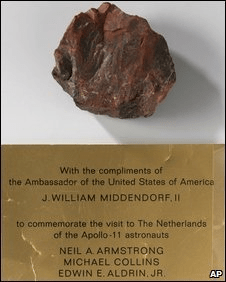
‘A treasured piece at the Dutch national museum – a supposed moon rock from the first manned lunar landing – is nothing more than petrified wood, curators say. It was given to former Prime Minister Willem Drees during a goodwill tour by the three Apollo-11 astronauts shortly after their moon mission in 1969. When Mr Drees died, the rock went on display at the Amsterdam museum. At one point it was insured for around $500,000 (£308,000), but tests have proved it was not the genuine article. The Rijksmuseum, which is perhaps better known for paintings by artists such as Rembrandt, says it will keep the piece as a curiosity. “It’s a good story, with some questions that are still unanswered,” Xandra van Gelder, who oversaw the investigation that proved the piece was a fake, was quoted as saying by the Associated Press news agency. “We can laugh about it.” The “rock” had originally been been vetted through a phone call to Nasa, she added. The US agency gave moon rocks to more than 100 countries following lunar missions in the 1970s. US officials said they had no explanation for the Dutch discovery.’
The US has been “faking” space data for decades so I am not surprised to learn that genuine Mars rock samples contain ballpoint ink pollution. I think we had more effective cleanliness protocols during our science experiments at school! ACW (18.4.2026)
Published on April 16, 2026 at 12:15|

Written by Lydia Amazouz|
Scientists Analyzed Martian Meteorites and Uncovered Materials No One Ever Expected
A surprising discovery in Martian meteorites raises questions about contamination in space research.
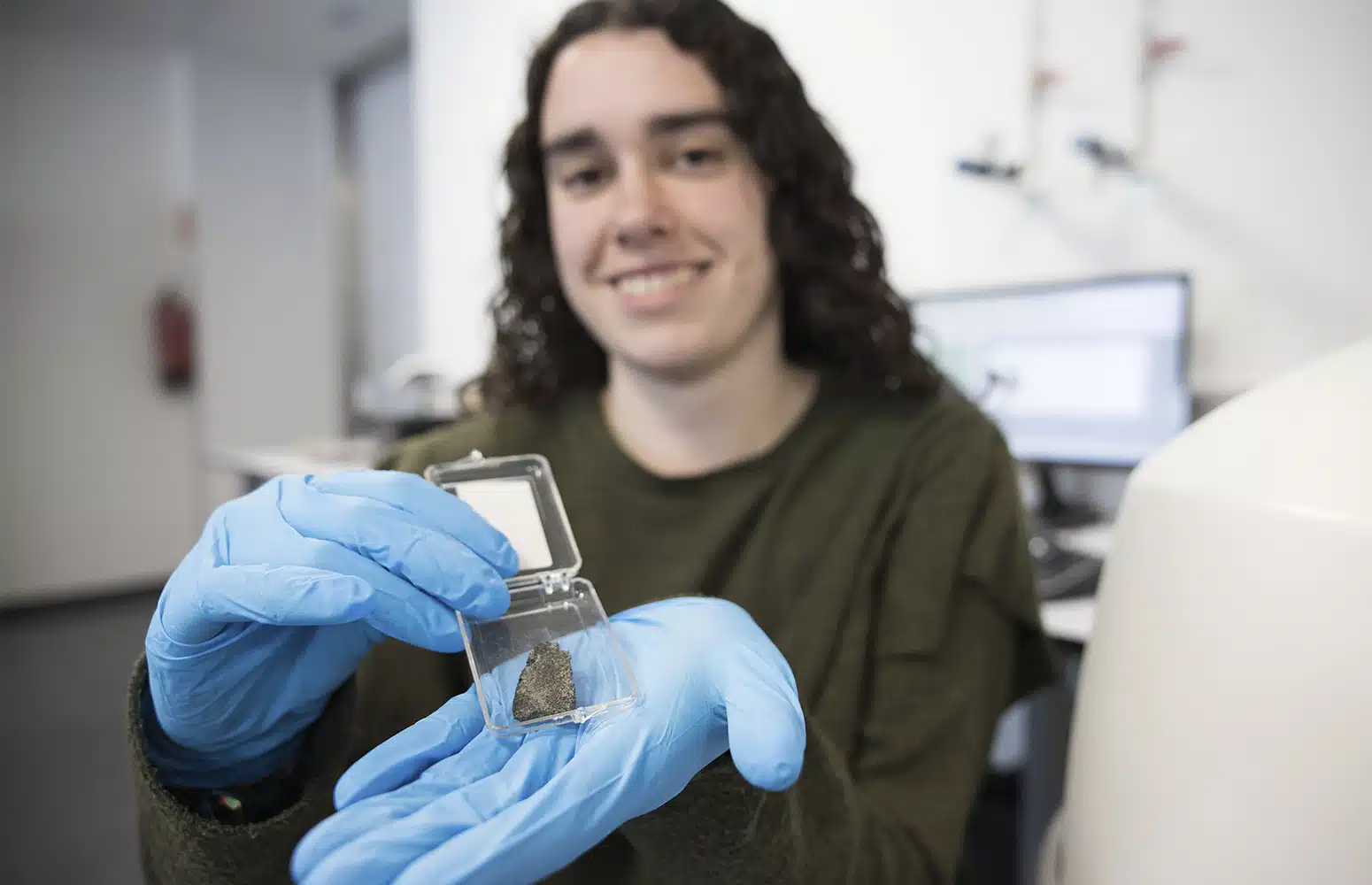
Scientists found traces of ink from ballpoint pens in Martian meteorites, an unexpected contamination that raises significant questions about sample preparation in planetary research. Published in Applied Geochemistry, the study by the University of the Basque Country highlights the unanticipated consequences of handling and processing extraterrestrial materials, a challenge that has profound implications for the integrity of future space missions. This revelation points to the need for a more refined approach to planetary sample handling, as contamination could obscure the very answers researchers seek from these precious samples from Mars.
The Mystery of Mars: Ballpoint Pen Ink Found in Meteorites
Meteorites from Mars are incredibly rare, offering scientists a once-in-a-lifetime opportunity to study the red planet’s makeup. However, the pristine nature of these extraterrestrial materials is often compromised during their preparation for analysis on Earth. In the most recent study, scientists made an alarming discovery: traces of ink from ballpoint pens were found in the samples they were studying. This contamination came not from Mars, but from the very process used to handle and prepare these meteorites for research.
Researchers from the University of the Basque Country analyzed six slices of post-processed Martian meteorites collected between 2001 and 2014. These samples had gone through various preparation techniques, including ultrasonic cleaning and cutting with diamond saws, designed to remove the outer crust and expose the interior for analysis. Despite these precautions, the study found that contaminants, including ink, were still present. “As planetary sample return missions continue to advance, the challenge of designing contamination-aware preparation protocols becomes increasingly important,” the team noted in the paper. This discovery underscores the complexities of handling such rare materials and calls for a more standardized and contamination-aware approach to their preparation.
The Process of Sample Preparation: A Delicate Balance
One of the most challenging aspects of planetary sample analysis is the preparation of extraterrestrial materials once they arrive on Earth. The act of bringing space rocks back to Earth already changes their composition.
‘When [rock samples] pass through the Earth’s atmosphere… They undergo changes—usually caused by high temperatures and pressures—which generally result in a sort of crust forming on them,” explained Leire Coloma, one of the study’s co-authors and an analytical chemist.’
Leire Coloma, PhD Student at the EHU-University of the Basque Country
This alteration creates a crust that complicates the determination of the original mineralogical composition of the meteorite. Removing this outer layer is essential, but as this study highlights, it is not always a straightforward process.
The team used Raman spectroscopy, a technique commonly employed to study the chemical composition of objects, to identify various contaminants. Among these were copper compounds, synthetic organic molecules used in inks for ballpoint pens and gel pens, and blue polyester, likely from textiles. These contaminants raise a crucial question: how much of the Martian rock’s natural composition is truly represented in these samples? The presence of such human-made materials suggests that, despite rigorous efforts to prevent contamination, these meteorites are far from untouched by Earthly influence.
The Importance of Contamination Control in Space Research
The findings also emphasize the importance of refining contamination control measures for future space missions, especially as NASA’s Perseverance rover continues to collect and send back Martian samples. The study’s authors suggest that contamination-aware protocols should be established and standardized across all laboratories analyzing extraterrestrial samples. “The lack of standardized, contamination-aware preparation protocols underscores the difficulties faced by researchers,” the study elaborates. The researchers are not only focused on identifying these contaminants but also on improving techniques to prevent them in the future.
NASA, along with other space agencies, has worked tirelessly to minimize contamination during planetary sample collection and preparation. However, this study shows that even the most meticulous efforts may not be enough. The risk of contamination is always present, whether from handling or from the preparation tools themselves. The ink found in these meteorites might seem trivial, but it highlights the inherent challenges in working with materials that come from another planet. Ensuring that future analyses are as uncontaminated as possible is vital for the accuracy of the findings.
 SANGHA KOMMUNE (SSR)