Blogger’s Note: When China successfully landed a probe on the dark-side of the Moon during early 2019 (during Trump’s first term) – Trump ordered that billions of dollars be diverted to the Israeli and Indian space projects – tasking these anti-China entities with the task of also landing probes on the Moon (designed to give the false impression that the capitalist world can equal the Socialist world in scientific endeavour). Not only was US money supplied – but also US technological advice. These projects were rushed – and given how dangerous and unpredictable space travel is – there can be no short-cuts. There must be a steady and continuous (material) scientific advance toward the desired goal. The Soviets abandoned their Moon-shot because the danger to the cosmonauts was too high. Will, in 2019, both the Israeli and Indian probes crashed on impact – destroying all the equipment and completely failing in their Trump-inspired anti-China mission (at that time the head of Huawai was being falsely held for Trump by the Canadian government). ACW (28.2.2026)
China to accelerate lunar mission plans this year
China Daily 2026-02-28 13:09:06 13.4万
China is advancing toward its goal of sending a manned mission to the moon by around 2030, with the pace of construction of major related infrastructure set to accelerate this year, the China Manned Space Agency said in a news release on Friday.
“In 2026, full efforts will be made to push forward the construction of facilities and equipment required for lunar landing missions at the Wenchang Space Launch Centre in Hainan province, as well as the building of other ground support systems such as telemetry, tracking, command, communications and the landing site,” the agency said.
It added that the development of major flight vehicles, including the Long March 10 heavy-lift carrier rocket, the Mengzhou crew spacecraft and the Lanyue lunar lander, is progressing smoothly.
A series of critical tests have been completed, including the pad abort and maximum dynamic pressure escape flight tests for the Mengzhou, the landing and take-off tests for the Lanyue, and the static ignition and low-altitude flight tests for the Long March 10, the agency said.
Once realized, China’s manned lunar programme will make the country the second nation to land astronauts on the moon, significantly boosting its global space standing. The United States successfully sent six crewed missions in the 1960s and 1970s, putting 12 US astronauts on the moon.
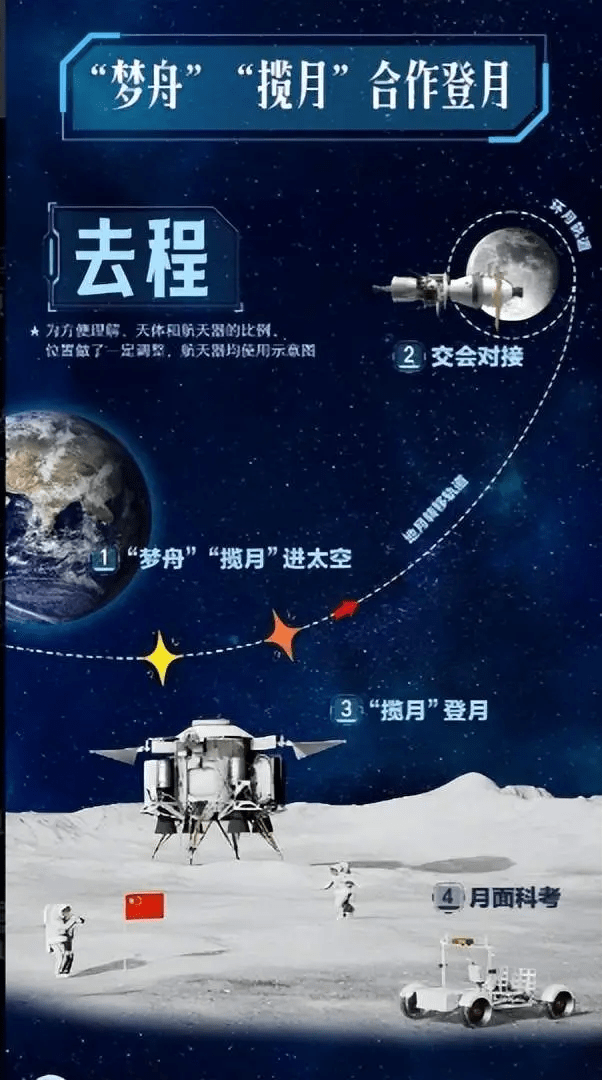
China’s road-map for its first manned lunar expedition involves two Long March 10 launches from the Wenchang spaceport to transport a Lanyue lunar lander and a Mengzhou manned spacecraft to the lunar orbit. After reaching their pre-set orbital positions, the Lanyue lander and the Mengzhou vessel will rendezvous and dock. Two crew members will enter the lander, which will then undock and descend toward the lunar surface for an engine-assisted soft landing.
On the moon, the cosmonauts will drive a Tansuo rover to carry out scientific tasks and collect samples. Upon completion of their assignments, they will return to the Lanyue module, which will fly them back to their spaceship waiting in the lunar orbit. In the final stage, the cosmonauts will carry the samples into the Mengzhou spacecraft, which will then undock and carry the crew back to Earth.
In a separate development, the agency said cosmonauts selected from the Hong Kong and Macao special administrative regions were highly likely to embark on their first spaceflight this year. The nation plans to carry out two manned spaceflights and a cargo mission to its Tiangong space station in 2026.
China selected the country’s fourth generation of cosmonauts in June 2024, recruiting 10 new members — eight spacecraft pilots and two science payload specialists. Both payload specialists were chosen from among applicants from Hong Kong and Macao. This is the first time that anyone from the two special administrative regions has had the opportunity to join the nation’s cosmonauts team.
 SANGHA KOMMUNE (SSR)