Translator’s Note: In many ways, it is Cuba that maintains a pure interpretation of the 1917 Russian Revolution – despite the unjust economic embargo inflicted by Kennedy and maintained by every President since – in as much as healthcare is delivered free of charge at the point of use. Having been brought up in the Socialist NHS in the UK (established in 1948) – free health delivered free at the point of use is normal, civilised, and logical. It is paid for through collective taxation as a form of universal health insurance, and works because the majority of the population is not ill at any given time – and finance the small percentage that are (even in times of mass illness – so mush unused money is available that treatment is available with no shortage. In poor – or undeveloped countries – this balance of finance might not be so readily available, meaning that these countries should be allowed and assisted to grow). As we got older, when we are injured, or made disabled, the care is equally in-place. With the spread of a US controlled internet – our children in Europe are being “groomed” (brainwashed) to think a priori that free medicine is wrong, that death through medical neglect is natural, and that debilitating debt is morally preferable to possessing a collective peace of mind. What Trump II is doing in the world is pure evil and particularly so against Cuba – but killing the children of other nations is a classic hallmark of US neo-imperialism. Finally, having studied Cuban history, I notice that many Cuban citizens possess “Chinese” surnames. This is a product of Chinese (male) migrants mixing with the local population and passing on their surnames to their South American population. Indeed, the doctor mentioned in this article is surnamed “Chang” – which is probably written as “張”. Socialist Cuba is a gem and needs protecting and securing against the tide of US neo-imperialism. Indeed, when Russia and the Soviet-Communist countries abandoned Cuba post-1991, many of us of working-age in the West contributed small monthly amounts of finance to the Cuban State. ACW (8.2.2026)
by MINSAP Editorial Team · 5 February 2026 – Written by Redacción MINSAP
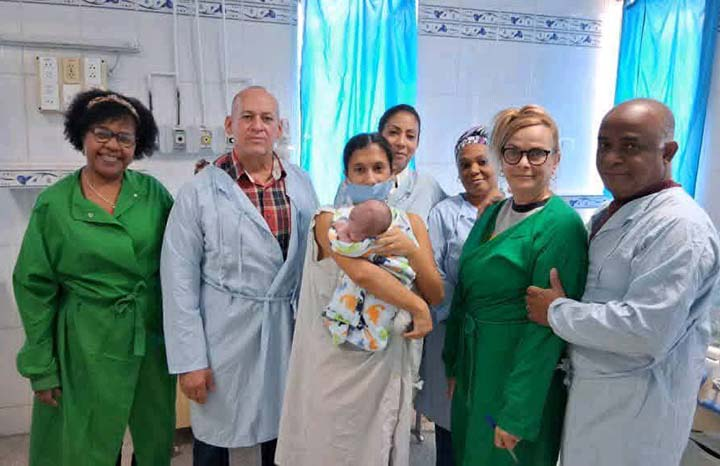
Mateo’s story is not just another statistic in the fight against the reduction of infant mortality in Villa Clara, but the first sound of a cry from the municipality of Remedios, the trembling caress of first-time parents and the dim light of an intensive care room where life, as fragile as a thread, it was sustained for 15 days by the unwavering will and professionalism of a medical team.
This new-born, who came into the world with oesophageal atresia, became, without knowing it, a symbol of resistance in the face of one of the most unequal battles: that of preserving children’s health in Cuba despite the material shortages also resulting from the economic siege that the United States government tries to intensify every day against Cuba.
Dr. Yandry Alfonso Chang, director of Medical Assistance and Medicines in the territory, reflects on this case with a mixture of professional pride and citizen concern.
“Every child we save, like Mateo, is a victory of the human principle that guides our medicine,” but behind every incubator, every ventilation equipment, there is another silent struggle against a blockage that deliberately seeks to suffocate us and deprive us of the essentials.”
The story of the doctors at the José Luis Miranda Provincial Paediatric Hospital is that of a daily triumph against adverse odds.
In front of Mateo, anaesthesiologists, surgeons, neonatologists and nurses joined in a perfect choreography of knowledge and dedication; What in any other place would have meant an unattainable bill for a humble family, here was a right exercised: complex neonatal surgery, mechanical ventilation, parenteral nutrition and 24-hour surveillance, at no cost.
However, that “no cost” contains a bitter truth: it is the result of a titanic effort by the Cuban State to sustain what is free while navigating against a tide of prohibitions.
The intensification of the blockade policy, materialized in new executive orders of the U.S. administration, acts like a virus that infects every link in the health chain on the island.
“When we talk about the blockade, we are not talking about a political abstraction,” Alfonso Chang stresses, “we are talking about the fact that 90 percent of our transactions to buy medicines or spare parts are rejected by the international banking system for fear of fines from the United States.”
According to the specialist, it is that a company that manufactures a special food or a heart valve for a new-born can refuse to sell to Cuba, not for lack of ability to pay, but for fear of extraterritorial reprisals; The impact of the blockade is tangible and multifaceted.
In the area of medicines, the acquisition of essential drugs, laboratory reagents and disposable material is restricted and extremely expensive; while in the technological sphere, the renewal and maintenance of high-tech equipment such as neonatal ventilators, multiparameter monitors or imaging equipment are severely hindered.
Likewise, in the infrastructural area, vital hospital repair and modernization projects, such as the one undertaken at the Mariana Grajales Gynaecological-Obstetric Hospital, encounter enormous difficulties in accessing construction materials, spare parts and modern hospital technology.
“Mateo was able to be discharged thanks to the expertise of our professionals and the resilience of our system,” concludes the official, “but every Mateo who comes after deserves the same opportunities, and for that we need the measures that seek to cause hunger and desperation to cease, as recognized in a memorandum from the United States government itself decades ago.”
The story of this baby, who today sleeps at home in the arms of his parents, is a hymn to life; But it is also an urgent reminder that the greatest threat to the health of Cuban children is not in a hospital room, but in the offices where a genocidal policy is designed, just 90 miles away, that does not distinguish between governments and newborns.
Author: Y. Crecencio Galañena León/ ACN
Spanish Language Text:
Mateo: un himno a la vida en medio de la adversidad
por Redacción MINSAP · 5 febrero 2026
Written by Redacción MINSAP
La historia de Mateo no es una estadística más en la lucha contra la reducción de la mortalidad infantil en Villa Clara, sino el sonido primero de un llanto desde el municipio de Remedios, la caricia temblorosa de unos padres primerizos y la luz tenue de una sala de cuidados intensivos donde la vida, tan frágil como un hilo, se sostuvo durante 15 días por la voluntad inquebrantable y la profesionalidad de un equipo médico.
Este recién nacido, que llegó al mundo con una atresia esofágica, se convirtió, sin saberlo, en un símbolo de resistencia frente a una de las batallas más desiguales: la de preservar la salud infantil en Cuba a pesar de las carencias materiales también resultantes del cerco económico que el gobierno de los Estados Unidos cada día intenta recrudecer más contra Cuba.
El doctor Yandry Alfonso Chang, director de Asistencia Médica y Medicamentos en el territorio, reflexiona sobre este caso con una mezcla de orgullo profesional y preocupación ciudadana.
“Cada niño que salvamos, como Mateo, es una victoria del principio humano que guía nuestra medicina”, pero detrás de cada incubadora, de cada equipo de ventilación, hay otra lucha silenciosa contra un bloqueo que busca, deliberadamente, asfixiarnos y privarnos de lo esencial”.
El relato de los médicos del Hospital Pediátrico Provincial José Luis Miranda es el de un triunfo cotidiano contra pronósticos adversos.
Frente a Mateo se unieron anestesiólogos, cirujanos, neonatólogos y enfermeras en una coreografía perfecta de conocimiento y dedicación; lo que en cualquier otro lugar hubiera significado una factura inalcanzable para una familia humilde, aquí fue un derecho ejercido: cirugía neonatal compleja, ventilación mecánica, nutrición parenteral y vigilancia las 24 horas, sin costo alguno.
Sin embargo, ese “sin costo” encierra una verdad amarga: es el resultado de un esfuerzo titánico del Estado cubano por sostener lo gratuito mientras navega contra una marea de prohibiciones.
El recrudecimiento de la política de bloqueo, materializado en nuevas órdenes ejecutivas de la administración estadounidense, actúa como un virus que infecta cada eslabón de la cadena de la salud en la isla.
“Cuando hablamos del bloqueo, no hablamos de una abstracción política”, subraya Alfonso Chang, “hablamos de que el 90 por ciento de nuestras transacciones para comprar medicamentos o repuestos son rechazadas por el sistema bancario internacional por miedo a las multas de Estados Unidos”.
Según el especialista, se trata de que una empresa fabricante de un alimento especial o de una válvula cardíaca para un recién nacido puede negarse a vender a Cuba, no por falta de capacidad de pago, sino por el temor a represalias extraterritoriales; el impacto del bloqueo es tangible y multifacético.
En materia de medicamentos, se restringe y encarece hasta lo extremo la adquisición de fármacos esenciales, reactivos de laboratorio y material desechable; mientras que en la esfera tecnológica, la renovación y el mantenimiento de equipos de alta tecnología como ventiladores neonatales, monitores multiparamétricos o equipos de imagenología se ven severamente obstaculizados.
Asimismo, en lo infraestructural, proyectos vitales de reparación y modernización de hospitales, como el emprendido en el Hospital Gineco-Obstétrico Mariana Grajales, encuentran enormes dificultades para acceder a materiales de construcción, piezas de repuesto y tecnología hospitalaria moderna.
“Mateo pudo ser dado de alta gracias a la pericia de nuestros profesionales y a la resiliencia de nuestro sistema”, concluye el funcionario, “pero cada Mateo que viene detrás merece las mismas oportunidades, y para eso necesitamos que cesen las medidas que buscan provocar hambre y desesperación, como reconoció un memorándum del propio gobierno de Estados Unidos hace décadas”.
La historia de este bebé, que hoy duerme en casa entre los brazos de sus padres, es un himno a la vida; pero también es un recordatorio urgente de que la mayor amenaza para la salud de los niños cubanos no está en una sala de hospital, sino en los despachos donde se diseña, tan solo a 90 millas, una política genocida que no distingue entre gobiernos y recién nacidos.
Autor: Y. Crecencio Galañena León/ ACN
 SANGHA KOMMUNE (SSR)