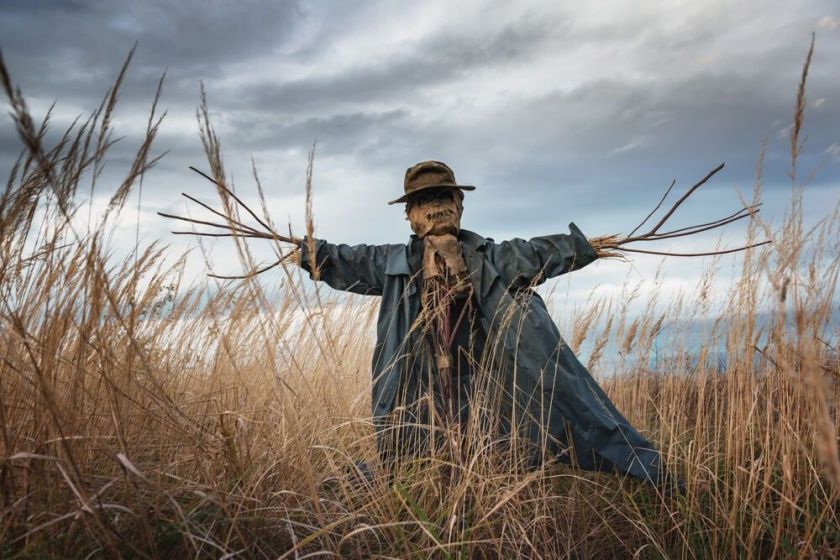

What follows are a number of academic notes I have made regarding the assumed history and cultural associations surrounding “Scarecrows” – which are still very prevalent within UK culture. If you live outside the UK, the books regarding “Worzel Gummidge” written by Barbara Euphan Todd – and immortalised on film by Jon Pertwee and Mackenzie Crook. There is definitely something “over-worldly” about Scarecrows and deeply spiritual. It is interesting that they are mounted upon a “cross”. Of course, the earliest Christian symbols were two fishes (often dolphins), a star, and a dove. The “cross” far out-dates Christian usage and was in Europe (as the Celtic Cross” and the Anglo-Saxon Cross” a long time before the arrival of Christianity). Indeed, nailing individuals to cross-beams was a practice in the ancient world probably long before the Jewish religion existed. Dionysus (c. 13th century BCEJ), for instance, is often depicted as being crucified and is linked to rebirth, etc. Furthermore, not all “crosses” are the same, the earliest I have seen in the UK – within the Shrine Room of a Roman Villa (c. 3th-4th century CE) is the “X” with a “P” in the middle – the so-called “☧” (Chi-Rho symbol) – portraying in the Greek language the first two letters of the name of “Christ” (Χριστός) – rather than a “crucifixion”. A “cross”, therefore, could well be a pagan symbol denoting the “four seasons” – a concept vitally important for the farmer.
British Scarecrows date from the 1300s – when the plague killed millions – causing people to stay in-doors and abandon the fields and open spaces. It is uncertain at the present time – whether any other type of field effigy existed prior to this time – as nothing observable has been recorded in writing. It may be that further research will fill-in this void at a latter date. Some type of farming had to continue during the plague, however, and basic crops had to be planted, grown, and then harvested. Prior to the plague, children were used to drive birds away from crops. Although Scarecrows are used to scare crows, the clever birds do not fall for such tricks and eat a small portion of the crop. The Scarecrow is often associated with far-older pagan (or natural) idols used to reference Fertility Gods or Nature Spirits. In Greece, an early version was constructed in honour of Priapus, whilst in Germany such effigies represent the Spirit of the Field. The Saxon Goddess “Frau Harke”, for instance, is depicted as a Scarecrow during festive times. Scarecrows are also associated with gods such as “Wodan”, a Corn God (broadly connected with the Norse god “Odin”). The Dutch Folklore of Pennsylvania records the “Butzemann” – a Scarecrow that has been given the “breath of life” (Greek: “Psyche”) and which protects the fields. He is “born” on Groundhog Day and “dies” on Halloween – in case his animating “Plant Spirit” be plucked-out by the Wild Hunt – and a more mischievous “Nature Spirit” be allowed to enter the Scarecrow body.
Obviously, British Scarecrows as we have them today, are not as old as the Nature Spirits associated with them (there may have been older “different” versions we know nothing about as yet). This may be due to the Celtic traditions developing within heavily forested areas prior to the arrival of the Romans – who cleared trees to build their straight roads. Romans also cleared forested areas to create farming fields – so open fields were “foreign” to the British Celts. The Druids are reported as detesting the Roman habit of destroying the sacred woods (the Druids and their Celtic Army were finally beaten by the Romans at the Battle of Anglesey circa 60 CE – the last time “magic” was known to have been used on a British battlefield). During these times, crops were planted within the safety of the forested-canopy – where the Gods of Fertility operated more or less unaffected by the wild birds. Wide, open fields were not yet accepted as “British”. It might have even been the case that Celtic farmers came to some arrangement with the wild birds – setting aside some food for them so that everyone got on without conflict. There was 800-years between the Romans (5th century CE) leaving and the plague creating the conditions that led to the development of the modern British Scarecrow (14th century CE).
 SANGHA KOMMUNE (SSR)