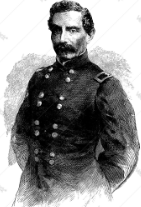
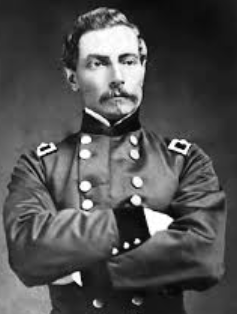
When the Army of the Confederate States of America (CSA) decisively defeated the invading Army of the United States of America (USA) at the First Battle of Manassas (Bull Run) in Virginia – thousands of ordinary citizens came out onto the streets of Washington (the capital city of the Union (USA) celebrating the Confederate victory and calling for the dismissal of the Lincoln Government with the arrest of Abraham Lincoln for “Treason” (as he had “Abolished” the 1776 “Right” of ALL States in the USA to “Secede” in 1861 – thus causing the rift between North and South and threatening the “Secessionists” with military action for exercising what had been their “Legal Right”). Confederate battle flags were hoisted by local citizens of Washington all over the city – even as the tens of thousands of badly shaken Union soldiers streamed in – many starving, ill-clothed and ill-shod. All had been thoroughly beaten by the expert military strategy of the Confederacy led by the transplanted Welshman – Jefferson Davis – the President of the Confederacy. This battle was masterminded by General P. G. T. Beauregard – who was of Welsh, French, and Italian extraction.
Indeed, many of his aunts and uncles were White people who had inter-married with Black, Mexican, and Native American partners. Indeed, whilst serving in the US Army prior to the war – P. G. T. Beauregard – his advancement was blighted by the fact that the US Military Authorities purposely discriminated against him on the grounds that he was “Not Trustworthy” – as he was the product of a family that deliberately “Race-Mixed”. This judgement kept him out of West Point as a Teacher (he had trained there in his youth – but was not permitted to pursue a substantive career in that institute) – until he was mistakenly posted as an “Instructor” at this College of Officer-Training in the US during 1861 (just prior to the breakout of hostilities). His appointment lasted just one-day until the mistake was realised by a Union pen-pusher. P. G. T. Beauregard was immediately removed on the grounds that the US does not allow any but “pure-raced” individuals exercising direct influence over the developing generations of US Military Officers. Indeed, the US Authorities applied this judgement by continuously referring to P. G. T. Beauregard as a “Creole” – implying that he was psychologically and physically “inferior” due to “race-mixing”.
How ironic it is that the US mythmaking machine has presented (the openly racist) Lincoln as the hero of this story – when he was nothing but an opportunistic “Dictator” who oversaw the wholesale invasion of the US by European “Federalism” – the very oppressive political ideology the American people had decisively rejected in the Revolution of 1776. When the seven Secessionist States quietly met in Montgomery (Alabama) in early 1861 (February-May) – the first capital city of the Confederate States of America (CSA) – the purpose was to establish a “peaceful” separation from the now alien US. At least half of those States present were committed to “pacifist” policies – but the warmonger Lincoln would have none of it. When it became clear that Lincoln was recruiting and training a massive migrant army of 75,000 to “invade” the South (comprised of groups of disparate men speaking diverse languages – who had arrived on boats from all over the world in New York as citizenship was guaranteed through Military Service) – the Confederate capital was moved to Richmond – as this was not only one of the most advanced and progressive cities in the world at this time, but it was easier to militarily defend.
When Jefferson Davis (and General Robert E Lee) put-out the request for the men of the South to rally around a New Flag defending the Old Revolution (the US was viewed as a compromised area of North America – now controlled by the “Federalist” Europeans) – hundreds of thousands of farming boys, scholars, tradesmen, fishermen, teachers and even poets answered the call. Around half of the Officers and NCOs already serving in the US Military promptly changed sides. The “Stars and Bars” smoothly replaced the “Star and Stripes” – as Black, Native American Indian, and Chinese people volunteered alongside the Irish indentured labourers to form very brave Regiments serving in the Confederate Army – all granted either “Freedom” or at least an enhanced social standing. Many Southerners had nothing to do with Slavery – with groups of White and non-White people treated like slaves by the US System that had been previously functioning. Lincoln was well-aware that many of the cotton plantations that peppered the South were comprised of land owned by the very same wealthy landowners who lived in the North – and contributed substantial sums of money to the Republican Party (and Lincoln’s campaign). Lincoln had to manoeuvre these individuals onboard in the North – before he could launch his policy of officially persecuting the 3% of Southern landowners who possessed slaves. Perhaps the greatest Black contribution for the Confederacy can be seen in the defence of Vicksburg.
The progressive (industrial) capitalist system of the North was driven by international commerce and a continuous flow of unbridled migration by Europeans (and some other groups – particularly the Chinese). As the landmass of the US was substantial – endless immigration was viewed as essential at the time – so that the Native American Indians could be disinvested, sidelined, and wiped-out as competing power-mongers (Marx and Engels discuss how the settling of the Americas – North, Central, and South – empowered the Bourgeoisie and ensured its survival and dominance in the “Communist Manifesto”). As there was nowhere near enough (White) Europeans to fulfil this task, the White settlers resorted to the odious practice of “Enslaving” men, women, and children from Africa. The issue of slavery cannot be ignored – but neither should it be inflated – so as to obscure other (equally important) contributing issues and factors. The Southern States reject an aggressive European-style industrialisation and preferred instead to retain their system of (genteel) Agrarian Capitalism (the very stage of development that existed in Czarist Russia in 1917 – during the Bolshevik Revolution). Given time, slavery was already ending in the South and on its way out, whilst its population would have undoubtedly developed its own form of modern capitalism, albeit one distinct and separate from the North that was not forced upon it by the North.
When Lincoln provoked the hostilities that comprise the American Civil Way, no one was aware of how long the war would last, or if the matter could be resolved by a single battle. The South could not compete overtime with the North with regards to the importation of manpower (the North could muster three million men at any one time as opposed to the South’s one million) or in industrial output (individual States in the North possessed more productive wealth than the entirety of the South combined). As the North used its Navy to blockade the South – this finite amount of resources was exasperated. How could the South prevail? The idea was that if Great Britain and France “Recognised” the CSA – then the USA would be crushed by the forces of history. The British Royal Navy and French Republican Navy would have easily destroyed the US Navy and freed the coasts of the CSA to benefit from an unbounded trade and assistance from its allies. Even with the US embargo – the UK continuously sent fire-arms and ammunition (as well as medicine, clothing and other supplies) via various forms of illicit shipping to the CSA – running the blockade. As the Confederacy was dialectically progressive, its inspired engineers developed “Iron-clad” warships – and even designed and built a working “Submarine”.
The UK intended, following the diplomatic recognition of the Confederacy, to send a vast British Field Army from Canada southward into the Northern States. The British Army would have destroyed the US Army and linked-up with a triumphant (Northward) advancing Confederate Army. One (single) battle could have triggered all this victory – and this is why the Confederacy fought hard and fought on- despite the intense suffering warfare visited on its soldiers and its civilian population. The Battle of Manassas (First Bull Run) was the product of substantive skirmishing over many weeks – that culminated in a decisive battle fought on July 21st, 1861. Robert E Lee, together with P. G. T. Beauregard (the victim of US Army racism), worked-out that two decisive reactions had to occur if an invading US Army was to be checked and pushed-out of Confederate territory. The superiority in numbers enjoyed by the Union could only be successfully countered through the necessity of ALL available Confederate Armies converging upon the single (greatest) point of military need. The principle of an aggressive-defence would be applied – meaning that all Confederate formations would be required to go on the offensive at the first point of contact.
To aid this fighting spirit, the “Rebel Yell” was developed (designed to psychologically “disturb” the mind-set of Lincoln’s troops, many of which did not speak English), as was the (British) reliance upon the use of the bayonet (this hid the lack of ammunition). Indeed, Lincoln declared that the British influence seen in the Confederate Army (through the spirited-use of the bayonet) constituted nothing less than the propagation of “terrorism”! Be that as it may, this Confederate aggression was not meant to be permanent (unless the Union troops folded-in). In the months leading up to the Union invasion of Manassas, P. G. T. Beauregard had designed a “defence in strength” strategy which saw Confederate engineers, miners, and workmen of every kind (including free and enslaved Black men – some of them soldiers in the CSA Army) constructing many layers of substantive defensive obstacles, redoubts, trenches, kill-zones, tunnels, inverse slopes, walls, pits, and all kinds of cleverly camouflaged sniping areas!
Although specially trained Confederate Army Units were given to hold each specific area of these defensive zones – the entire strategy relied upon the arriving CSA Army Units pushing forward far beyond the defensive zones – before systematically “retreating” in good order and taking up positions in the prepared defensive structures. The arriving CSA Army Units would weaken the frontlines of the US Army – and then deliberately “disengage” and fall-back to prepared – and already manned defensive positions. The idea was to goad the US Army to go on the “attack” against an enemy that appeared weak and dispirited. In reality, the arriving CSA Army Units were strengthening the Southern Forces minute by minute – to a point where they outgunned and outnumber the US Army at the point of contact. This was a change in battlefield dynamics that went unseen by the US Army Authorities. As the US Army advanced in the wake of thousands of CSA soldiers retreating – it voluntarily walked into cleverly prepared kill-zones that saw firing on three-sides – front, left, and right. The deeper the US Army progressed through strength of spirit – the greater number of Confederate troops it encountered.
The casualties suffered were catastrophic for this US Army – a US Army that lacked for nothing (many Confederate soldiers lacked shoes and even a proper uniform) – that broke, disintegrated, and bolted from the field in total disarray (similar to the US Army defeat in Korea in 1950). Interestingly, a similar strategy was used by Marshal Zhokov of the Red Army in 1940 and thereafter – to stem the tide of the Nazi German invasion of the USSR. It has been said that the Confederacy could have won this war a number of times if only it had possessed the ability not just to defend its borders – but also to project its strength into the North. Yes – Robert E Lee, as great a leader as he was (his family was originally from England) – even when he crafted a Confederate Army able to invade the North, was unable to sustain such an Army in the face of reversals that were allowed to become defeats. The North could lose tens of thousands of soldiers in terrible defeats, and simply replace these losses as the ships full of migrants arrived in New York. The South had no such luxury and as no European country overtly came to its aid, the pool of manpower it possessed remained extremely limited.
The point is that predatory capitalism prevailed for the North during the American Civil War. Black people were lifted out of institutional slavery and placed into the position of wage-slavery (the bourgeois refer to this as Black people attaining “freedom”) – whilst All people living in the US lost the freedom earned in 1776 by Lincoln’s victory. Each independent “Country” (or “State”) became a “County” (or “province”) as Federalism was allowed to smash its way through the South. Meanwhile, White racism toward non-Whites not only remained strong in all areas – but has been allowed to be strengthened by the various incarnations of the ruling elites – all claiming that it came to an end with the defeat of the Confederacy. The reality is that Lincoln was a counter-Revolutionary who required a change in the status of slaves for his scheme to win (although he much preferred the Black population to be deported back to Africa). Lincoln wanted to strip the cultural identity of the South and bring it into line with the industrialised North. To achieve this, slaves must not be allowed to become equal citizens of the Confederacy – but must be seen as being “rescued” from the grasp of the Confederacy. Black (and non-White) Confederate soldiers cannot be free-thinking individuals who weighed-up both sides of the issues at hand and wilfully joined the Confederate Army. All goodness pertaining to the Confederacy had to be wiped-out for the North to be seen as the playground winner. A pattern of anti-intellectual behaviour (and thuggery) the US has manifested many times since the end of the American Civil War.
Postscript:
During the Battle of Mannasa (First Bull Run) there were important battles in and around the areas of Chinn Ridge and Chinn Farm. The following email of enquiry (written by myself) sumerises my initial ideas on this point – ideas which are still in the midst of being researched:
Dear Mai Wah Museum
In the above linked article (carried on your wonderful website), I encountered a branch of the “陳” family living overseas (in the US) – who spell their name “Chinn” in the English language. This is an important observation, and serves to justify my entire communication with your good self, despite the fact that the Museum is located in a different geographical position to the location of my enquiry.
My name is Adrian Chan-Wyles and I live and work in South London, England. I was born in Oxford and am of Anglo-Chinese descent (my Chinese surname is “陳 ” – pronounced “Chan” due to our Hakka family settling in Southern Guangdong province – New Territories and being in the strata of Clan Leadership (I think the elders thought it “posh” to use this spelling). Most of our Hakka relatives prefer the “Chin” transliteration – with only the Hakka people using this variant.
I have been studying the American Civil War from a number of alternative perspectives, and have been fascinated by encountering the “Chinn Farm” and “Chinn Ridge” – over and through which important and decisive battles were fought during the Battle of Manassas (1st Bull Run) in Virginai (1861).
Furthermore, I note that the “Chinn” family concerned are registered as being “African-American” with “Native American” influence. Indeed, the father of May Edward Chinn (April 15, 1896 – December 1, 1980) – a “Mr William Lafayette Chinn” – was a slave born in Manassas (in 1852) – escaping at age 11-years.
Of course, there is a “Chinn” surname in the UK – but it is very rare and seldom encountered. I am enquiring as to whether the “Chinn” surname encountered in Massassas is of Hakka Chinese – or of “European” (White) origin? Any information you might possess will be gratefully welcomed.
All Best Wishes
Dr Adrian Chan-Wyles
Sutton – London
Reference:
Edward G Longacre: The Early Morning of War – Bull Run, 1861 (Campaigns and Commanders Series), University of Oklahoma Press, (2020, Audible
 SANGHA KOMMUNE (SSR)