
Translator’s Note: It is speculated that Shang Dynasty sailors successfully navigated their way to the West Coast of North America c. 1300 BCE – or 3300 years Before Present (BP). The Neolithic dug-out canoe pictured above dates back to 5000 BCE (or 7000 BP). Between this Neolithic canoe and the Shang Dynasty ships (which appear to have been a development of a bamboo-raft – perhaps with built-up sides) there is 3700 years of ongoing development and evolution.
What I find interesting is that within this simple canoe – the entire shape and design of all later (and far more sophisticated) “Chinese” ships can already be seen. These are the scientifically “proven” Dynastic dates (data accrued by modern Chinese science) – compared to the “Traditional” dates recorded within old (Classical) documents:
Xia Dynasty = 2070-1600 BCE (Traditionally 2205-1766 BCE)
Shang Dynasty = 1600-1046 BCE (Traditionally 1783-1122 BCE)
Zhou Dynasty = 1046-256 BCE (Traditionally 1134-256 BCE)
What I would say is that comparative dating systems should not be viewed as “competing” – but rather as forms of scientific attempts at developing a cchronology premised upon the limitations of prevailing socio-economic conditions. The traditional dating system is “correct” – but only within the cultural context within which such a system developed. Therefore, when I am speaking the Chinese language – the “traditional” dates are correct and makes sense. However, if we switch to the English language – our “secular” Judeo-Christian dating system (with its “objective” Greco-Roman undertones) – takes precedent. It is interesting to consider that Western dating tends to hang all its objectivity on Alexander the Great’s Invasion of India – which occurred (according to modern-dating) during 327 BCE! ACW (13.3.2024)
Neolithic China (c. 5000 BCE)
From grasping usurping natural floating objects (such as people straddling a tree trunk or holding a gourd as a means of crossing a body of water) to waist-floats (perhaps several gourds tied together with ropes to increase the buoyancy of the mid-riff) to rafts (flat and wide buoyant objects tied together to increase the buoyancy – enough to bear the weight of a person whilst floating across the water). The emergence of rafts was a clear sign of a great technological leap forward for humanity which removed a traveller getting wet and actively creating proper water vehicles. Later, with the help of stone axes and fire (according to Friedrich Engels), a “boat” (as a “Canoe”) was made from a whole piece of wood. An example of this is pictured above which stems from the 7,000-year-old (c. 5000 BCE) Neolithic ruins discovered at Hemudu, Yuyao, situated in Zhejiang.

Xia, Shang and Zhou Dynasties (2070-256 BCE)
The emergence of wooden boats was an epoch-making leap in the history of shipbuilding. Using the same length of wood, a boat with several times the capacity of that produced by natural “floats” (for effectively carrying people and objects) was built. Navigation activities began during the Xia Dynasty, and it has been proven that there was a fixed round-trip route between Yuyi (now Beizhen County, Liaoning Province) and the Shandong Peninsula. In the Shang Dynasty, people already knew the East, West, and Northwest winds.
Spring and Autumn Period (770–476 BCE) – Warring States Period (475–221 BCE) – Both Appearing Within the Zhou Dynasty
Meteorologically – involving the concepts of eight winds and twelve winds was born. During this period, the theory of Yin and Yang and the Five Elements emerged, which interconnected Yin and Yang, the Five Elements, Bagua, Stems and Branches, the Seasons and the Directions, etc., and combined this understanding with political ideology to form a synthetic philosiphical system that encompassed all things.
Hydrology – focused upon the understanding of ocean tides and the resulting currents. This development had a great influence on navigation activities. Astronomy – progressed through the quantification, observations and movement of the stars and planets. Establishing the east-west direction, the observation and identification of the Big Dipper and Polaris were very precise.
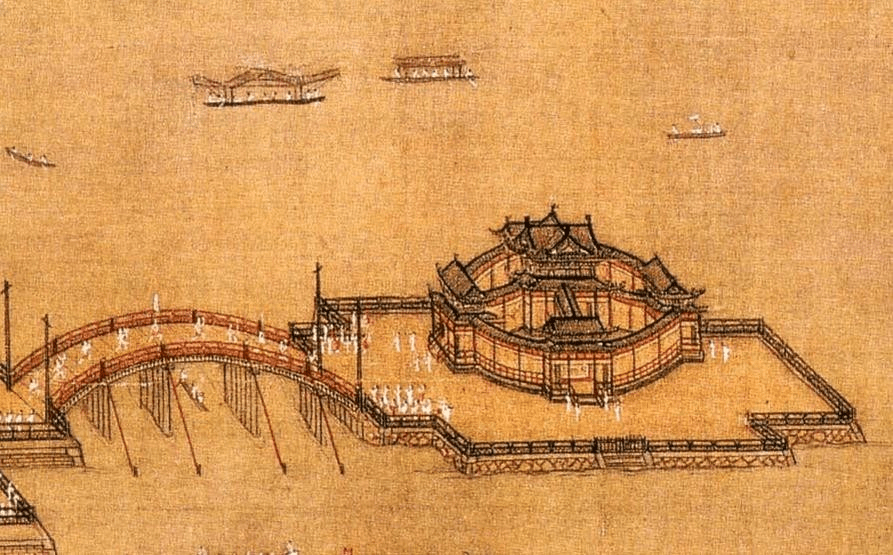
Transportation Pass – short (local) journeys, as well as more substantial journeys carried out over land and across water – eventually required a Transportation Pass. The “Shipping” Section was used primarily for Waterway Transportation (such as through internally constructed canals and around coastal areas). The “Carriage” Section is mainly used for Land Transportation (using foot carriage, carts, sedan-chairs and other forms of road-based travel). When using these governmental documents, the Merchant and the Official were issued with exactly the same Transportation Pass. These documents had to be shown when requested by any and all Local Authorities. These documents “recorded” all journeys and registered individuals, their transportation means and the objects they were carrying.
Chinese Language Text:
https://www.sohu.com/a/105504916_454366
带你了解中国古代航海史时间轴!
2016-07-13 23:41
上古时期
从浮具(人是跨着一根树干,或是抱着一个葫芦作为渡水的)到腰舟(数个葫芦用绳子绑到一起,以提高渡具的浮力)到筏(将有浮力的物体绑扎在一起可以加大浮力,足以可以承受一个人的重量漂浮在水中)。筏的出现是人类摆脱水浸主动创造水上交通工具的一个飞跃标志。后又借助石斧和火(恩格斯断定)用整块木头制作成了舟(浙江余姚河姆渡发现的7000年前的新石器的遗址证明)。
夏商周时期
出现木板船,是造船史上一次划时代的飞跃。同样长短的木料,造出容量增大数倍的舟船。
从夏朝就开始航海活动,经证明隅夷(现在的辽宁省北镇县)与山东半岛之间设有一条定点的往返航线。
商代时人们已认识东南西北风。
春秋战国时期
气象上——产生了八方风与十二方风的概念。这一时期产生了阴阳五行学说,把阴阳、五行、八卦、干支、时令、方向等都相互联系,并和一些政治主张联合起来,形成了一个网罗万物的体系。
水文上——开始有所认识,海洋潮汐以及由此而生的潮流对开航海活动影响很大。
天文上——进展表现在对恒星与行星的观察的定量化上。确立东西方向,对北斗星与北极星的观测与辨认已相当精细了。出现交通运输通行证——节,水陆交通运输凭证(舟节主要用于水路运输通行;车节主要用于陆路运输通行。使用时货主与官吏各有相同的节,对核后无误才可通行)。
 SANGHA KOMMUNE (SSR)