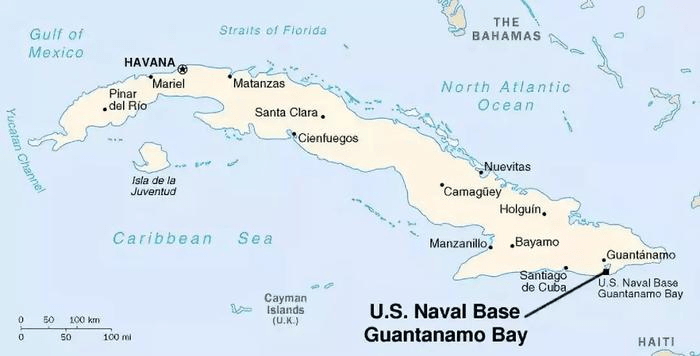
On December 5th, 2019, the US “New York Times” released a number of hand-drawn illustrations depicting various details of the ill-treatment and torture a “Detainee” suffered at the hands of the CIA during his arbitrary imprisonment within the US Naval Base located within Guantanamo Bay (Cuba)!
According to these hand-drawn illustration – Detainees in the Guantanamo Bay Prison have been subjected to punishments such as being stripping naked for long periods, waterboarding, being hit against a wall and deprived of sleep.
The constant exposure of prisoners to this type of inhuman abuse has caused a scandal at Guantanamo Bay – once again placing the United States – (which considers itself a Human Rights defender) – at the forefront of a scathing public opinion! However, the place where this shocking scandal took place was not in the United States – but rather on the island of Cuba!
Why is the Guantanamo Bay area of Cuba occupied by the United States? Can Cuba take back its territory from the United States? To understand the current situation – the history of of the relationship between the US and Cuba must be clearly understood – how this has related to “control” on the island territory, and how this process has led to attitudes of grievance and hatred!
1) Resistance Against Spain
The original inhabitants of the island of Cuba were Indians. In 1492, Columbus’s fleet reached the Caribbean. Since then, the European colonists began the unthwarted process of carving up the New World. In 1511 – the entire island of Cuba became a Spanish colony.
During the rule of the Spanish colonists – Cuba became an important tropical plantation area by virtue of its superior natural and geographical conditions. Natural rubber, cocoa, coffee and sugar became the lifeblood of the Spanish Cuban economy. However, the wealth brought by these tropical crops was firmly in the hands of Spain – the suzerain country – and the lives of the colonial people were extremely difficult.
Direct Spanish colonial rule aroused strong resistance among the Cuban people – and they initiated a longterm armed struggle! Cuba was inspired by the North American War of Independence in the late 18th century. In 1790, a Slave Uprising broke out in Cuba – but it was unsuccessful.
Influenced by the North American Independence movement, a Latin American Independence movement started from Mexico in the North and arrived in Argentina in the South. In 1826, after nearly 16 years of war, (except for a few areas such as Cuba), Spanish America and Portuguese America achieved Independence – and a series of emerging countries were born – one after another.
Driven by the Latin American Independence movement – Cuba initiated its first War of Independence in 1868 – but due to the disparity in strength and lack of experience in struggle, the war ended in the failure of the Cuban Rebel Army.
The failure did not extinguish the Cuban people’s determination to pursue National Independence. In 1895, under the leadership of Patriot José Marti – Cuba initiated its Second War of Independence! After three years of continuous offensives – the Cuban Rebel Army occupied nearly two-thirds of the country’s land. Spain’s colonial rule in Cuba was on the verge of disintegration – and the victory of the Independence movement was in sight!
2) US Occupation of Guantanamo Bay
The fruits of the Cuban Revolution, however, were eventually stolen by the United States. This is why Cuba’s road to Independence can be described as one-step forward – two-steps back! (The Chinese language text talks of a wolf lurking in the background implying the ‘US’ – which steals all the gains made by an aggressive tiger in the foreground – the Cuban people).
After the United States achieved Independence, it quickly embarked on the road of territorial expansion. After the Westward movement, the American-French and American-Spanish trade, and the Mexican War – the territory of the United States tripled from 1783. In the process of territorial expansion, the contradiction between the Free States in the North and the Slave States in the south became increasingly prominent – making a war between the North and the South inevitable.
In 1861, the American Civil War broke out. The war ended with the victory of the North. The victory of the North led to the rapid development of capitalism in the United States, and the United States gradually replaced Britain and France as the world’s manufacturing power, gradually preparing the country for external expansion. A wealthy and confident United States, with an expanding population and an abundance of natural resources – was ready for the development of a World Hegemony! (The Chinese language text talks of the US as a maturing bird spreading its growing and developing wings – which are full of power – and preparing to ‘fly’ to expand its territory).
The island of Cuba (in the Caribbean Sea) is located at mid-point between the Gulf of Mexico and the Caribbean Sea – with Puerto Rico guarding the outlet from the Atlantic Ocean to the Caribbean Sea. Therefore, the strategic position of Cuba is very important. If the United States could occupy these two places (Cuba and Puerto Rico), then it could better control the Caribbean and Central America.
At the time, however, the islands of Cuba and Puerto Rico were still Spanish colonies. In order to compete for control of these strategic points – a war between the United States and Spain appeared inevitable. In February 1898, a warship sent by the United States to protect its overseas citizens in Cuba exploded in the Port of Havana. The United States used this event as an excuse to demand retributions against Spain. In April 1898 – Spain Declared War on the United States – and the Spanish-American War broke out.
The Spanish-American War – which lasted nearly four months – ended with the victory of the United States. After the war, Spain and the United States signed the “Paris Peace Treaty”, and Spain ceded the island of Cuba, Puerto Rico and the Philippines to the United States. In this way, Cuba completed a change of ownership from Spain to the United States.
After stealing the fruits of Cuban Independence, the United States began to operate in Cuba a place which was close at hand. Cuba’s centuries-old anti-colonial struggle made the United States realize that if it wants to run Cuba, it cannot directly occupy it. Therefore, the United States adopted the method of appearing to recognise Cuba’s Independence on the surface – whilst actually keeping control behind the scenes!
In 1901, the United States issued the “Platt Amendment” against Cuba. This “Unequal Treaty” legally compelled Cuba to “allow” the United States to continue to exploit mineral resources on the island of Cuba – whilst retaining the right to garrison troops and conduct military intervention in Cuba. To facilitate this freedom, his agreement ceded Guantanamo Bay (and its adjacent land) to the United States to act as a military base.
In this way, although the Guantanamo Bay Naval Base is nominally (de jure) owned by Cuba – the actual (de facto) control lies in the hands of the United States.
Why is the United States so fond of Guantanamo Bay? This is inseparable from the US Caribbean strategy. The Caribbean Sea is located South of the Gulf of Mexico and is an important sea route for the United States to control Central and North America. However, many islands in the Caribbean, including Jamaica, were controlled by old colonial countries such as Britain, France, and the Netherlands.
For the United States, if it wants to control the Caribbean Sea, it is very necessary to establish military bases in the Caribbean Sea. The Windward Strait between Guantanamo Bay and Haiti Island on the East Coast of Cuba Island is an important channel for the Atlantic Ocean to enter the Caribbean Sea. This is why the United States covets Guantanamo Bay.
In 1902, the Republic of Cuba was established with the support of the United States. In 1903, under the pressure from the United States – Cuba was not only forced to accept the “Platt Amendment” – but also wrote an Amendment into the then Constitution of Cuba. According to this Amendment, Cuba agreed to lease Guantanamo “indefinitely” to the United States – for the annual rent of only 4,000 US dollars.
In 1934, Batista assumed power through a right-wing coup with the support of the United States. After Batista came to power – the United States and Cuba then re-signed the terms of the lease regarding Guantanamo Bay.
In this way, Guantanamo Bay was redefined as being “occupied” by the United States. At this time, Cuba fell into the full control of the United States – both economically and militarily. Cuba’s road to true National Independence became arduous – and appeared a long way off.
3) When United States and Cuba are at odds – Guantanamo Bay is More Important
Although Cuba established a “Republic” in 1902 – its military and political power remain in the hands of the United States. In 1952, the former Cuban leader Batista came to power again through a coup with the support of the United States, which intensified and strengthened the ethnic and class contradictions in Cuba.
In 1953, under the leadership of Cuban Patriot Fidel Castro – a Revolutionary War broke out in Cuba to overthrow the Batista dictatorship. On January 1st, 1959, after five years of arduous struggle, the Cuban Revolutionary Army led by Castro finally overthrew Batista’s rule and established a Revolutionary government!
In the early days of the victory of the Cuban Revolution, Cuba and the United States had not yet broken up. As the Cuban Revolution was at the beginning of the Cold War between the US and the Soviet Union – the US was fighting the Soviet Union and had no time to take care of the civil strife in Cuba. At that time, the policy adopted by the United States was to wait and see what happened. They hoped that no matter who came to power – as long as it was in the interests of the United States – it did not really matter.
Things did not develop in the direction envisaged by the United States – as Castro turned-out to be a staunch Nationalist! These Revolutionaries wanted to establish full Cubans control of their own country – rather than maintain a Cuba controlled by the United States! This “Socialist” vision completely contradicted the idea of the United States continuing to control Cuba! This is why the relationship between Cuba and the United States gradually deteriorated.
In May 1959, the new Cuban government took the lead in promulgating the Land Act. The new bill nationalised a large amount of land invested by the United States in Cuba. In October 1960, Castro promulgated the New Economic Act, which nationalised all American enterprises in Cuba!
This seriously violated the interests of the United States. On January 3rd, 1961, the United States unilaterally announced the severance of diplomatic relations with Cuba, isolated Cuba through economic blockade and trade embargo, and planned many different military activities to invade Cuba using mercenaries. All were repelled by Cuban soldiers and civilians.
The invasion by the United States completely destroyed the relationship between Cuba and the United States. This gave the Soviet Union an opportunity. With the aid of the Soviet Union, Cuba gradually turned to the Socialist camp. On May 1st, 1961, Castro loudly declared Cuba a Socialist country!
Cuba is only 80 nautical miles away from the United States – and it is unacceptable to the United States for another country to practice Socialism on its own doorstep! In order to “eliminate” any hostile country that are close at hand, since 1961, successive US governments have implemented a comprehensive blockade and hostile policy against the Cuban economy.
At this time, the ownership of Guantanamo Bay become an unavoidable issue between the United States and Cuba.
After taking Office, the Castro government, which insisted on Nationalism and Socialism, has always refused to accept rent from the United States. The new Cuban government believes that a series of Treaties signed between the previous government and the United States – violated the will of the Cuban people. Therefore, the Treaties signed by the previous Cuban government and the United States are invalid and require the United States to immediately return the Guantanamo Bay.
The United States has always rejected Cuba’s request. On January 4th, 1961, Eisenhower, then US President, declared after announcing the severance of diplomatic relations between the United States and Cuba: “The status of Guantanamo Bay will not be affected in any way.” Since then, successive US governments have refused to return Guantanamo Bay to Cuban control.
4) Can Cuba Take Back the Base?
The Guantanamo Bay Naval Base is a thorn in the paw of Cuba – a form of passive-aggression perpetuated by the United States – with its existence seriously damaging Cuba’s sovereignty and self-interests. This is why the Cuban government in the new era has never given up its efforts to take back Guantanamo Bay.
In the face of absolute strength, the United States is far stronger than Cuba. At present, it is almost impossible for Cuba to use its own military power to take it back by directly confronting the United States.
In order to force the United States to withdraw – the Cuban government (during the Castro period) cut off the fresh water and the power supply serving Guantanamo Bay Naval Base area in an attempt to force the United States to submit. In reality, this move has had little tangible effect. Relying on its own strong economic and military strength – the United States has established the ongoing desalination of seawater – and an independent power supply system to counter Cuba’s policy.
In order to take back the Guantanamo Bay Naval Base, Cuba also used various diplomatic means such as International Conferences – based on Article 52 of the Convention on the Law of Treaties – “A Treaty is invalid if it is signed under the threat or imposition of one party”. In other words, the US is accused of illegally occupying the base – and the Cuban government demands that the land is returned.
Although Cuba’s just demands have won the support of the majority of the world, Cuba remains a weak country without real or effective diplomatic influence. The United States, relying on its substantial international influence, has always refused to return Guantanamo Bay – or stop using it as a Naval Base. Due to the long-term blockade of Cuba by the United States – its economic development has been severely restricted. It can be said that it is very difficult for Cuba to recover Guantanamo Bay.
Although the United States is far ahead of Cuba in terms of absolute strength – Cuba has made major adjustments to the surrounding regional structure through unremitting struggles. At this time, the domestic political environment in the United States also changed in favour of Cuba. Under the combined effect of various factors, the relationship between Cuba and the United States was normalized and diplomatic relations were re-established during the Obama Administration.
Chinese Language Text:
http://k.sina.com.cn/article_5044281310_12ca99fde020014rs1.html?from=news&subch=onews
古巴的关塔那摩湾为什么被美国占据着?
作者:雄鹰 编辑:Thomas
12月5日,美国《纽约时报》公布了一个关塔那摩监狱囚犯的手绘图,该图展示了其被关押在关塔那摩监狱期间,遭遇美国中情局虐待和酷刑的各种细节。
根据该手绘图描述,关塔那摩监狱的在押囚犯曾遭遇过被扒光、水刑、撞墙、剥夺睡眠等刑罚。
不断曝光的关塔那摩监狱虐囚丑闻,使以人权卫士自居的美国再次处在了舆论的风口浪尖。然而,这个惊天丑闻的事发地却不在美国本土,而是在古巴岛上。
古巴的关塔那摩湾地区为什么会被美国占据?古巴又能否从美国手里收回自己的领土呢?这一切的恩怨情仇,都要从美国和古巴的控制和反控制说起。
一、反抗西班牙
古巴岛的原居民是印第安人。1492年,哥伦布的船队到达加勒比海地区。此后,欧洲殖民者就迫不及待地开展了瓜分新大陆的进程。1511年,古巴岛全境沦为了西班牙的殖民地。
在西班牙殖民者统治期间,古巴凭借着优越的自然地理条件,成为重要的热带种植园区,天然橡胶、可可、咖啡和蔗糖成了西属古巴经济的命脉。但是,这些热带作物带来的财富,却牢牢掌握在宗主国西班牙的手里,殖民地人民的生活却异常困苦。
西班牙的殖民统治激起了古巴人民的强烈不满,他们时时刻刻通过武装斗争的方式推翻殖民统治。18世纪末的北美独立战争鼓舞了古巴。1790年,古巴爆发奴隶运动,但是没有成功。
受北美独立运动影响,一场北起墨西哥,南抵阿根廷的拉美独立运动如火如荼地展开。1826年,经历近16年的战争,除古巴等少数地区外,西属美洲和葡属美洲地区均取得了独立,一系列新兴国家相继诞生。
在拉美独立运动的推动下,古巴于1868年爆发了第一次独立战争,但由于实力悬殊且斗争经验不足,战争以古巴起义军的失败而告终。
前两次的失败并没有扑灭古巴人民追求民族独立的决心。1895年,在爱国者何塞·马蒂的带领下,古巴爆发了第二次独立运动。经历了三年的持续打击,古巴起义军占领了全国近三分之二的土地,西班牙在古巴的殖民统治趋近瓦解,独立运动胜利在望。
二、美国占据关塔那摩湾
然而,古巴革命的胜利果实最终被美国盗走。古巴的独立之路,可谓是前有狼后有虎。
美国在完成独立之后迅速走上了扩张领土的道路。经历西进运动、美法和美西交易以及墨西哥战争后,美国领土比1783年扩大了两倍。在领土扩张过程中,美国北方自由州和南方蓄奴州的矛盾日渐凸显,南北方的战争在所难免。
1861年,美国南北内战爆发。战争最终以北方的胜利而告终。北方的胜利,使美国的资本主义飞速发展,美国也逐步取代英法成为了世界制造业大国,逐备了对外扩张的实力。羽翼逐渐丰满的美国也走向了追求世界霸权的道路。
加勒比海地区的古巴岛地处墨西哥湾和加勒比海的据点,波多黎各又扼守大西洋到加勒比海的出海口,战略地位十分重要。如果美国占据了这两块地方,可以更好地控制加勒比海和中美洲地区。
然而在当时,古巴岛和波多黎各岛依然是西班牙的殖民地。为了争夺战略要地,美国和西班牙之间的战争似乎在所难免。1898年2月,美国派往古巴护侨的军舰在哈瓦那港发生爆炸,美国以及为借口,要求惩罚西班牙。1898年4月,西班牙向美国宣战,美西战争爆发。
历时近4个月的美西战争以美国的胜利而告终。战后,美西签订《巴黎和约》,西班牙将古巴岛、波多黎各和菲律宾割让给美国。就这样,古巴完成了从西班牙向美国的易主。
窃取了古巴独立的果实后,美国开始经营近在咫尺的古巴。古巴几百年的反殖民斗争也让美国意识到要想经营古巴,直接占领是不行的。因此,美国采取了承认古巴独立但实际控制的方式。
1901年,美国出台针对古巴的《普拉特修正案》,古巴允许美国在古巴岛开采矿产资源,并保有驻军和对古巴进行军事干预的权力,其中,关塔那摩湾及其附近的陆地允许美国作为军事基地。
这样,关塔那摩湾海军基地虽然名义上归古巴所有,但实际控制权掌握在美国手里。
美国为什么对关塔那摩湾那么青睐呢?这跟美国的加勒比海战略是密不可分的。加勒比海位于墨西哥湾以南,是美国控制中北美的重要海上要道。但是,包括牙买加岛在内的加勒比海众多岛屿当时被英国、法国、荷兰等老牌殖民国家所控制。
对于美国来说,想控制加勒比海,在加勒比海地区建立军事基地就十分必要了。而古巴岛东海岸的关塔那摩湾和海地岛之间向风海峡,是大西洋进入加勒比海的一个要道。这是美国觊觎关塔那摩湾的原因。
1902年,古巴共和国在美国的扶持下成立。1903年,屈于美国的压力,古巴不仅被迫接受了《普拉特修正案》,还将该修正案写入了当时的宪法。根据该修正案,古巴同意美国无限期租用关塔那摩湾海军基地,租金仅为4000美元。
1934年,巴蒂斯塔在美国的扶持下通过政变上台。巴蒂斯塔上台后,美国和古巴之间重新签订了关于关塔那摩湾海军基地的租借条款,美国租借关塔那摩湾的期间为双方均同意废止为期。
就这样,关塔那摩湾就事实上被美国所占据。此时的古巴,无论在经济上还是军事上陷入了美国的全面掌控之中。古巴争取真正的民族独立之路,依然是漫长而又艰巨的。
三、美古交恶,关塔那摩湾更加重要
古巴虽然在1902年成立了“共和国”,但军事和政治权力都掌握在美国手里。1952年,古巴前领导人巴蒂斯塔在美国的扶持下通过政变再次上台,此举使古巴的民族矛盾和阶级矛盾彻底激化。
1953年,在古巴爱国者菲德尔·卡斯特罗的领导下,古巴爆发了推翻巴蒂斯塔独裁统治的革命战争。1959年1月1日,卡斯特罗带领的古巴革命军在经历了5年的艰苦斗争后,终于推翻了巴蒂斯塔的统治,建立了革命政府。
在古巴革命胜利初期,古巴与美国还未决裂。因为古巴革命时期正值美苏冷战的初期,美国正在同苏联斗得不可开交,无暇顾及古巴内乱。在当时,美国采取的政策是静观其变,他们希望不管谁上台,只要符合美国的利益就行。
然而,事情却没有往美国设想的方向发展。卡斯特罗是一个坚定的民族主义者,他们想建立的是古巴人自己掌握国家命运,而不是被美国控制的古巴,这与美国试图控制古巴的设想完全背道而驰。古美关系逐渐恶化。
1959年5月,古巴新政府率先颁布土地法案。新法案将大量美国在古巴投资的土地征为国有。1960年10月,卡斯特罗又颁布了新经济法案,将美国在古巴的所有企业收为国有。
这严重侵犯了美国的利益,1961年1月3日,美国单方面宣布与古巴断交,通过经济封锁、贸易禁运的方式来孤立古巴,还策划了多起通过雇佣军入侵古巴的活动,但都被古巴军民击退。
美国的入侵行为让古美关系彻底破裂。这给苏联可乘之机,在苏联援助下,古巴逐渐投向社会主义阵营。1961年5月1日,卡斯特罗高调地宣布古巴为社会主义国家。
古巴距离美国只有80多海里,在美国的家门口搞社会主义,这是美国无论如何都无法接受的。为了“铲除”近在咫尺的敌对阵营国家,从1961年开始,美国历届政府都实行了对古巴经济的全面封锁和敌视政策。
此时,关塔那摩湾海军基地的归属,就成为了美古之间一个难以回避的问题。
坚持民族主义和社会主义立场的卡斯特罗政府上台后,一直拒收美国的租金。古巴新政府认为前任政府与美国签订的一系列条约违背了古巴的意愿,因此,古巴前任政府和美国签订的条约是无效的,要求美国归还关塔那摩湾军事基地。
但美国始终拒绝古巴的要求。1961年1月4日,时任美国总统的艾森豪威尔在宣布美古断交后宣称:“关塔那摩湾的地位不会受到任何影响。”此后,美国历任政府都拒绝归还关塔那摩湾军事基地。
四、古巴能否收回该基地?
关塔那摩湾海军基地是美国扎在古巴的一个钉子,它的存在严重损害了古巴的主权和利益。新时期的古巴政府,从未放弃过收回关塔那摩湾的努力。
然而在绝对实力面前,美国是远远强于古巴的。目前古巴想用自己的力量,通过和美国直接硬碰硬的方式收回近乎是不可能的。
为了逼迫美国撤出,卡斯特罗时期的古巴政府曾通过断水、断电等方式切断了关塔那摩湾海军基地的淡水和电力供应系统,试图逼迫美国就范。但此举收效甚微。美国凭借强大的经济和军事实力,在该地建立了海水淡化和独立的供电系统来反击古巴的政策。
为了收回关塔那摩湾海军基地,古巴还通过国际会议等多种外交手段,以《条约法公约》第52条“条约是在一方威胁或强行施加的情况下签署的,则此条约无效”为依据,指责美国占据是非法的,要求美国归还该基地。
古巴的正义要求虽得到了全世界大多数的支持,但无奈弱国无外交,美国凭借着巨大的国际影响力,一直拒绝归还关塔那摩湾海军基地。反观古巴因长期被美国封锁,经济制裁,经济发展受到了严重的限制,收回关塔那摩湾可谓是难于上青天。
虽然绝对实力上美国远在古巴之上,但古巴通过不懈地斗争使周围地区格局出现了重大调整。而此时,美国的国内政治环境也出现了有利于古巴的变化。在多种因素的共同作用下,古美关系在奥巴马执政期间实现了关系正常化,并重新建立起外交关系。
 SANGHA KOMMUNE (SSR)