Blogger’s Note. I was born in Oxford – but my parents brought me up in Devon – which is part of the West Country – an area of England with very strong Celtic heritage (we drink cyder and not beer). Professor Colin Pillinger was also from the West Country and spoke with a strong West Country accent. He was famous, not for space science, but for his appearance on the TV series entitled “Time Team” – a programme dedicated to archaeology and digging-up famous and not so famous – places of historical interest. Professor Colin Pillinger was the driving force behind a mini “British Space Programme” that would have rivelled the Soviet imitative – and defied the US domination of the time (2003). We were staying with my parents in Torquay during the Xmas season of 2003 – and we kept the radio on through the night to listen to live coverage – to be part of the “British” probe landing on Mars! As Beagle 2 approached Mars all was fine – but as it came down to land – all suddenly went “silent”. For months afterwards there was speculation – but no answers. Then, in 2014, a US probe discovered a partly “landed” Beagle 2 – which seemed to have deployed – but only after trapping its only aerial (preventing all communication). Professor Colin Pillinger had passed-away just 8-months before his space-machine was discovered – and proven to have been mostly successful. Someone commented to me that this was like “Dunkirk” all-over again! We can take it. After-all, we sent a version of “Simon Says” to Mars and nearly got away with it! ACW (8.10.2026)
BBC Danny Fullbrook – 8.10.2026
Bedfordshire, Hertfordshire and Buckinghamshire
A series of plaques has been unveiled across the UK to celebrate the country’s first spacecraft to reach another planet.
Yet the mastermind behind Beagle 2 was never your typical rocket scientist.
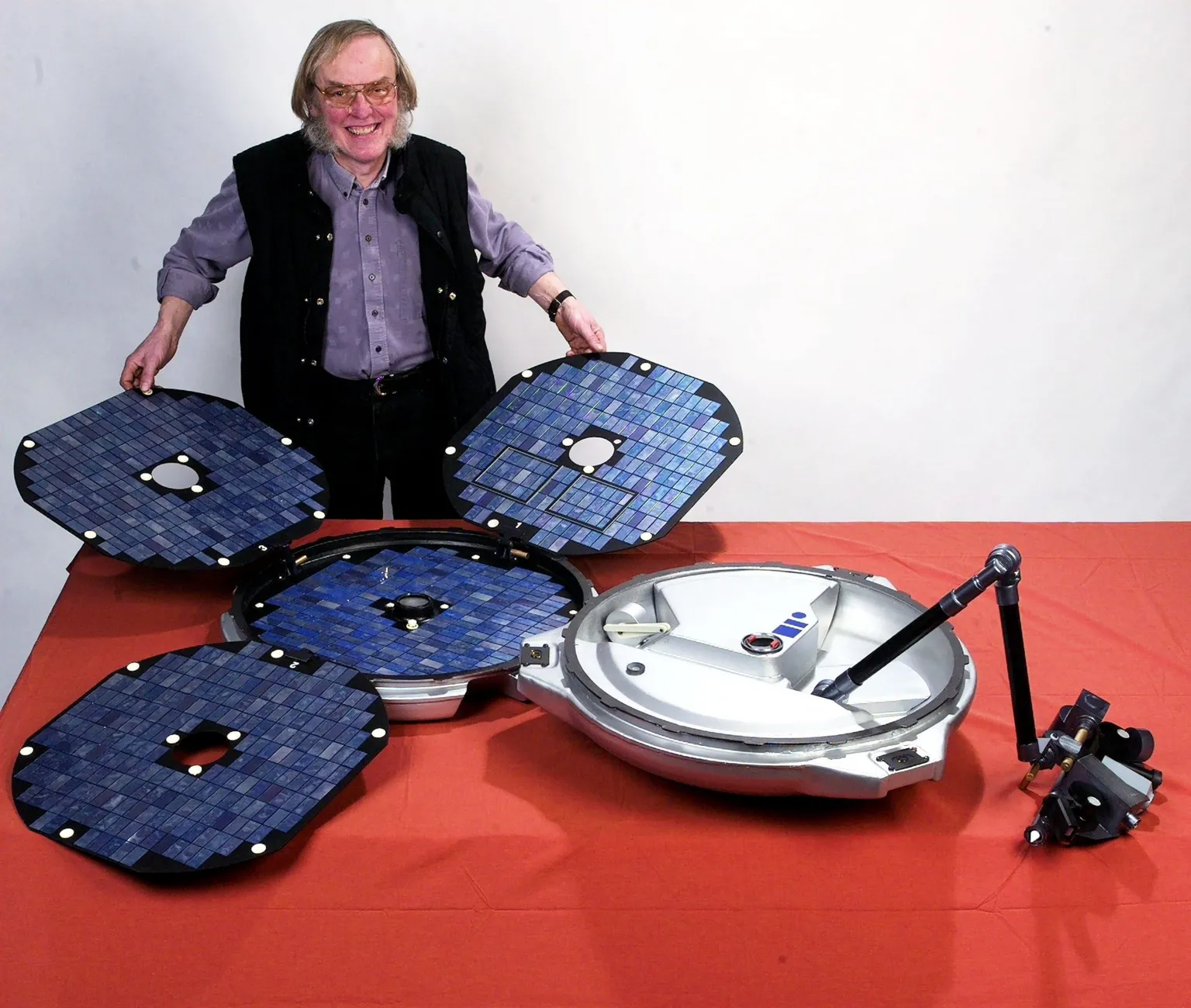
With his mutton-chop sideburns, West Country accent and infectious enthusiasm, Professor Colin Pillinger persuaded politicians, pop stars and the public to support what had seemed impossible: a British mission to Mars.
For years the story of this maverick scientist was synonymous with ambitious British failure. So what changed to make it worthy of nationwide celebration?
What was Beagle 2?
Pillinger was born in Kingswood near Bristol and completed his degree at Swansea University.
He gained international recognition for his lunar research before moving to Cambridge University, where he analysed meteorites found in Antarctica that were believed to have come from Mars.
By the 1980s, he had become one of the founders of the Planetary and Space Sciences Research Institute at The Open University in Milton Keynes.
It was here he conceived the idea of sending a lander, named Beagle 2 by his wife, to Mars, where it could study the red planet directly for signs of life.
Space exploration was dominated by international superpowers and agencies such as Nasa, which had the funding for such expensive work.
Britain had no dedicated space agency, so Pillinger proposed that Beagle 2 hitch a ride aboard Mars Express, a European Space Agency (ESA) spacecraft already scheduled to travel to the planet.
When the ride was approved in 1999, the ESA did not guarantee funding or wider support for the project.
Marslife
The scientist believed that capturing the public’s imagination would help attract financial backing.
Pallab Ghosh, the BBC’s science correspondent, recalled being sceptical when he was sent to meet a “bloke in Milton Keynes who is sending a spaceship to Mars”.
Those doubts deepened when Pillinger placed a model of Beagle 2 on the lawn. According to Ghosh, it “did not look much like a spaceship”.
On another occasion, Pillinger loaded a Beagle 2 replica into a supermarket trolley and wheeled it around The Open University’s car park, demonstrating its compact size to cameras.
The footage was later ridiculed on Have I Got News for You, ensuring it reached an even wider audience.
Pillinger persuaded Britpop band Blur to compose a distinctive call-sign that Beagle 2 would transmit to Earth after landing.
Artist Damien Hirst created a spot painting to serve as a calibration target for the lander’s onboard camera.
The project eventually won financial support from the UK government, academic institutions, industrial contractors and private sponsors.
Beagle 2 was reportedly built for about £50m; in comparison Nasa spent $25bn on the Apollo programme during the 1960s.
Ground control to Beagle 2
Mars Express launched on 2 June 2003 with Beagle 2 aboard; it was due to reach Mars on Christmas Day.
On Christmas Eve, excited scientists and celebrities gathered at The Open University’s London headquarters.
Members of Blur drank mulled wine, singer Myleene Klass handed out jelly babies, and the crowd waited for Beagle 2 to confirm it had landed safely.
The signal never came.
Pillinger and his team believed it had descended too quickly after being caught out by Martian atmospheric conditions.
Official inquiries by the government and ESA criticised the project’s finances and management structure.
Supporters argued the project had brought industries together behind a single planetary mission.
Pillinger, undeterred, proposed a successor, Beagle 3, which ESA rejected in 2004.
In his 2010 autobiography, My Life on Mars, he recalled a builder stopping him in The Open University car park to shake his hand.
He wrote: “There’s nobody in the UK I didn’t reach.”
Beagle 2 found
Pillinger died in May 2014 after suffering a brain haemorrhage and falling into a coma.
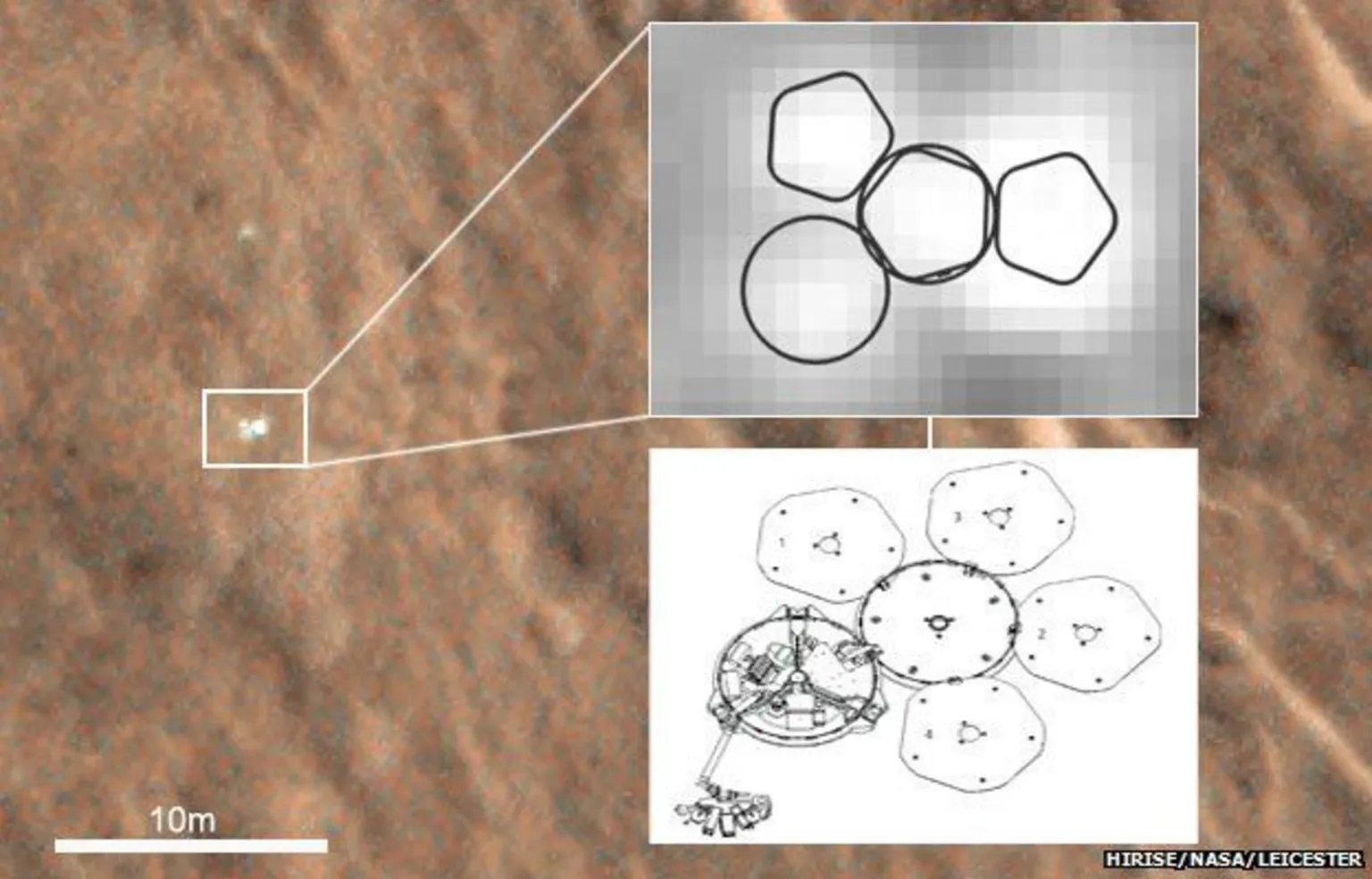
Eight months later, high-resolution images captured by Nasa revealed something surprising.
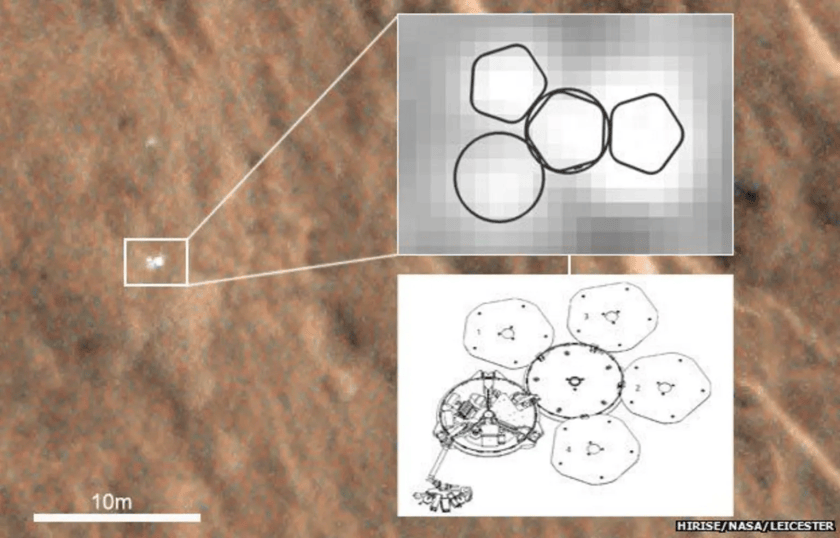
Sitting in the red dust, just 5km from its intended landing site, was the largely intact Beagle 2.
The images confirmed that much of its landing sequence had worked. Its parachutes and cushioning airbags had deployed as planned.
However, its petal-like solar panels had failed to open fully, trapping the antenna and preventing Beagle 2 from communicating.
For his son Nic Pillinger, the discovery meant an achievement that had been “on ice for many years” could finally take its rightful place in history.
Reflecting on the fact that his father died without knowing the mission succeeded, Nick added: “My dad always spoke of himself as being the frontman to the band that was behind this.
“It wasn’t just a one-man project. It was a huge number of people working across different institutions coming together to make it happen.”

