Church Times – by Madeleine Davies – 23 September 2026
Tahir Mehmood Ashrafi says he has been subject to ‘propaganda’
THE Archbishop of Canterbury should apologise to the Muslim scholar whose interfaith award was withdrawn by Lambeth Palace last week, the Moderator of the Church of Pakistan, Dr Azad Marshall, has said.
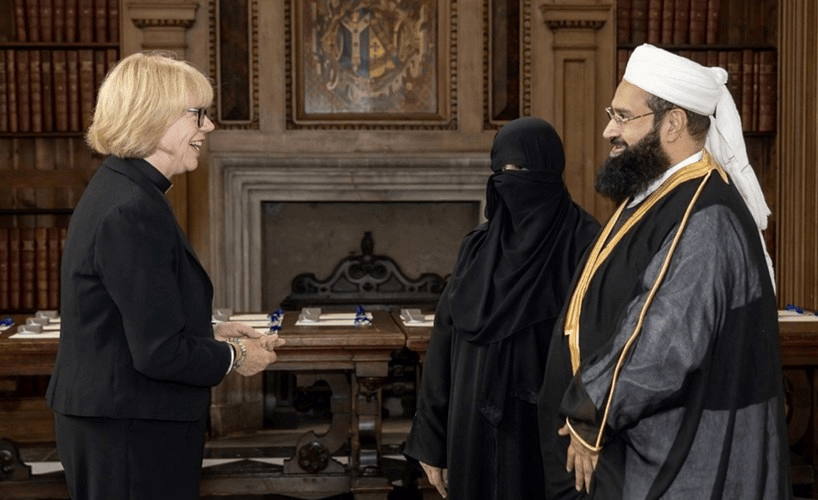
Hafiz Muhammad Tahir Mehmood Ashrafi was given the Hubert Walter Award for Reconciliation and Interfaith Cooperation on 11 September for his “outstanding work as an ambassador of interfaith harmony in Pakistan” (News online, 18 September). A week later, Lambeth Palace announced that it had been withdrawn, after previous comments made by Mr Ashrafi came to light, including a decision to honour Osama bin Laden as a “Sword of God” in response to Salman Rushdie’s being given a knighthood.
In an interview with Canon Chris Sugden on the Anglican Mainstream website on Saturday, Dr Marshall said that the Church of Pakistan had been “deeply humiliated” by the withdrawal of the award to Mr Ashrafi. “He trusted Canterbury as a Church office and took his wife and daughter there. This is a highest offence against him and us.”
And Mr Ashrafi told the Church Times on Wednesday that he had been subject to “propaganda” and that comments about his wife’s wearing of the niqab had caused her to be “in grief”.
After the presentation, two Conservative shadow ministers, Nick Timothy and Rebecca Paul, wrote a letter to Archbishop Mullally warning that the episode had caused the Church “serious reputational damage” because of previous remarks made by Mr Ashrafi.
On Tuesday, Mr Ashrafi spoke of attempts on his life because of his efforts to speak out against terrorism and extremism, and suggested that critics of the Archbishop were “attacking because she is a woman, and that is politics, not a religion”.
He said: “Hopefully, one day I think these people will realise they are on wrong side and we are right side because we believe in Allah, in our work, in humanity, in peace and dialogue. We do not believe in a propaganda campaign.”
The award nomination was instigated by the Church of Pakistan during Archbishop Welby’s 2022 visit to the country (News, 4 February 2022). Mr Ashrafi took responsibility for the Primate’s safety during the trip to Peshawar, the site of a recent terrorist attack, Dr Marshall said.
Dr Marshall gave as an another example of Mr Ashrafi’s “tremendous work” his condemnation of the mob violence against Christians in Jaranwala in 2023 (News, 18 August 2023). In relation to blasphemy laws, he had been “instrumental in releasing many people before the mob can lynch them”, Dr Marshall said.
“Canterbury had the time and ought to have done due diligence if they wanted to or if they had questions,” he said. “But right at the end, I mean, it was so unfair.” When it came to Mr Ashrafi’s past comments, he said: “People change, and he has definitely demonstrated deep respect for Christians, which has to count for something.” Dr Marshall had “pleaded” with Lambeth Palace not to withdraw the award.
The episode meant that the Church had “lost confidence and standing as a national or international community” in its own country, he said.
The interview was accompanied by an article by Dr Marshall’s daughter, Michelle Samuel, programme director of Lahore College of Theology. “In a bid for curated bespoke optics that tell a sanitised story, the Church in Pakistan’s telling of gritty reality was discarded,” she wrote. “Canterbury treated a relationship formed in the dangerous realities of Pakistan as though it were a public-relations object that could be displayed and then removed when the British political weather changed.”
She acknowledged that Mr Ashrafi’s earlier remarks were “deeply offensive”, but said that he “should have been asked to defend himself and address them directly, state whether he repudiates them, and explain the change his later work represents”.
Among her recommendations was that Lambeth Palace should confirm whether “appropriate government or security advice was sought” during the débâcle. “An institution that frequently intervenes in political questions cannot treat basic due diligence as an afterthought when an overseas Church’s safety and credibility are at stake.”
A graduate of Punjab University, Mr Ashrafi attended the Jamia Ashrafia in Lahore, a centre of Islamic learning named after Ashraf Ali Thanawi, a traditionalist Deobandi Sufi and scholar. Besides coordinating the Prime Minister of Pakistan’s interfaith and counter-extremism body, he chairs the All Pakistan Ulema Council — which, according to the Pakistani Dawn newspaper, serves as “a bridge between the government and different religious groups — both extremist and moderate — whenever the need arises”.

