By: Armando Rodríguez BatistaIn this article: Cancer, Cuba, Disease, Photography, Childhood, Children, Oncology, Health, Santiago de Cuba, Society4 May 2026
The phone rings at two in the morning. Yohima grabs it before the doorbell completes the first cycle. On the other side, a mother who has just lost her daughter. The girl had learned to wait for her mother to fall asleep before calling the doctor secretly. “And to wonder what other things she could take to relieve the pain without worrying her mom,” Yohima recalls. That call, the most difficult of his career, he does not forget.
Yohima Rubio Nerey is an oncology specialist and head of the Paediatric Oncology service at the South Children’s Hospital in Santiago de Cuba, a regional centre that serves the provinces of Santiago de Cuba, Granma and Guantánamo. She arrived almost by accident, seduced by a teacher who dressed as a clown to visit, he realized that with that costume he achieved things in children that he did not achieve before, an exam, medication… “He saw in me perhaps the possibility of continuing his work,” he reflects.
Little did she know then that her life would be torn between being a mother and being a children’s doctor. “There is no way to change your outfit and stop being a mother to start being a doctor,” she confesses. The limit is often blurred, even, “it is inevitable when our children get sick, the first thing you think is it a malignant disease?” It is a very difficult job, “however, I think that without my family I would not have been able to carry out this work. Because we can be having a family day, it can even be Mother’s Day, we can be doing family activities and receive a call from one of my patients or their parents because my patients have my phone number and it is a priority for my family as well as for me.”
Working here, he explains, “is very complicated.” Not only because of the disease itself – “paediatric cancer is the leading cause of death in childhood” – but because of everything that surrounds it. “We, as Cubans at last, have blackouts, it is difficult to prepare food at home, we are exhausted by the daily, transportation is complex.” And then they arrive at the hospital, and from the long corridor a child welcomes them with a hug, restoring the meaning of everything, “and then to fight for it.”
But fighting, in this little corner of the East, is an act of emotional engineering and exhausting logistics. “There are difficulties with the medicines, because of the blockade,” and he says it so naturally that he seems to break the fence with his expression. Yohima notes without euphemisms: “There are medicines that are difficult to acquire or that are scarce. There are others that we cannot even acquire because the raw material is from the United States.” Thus, what should be the first line of treatment, and palliative care “we cannot apply it”.
Shortages are chained together like a suffocating skein. The fuel is not enough for the generators, and the chemotherapy room – which must be kept airtight – is left without air conditioning. “Children who have chemotherapy are hot,” she describes. “And even if you open a window, it doesn’t circulate because the room is airtight.” The refrigerators that hold medicines are in danger with each power outage.
Then there is the transfer. “From Baracoa to here, from San Luis to here, from Guantánamo to here.” The immuno-histochemistry studies must be sent to Havana. The CT scans, to Las Tunas: “Four hours of walking on roads that are not in good condition”. On one occasion, three patients left at dawn, arrived, and “there was a drop in the national electricity service that lasted for days. The test could not be performed” and returned without the images. “There is no fuel,” he reiterates.
“There’s a lot of fear,” he admits. “Fear of not being able, of not being on time, losing more days… It scares us. The effectiveness of the treatment is lost.”
But Yohima does not stop at lamenting. His voice tightens, becomes precise.
“Regardless of all the difficult things we go through, like every good Cuban, we have the heartbeat, the knowledge. And emotions don’t need fuel, they don’t need oil to function.”
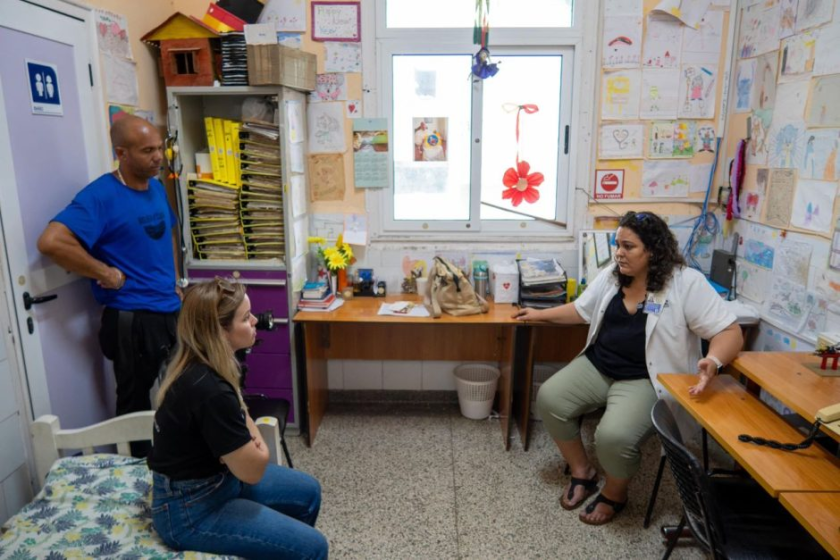
And then he shows with pride and relief the walls of his office. Equipped with what you need to spend the night. This small and warm space has something that no blockage can frustrate: a children’s gallery. “The children, when they arrived here, did not want to cross the threshold of the door,” he recalls. A colleague had the idea of distracting them with drawings. “They were accumulating and we were sticking the drawings on the wall, some that had no colour, we coloured them.” The children came back and saw his work, he motivated them and wanted to bring another one. “The idea is that they make this place a place for them, where everything is fine, where everything is safe.”
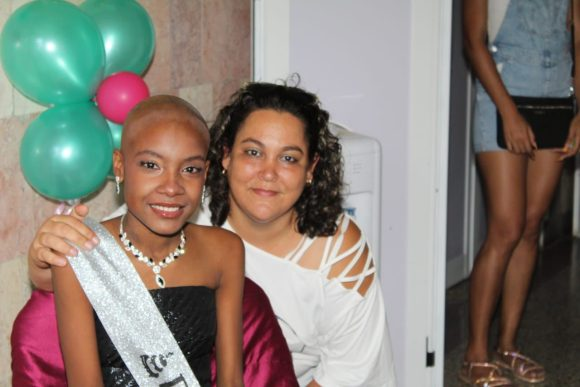
There is also the bell, an idea in which they were pioneers in Cuba. At the end of chemotherapy, the child walks down the hallway while the other mothers and the other children applaud. The bell rings. “It’s amazing the effect,” Yohima says, and something breaks in her voice. “We see images pass in front of us: how they arrived, everything they went through, each stage… and they got to that point. It tastes good.”
She then remembers a three-year-old girl. The little girl held her hand on her final bed and said, “When I grow up, I want to be you.” Yohima asked him if he wanted to be a doctor. “No,” the girl replied, “I want to be you.”
“That makes us put our fears aside,” Yohima says, and the silence she leaves behind is more eloquent than any denunciation. Because the blockade is not just a policy. It is the mother who cannot be with her son because she works, it is the grandmother who takes care of her, it is the electricity that does not arrive, it is the medicine that does not exist. But it is also this woman who, when the phone rings on a Sunday, in the middle of Mother’s Day, “the world stops”.
“It doesn’t matter how many ballots I have to win or not,” he says. “We are going with all our strength to try to fight without hurting them.
“And yes, we lose some children but we also save many children.” We go with all our strength to try to fight without hurting them, without going beyond what is allowed, without exaggerating, without overtreating when there is no criterion to do so, we go with everything.”
“We try to save them from the disease, and if that is not possible, at least that they live with quality, without pain. And one thing we always do, regardless of anything, is to accompany.”

