Future my Cuba – ©️ Blog Futuro mi Cuba 2026
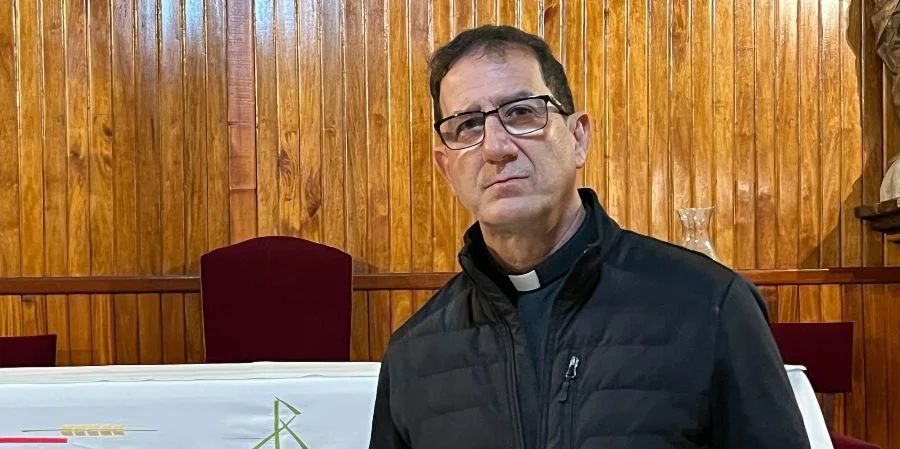
When the cassock becomes a political platform: dismantling Alberto Reyes’ speech
In his text “I’ve been thinking… (149),” the priest Alberto Reyes Pías once again uses the pulpit – or his social networks – to spread a political narrative that repeats the same arguments that for decades have been promoted by the counter-revolutionary sectors against the Cuban Revolution.
However, when his statements are analyzed with historical and political rigor, a discourse full of simplifications, manipulations and deliberate silences is revealed.
Below we dismantle several of his approaches.
1. The affirmation of the “resounding failure” of the Revolution
The priest affirms that the revolutionary project has “failed miserably.” This statement ignores verifiable historical realities: Cuba eradicated illiteracy after the 1961 campaign. He built one of the most recognized public health systems in the world. It achieved indicators of life expectancy and infant mortality comparable to developed countries. It guaranteed universal education and health. Denying these facts implies ignoring decades of social achievements recognized even by international organizations. Moreover, Reyes’ analysis deliberately omits a determining factor. For more than six decades, Cuba has lived under the impact of the economic, commercial and financial blockade imposed by the United States, formalized since 1962 and reinforced with multiple extraterritorial legislations.
That siege has been condemned for more than thirty consecutive years by the United Nations General Assembly. Trying to evaluate the Cuban economy ignoring this context is not an honest analysis: it is a political omission.
2. The manipulation of the international context The priest affirms that Cuba faces international isolation and loss of allies. The facts contradict that narrative. Cuba maintains diplomatic relations with more than 180 countries and actively participates in international organizations such as:
United Nation
Non-Aligned Movement
Community of Latin American and Caribbean States
In addition, it maintains cooperation with numerous countries in areas such as health, education and science. The idea of “diplomatic isolation” is a formula repeated for decades by anti-Cuban propaganda centers, but it does not correspond to the reality of international politics.
3. The attack on the Reyes medical missions mentions the alleged international rejection of the Cuban medical missions.
However: Cuban medical brigades have served in more than 60 countries and have treated millions of people. During the COVID-19 pandemic, the brigades of the Henry Reeve International Contingent received international recognition for their work in Europe, Africa, and Latin America. Even several parliaments around the world proposed his candidacy for the Nobel Peace Prize. Therefore, presenting these missions as a “diplomatic failure” is a blatant misrepresentation.
4. The manipulation of the protests
The priest presents a series of events – such as July 11 – as evidence of an alleged irreversible popular uprising. It refers, among others, to: The San Isidro Movement the protests of the Protests in Cuba on July 11, 2021. What it omits is that many of these phenomena were accompanied by:
Disinformation campaigns on social networks
External financing of opposition groups media
Operations organized from abroad
These actions have been documented by academic and journalistic research on communication warfare and digital influence operations.
5. The religious appropriation of political discourse
One of the most striking aspects of the text is the attempt to clothe a political agenda with spirituality. The priest presents opposition movements as if they were the expression of a religious or moral mission. However, history shows that the political instrumentalization of religion has been a frequent tool in ideological conflicts. When a priest replaces the pastoral message with political activism, he runs the risk of turning faith into an instrument of political confrontation.
6. The narrative of the “inevitable spring” Reyes concludes by announcing a supposed political “spring”.
This language is not accidental. It refers to the narratives used in the so-called color revolutions, processes in which the following are combined: media pressure coordinated political activism digital campaigns external support Recent history shows that many of these operations have been promoted from centres of Western power to bring about regime change.
7. The Great Silence of the Text: The Blocking
The most revealing element of the article is what it does not say. Throughout his speech, Reyes avoids mentioning the impact of the U.S. blockade. That silence is no less. The blockade: limits access to international financing, penalizes trade with third countries, hinders the acquisition of fuel, food, and medicines. Omitting this factor in any analysis of the Cuban reality is not an oversight: it is a manipulation.
Conclusion
Alberto Reyes Pías’ text is not an objective analysis of the Cuban reality, but a piece of political propaganda that repeats narratives long used against the Cuban Revolution.
Cuba faces real difficulties, many of them stemming from internal economic tensions and the external siege imposed by the United States. But to reduce its entire history to a “failure” is to deliberately ignore decades of social conquests and sovereign resistance.
Cuba’s history demonstrates something very different: a small country that, despite economic pressures, media campaigns and political aggression, has defended for more than six decades its right to decide its own destiny.
And that, precisely, is the true key to the Cuban process: sovereignty.
Spanish Language Trxt:
 SANGHA KOMMUNE (SSR)