
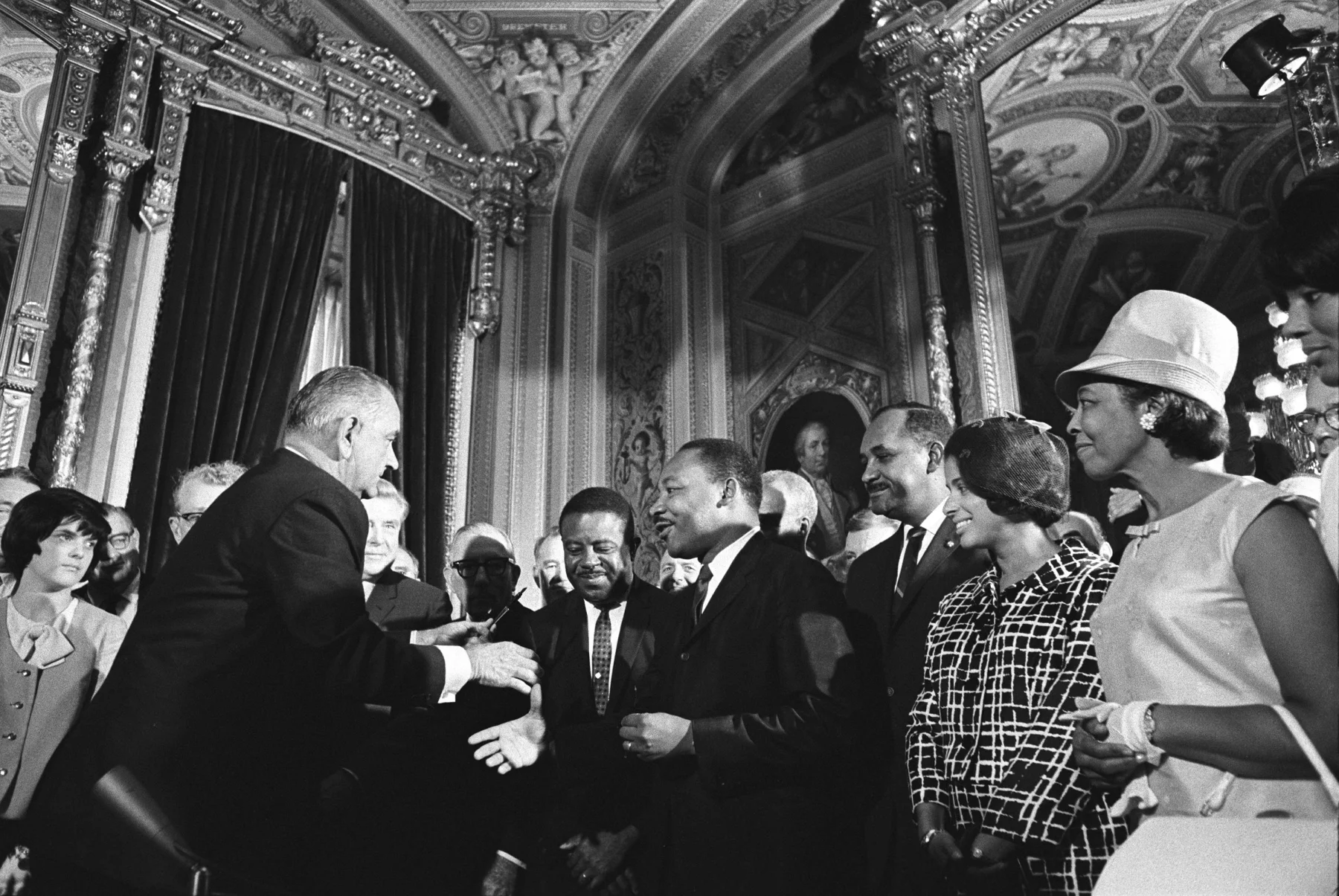
Yoichi Okamoto/Lyndon B. Johnson Library
Otis Wilson had enough with talking and decided to go to court.
His Louisiana town of St. Francisville, north of Baton Rouge, had long elected alderpersons as at-large representatives for a single, townwide district. In places where elections are racially polarized, that kind of voting system can result in a white majority’s votes drowning out the ballots of voters of colour, courts have found.
“I filed a lawsuit because we had no Blacks at all on the council. And I tried to talk to the council and the mayor to work something out, and it didn’t,” says Wilson, a now-retired school bus driver, who led a group of other Black voters to sue St. Francisville officials in 1992.
Their lawsuit was among the hundreds of cases that private individuals and groups have brought to enforce protections against racial discrimination under the federal Voting Rights Act, which then-President Lyndon B. Johnson signed into law 60 years ago this week.
After a long and complicated legal battle, St. Francisville ultimately agreed that the town had violated Section 2 of the Voting Rights Act and switched to alderperson elections with multiple districts.
“It wouldn’t have happened” without the pressure of his lawsuit, says Wilson, a onetime candidate for alderperson who was later elected as a Democratic member of his Louisiana parish’s police jury, a local governing board. “If you didn’t go further, it just wouldn’t happen.”
The legal path that allowed Wilson to fight against the dilution of his and other Black voters’ collective power at the ballot box, however, may be ending soon, as a novel legal argument makes its way to the U.S. Supreme Court.
Contrary to decades of precedent, Republican state officials in at least 15 states contend that private individuals and groups do not have the right to sue to enforce Section 2 because they are not explicitly named in the landmark law’s text. Only the head of the Justice Department, they argue, can bring this kind of lawsuit.
The issue is at the heart of a North Dakota legislative redistricting case that was brought by two tribal nations. A federal appeals court ruled against the Native American voters, and the case may be up for a full review soon at the Supreme Court. The justices may also be preparing to take up a broader question about the constitutionality of Section 2 protections, based on an order last week for legal briefs in a Louisiana congressional redistricting case originally filed by Black voters.
 SANGHA KOMMUNE (SSR)