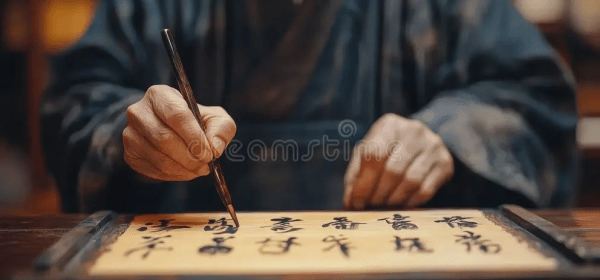
Confucius lived from 551 BCE to 479 BCE

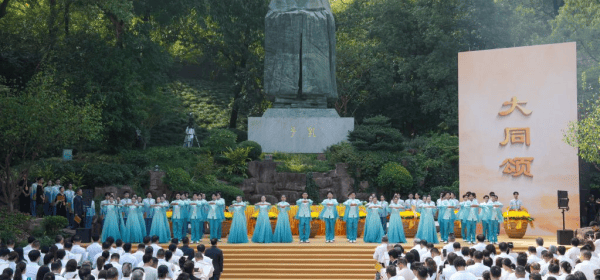
China: Life of Confucius [551-479 BCE] Commemorated! (29.9.2026)

This meant that the nobility could do whatever they wanted to the peasants in different circumstances, and that the there was no set law that applied identically to everyone in every situation. This was fine just as long as the nobility showed proper respect to their superiors and guidance to their inferiors within the aristocracy. As for peasants, Confucius believed they should be treated with the harshest of draconian laws to keep them in-line. Peasants had no rights other than offering the highest deference toward the aristocracy. The Emperor retained the right to execute anyone (of any rank) at anytime, for any reason. Social order was the purpose of politicised Confucianism. On the other hand, some are of the opinion that as a personal philosophy (rather than a forced political ideology), Confucianism advocates self-discipline and a dedication toward a continuous academic study and character-refinement (modern China takes this position). Indeed, Confucius the man pursued this latter model as he possessed no political power during his lifetime. Behind the scenes, scholars argued whether humanity was inherently “good” or “bad’ – and whether people outside your own family (nepotism) should be treated with the same respect and consideration as people within your family. The First Emperor detested hierarchical Confucianism, banned it, and introduced “Legalism” – a unique idea in China at the time – an ideology which advocated that the same law applied everywhere, to everyone – at all times – without exception or deference to social status. Today, The CPC advocates the rule of law and defines Confucianism as pursuing the ability to “educate” in relation to the learning of the Chinese language (reading, writing and speaking). This approach removes the unsavoury aspects of politicised Confucianism (without suppressing Confucianism per se) and lifts its thinking out of the quagmire of a narcissistic philosophy.
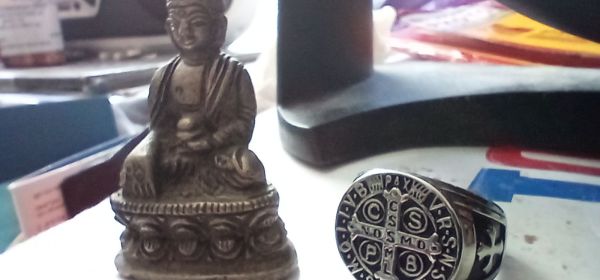
Buddha & St Benedict United!

UK: Buddha & St Benedict Entwined – a Retrospect! (10.9.2026)

Now, whilst in Hereford I befriended an Irishman (my family are part Irish) named “Brian Gray” – who was training to be a Catholic Priest. He was fascinated by Buddhism and liked to “spar” with me in gloved-boxing matches (I was a nasty bit of work in my late teens – as I discovered my natural physical strength). He introduced me to a “Father Thomas” the Abbot of the Catholic Hereford Cathedral. He wanted me to go to the Vatican to meet the Pope – and to join the Catholic faith – but of course, this was not my path. I am not attuned to entering these paths that discriminate against non-members for not being members. Also, at that point I was learning about how the Vatican supported fascism before, during, and after WWII. So you can see my predicament. Although I had friendly interactions on the personal level, there were certain political realities that had to be acknowledged and balanced. Anyway, the upshot of all this was that I was introduced to the study of the Rule of St Benedict followed by the monastics of the Catholic Church (and given the ring you can see here – although I am unaware of its significance).

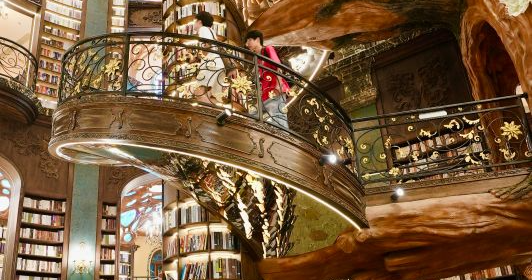
Sinkhole-turned library in Wuyuan County, east China's Jiangxi Province!

China: Sinkhole [天坑 – Tian Keng] Library in Juangxi – Offers Distinctive Reading Experience to Visitors! (27.8.2026)

A child reads a book at a sinkhole-turned library in Wuyuan County, east China’s Jiangxi Province on Aug. 26, 2026. A special sinkhole-turned library opened to the public recently in Wuyuan County of east China’s Jiangxi Province. It incorporates a natural sinkhole and surrounding rock walls into its architecture. The library features a carved spiral staircase and warm lighting, offering visitors a distinctive reading experience. (Xinhua/Hu Chenhuan)

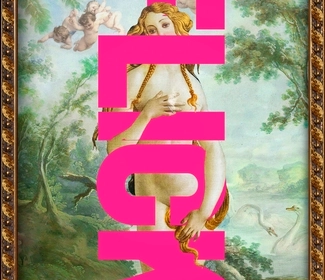
"Flick: The Story of Female Pleasure" (2026) by Dr. Kate Lister

UK – My Review of “Flick: The Story of Female Pleasure” (2026) by Dr. Kate Lister! (26.8.2026)

It is thought that “soul” is of a Germanic (Pagan) origin of uncertain meaning. Western secular narratives tend to incorrectly use “soul” when referring to “psyche”. The Greeks would not have known this term and did not agree with the notion of a spirit existing in opposition to the body. This is a purely Christian corruption of this Greek term. It is a habit of laziness that even academics who should know better at Oxford and Cambridge – still confuse “psyche” for “soul”. These two terms are not the same and should not be conflated. An argument can be made that “psyche” could be construed as the “moment of conception” in the womb (rather than a “soul” which is separate from the body, and which has nothing to do with sexuality). Psyche is the “essence” of psychological and physical existence.

A Scholar Can Accurately "Copy" Just As They Accurately Think Their Own Thoughts!

UK: Email – Defining the Latin-Term “Amanuensis”! (24.8.2026)

Thank you for your very interesting email. Years ago, when I was involved with formal academia (frequenting colleges and universities) the function of “amanuensis” was fairly common. I am not sure if this is the case today – as I am engaged in a broad post-doctorate study that involves researching in (and from) various sources of data. Generally, this is termed “field work”, etc, and can involve much travelling – but with the advent of the internet means that “without going out of my room – I can know all things” – to quote the Book of Change. I often find that examining the Chinese-language equivalent of Western words can give an important insght into the historical meaning of these terms.

St Paul's Commemorative Coin - 15.6.2026

UK: Climbing the Dome – Surviving the 528-Steps of St Paul’s Cathedral! (16.8.2026)

In fact – although one of the centres of the Church of England (CofE) – there seems to be an element of “Sadomasochism” to it all. As if those Church Authorities watching enjoy the spectacle of the fee-paying faithful (yes – you have to “pay” to voluntarily submit yourself to this madness) – or non-faithful (as the case may be) – inflicting pain upon themselves (a form of self-flagellation). It is the design of this building possesses a nasty side in its design. Who knows – when the Cathedral is closed the Church Fathers might draw pleasure by climbing the steps themselves. Of course, like all things “CofE” – the entire place, although of historical and archaeological importance, is subject to capitalist free market forces. The over-priced gift shop reduces Christianity to fluffy toys and cut book-marks – all over-priced – of course. I suspect that if you actually asked a question about religion – nobody working in there could answer it. Still, history is history, and other than the excessive steps – the history entwined in the stone-work of the building was good for the children to enjoy. At the entry point – the clerk shouted that there was no photography – but then said we could photograph anything we wanted to. So, we never quite worked-out what the rule was – and recorded everything we could see. Finally, when we got to what we thought was the top – it turned out there was actually over another hundred steps to go! In the video I say we had climbed the 528 steps – but I think there was around another 140 to go!

1 2 3 … 13