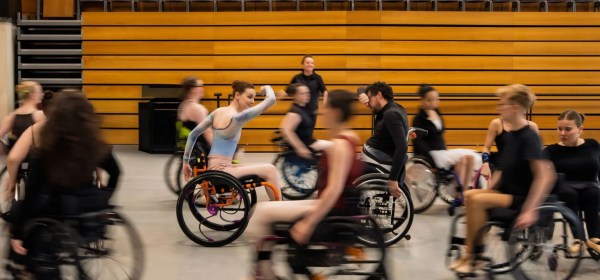
Kate Stanforth said she wanted to deliver more in-person classes, but costs were prohibitive

UK: Kate Stanforth Academy of Arts – Funding for Popular Disabled Dance School Required! (25.10.2026)

She said she wanted to expand in-person opportunities, but accessible venues and the subsequent fees for travel and equipment are “incredibly expensive”.

Currently, she is trying to raise £20,000 to allow her to keep the academy running.

“We’re not struggling because there isn’t a need for what we do,” Stanforth said.

“We’re struggling because making dance genuinely accessible costs money, and those costs aren’t always recognised.”

While she is thrilled some of her dancers have moved onto professional opportunities, Stanforth said the classes were about more than that.

“We’ve also seen people find joy in movement again after believing that part of their life was over,” she said.

“I don’t want another generation of disabled dancers growing up believing their ambitions are unrealistic.”
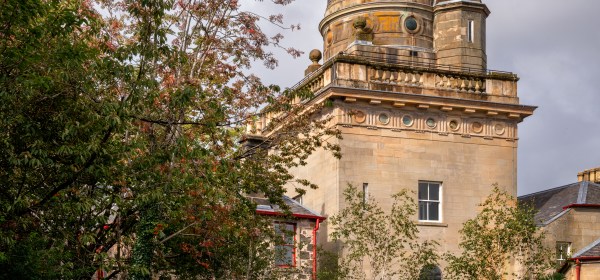
The Coats Observatory in Paisley

UK: The History of “Changing the Clocks” [It’s About to Happen]! (23.10. 2026)

The campaign for British Summer Time came about at the beginning of the 20th century when parliament passed the Summer Time Act in 1916.

British builder William Willett led the movement, inspired by his love of the outdoors. He advocated for BST in his 1907 ‘Waste of Daylight’ pamphlet to increase opportunities for leisure and help reduce energy costs.

He suggested a plan which included 20-minute changes four Sundays in a row in April and September to minimise disruption to people’s biological clocks, arguing that they would “lose nothing and gain substantially”.

He died in 1915 before his vision would become a reality.

The following year, a simplified version of his proposal – a change of an hour – was introduced as the country suffered from huge coal shortages during the First World War.

It has undergone some changes: During the Second World War, Britain kept clocks one hour ahead of GMT through the winter and, from 1941, adopted British Double Summer Time, placing clocks two hours ahead of GMT during summer months. It was then returned to GMT at the end of summer 1945.

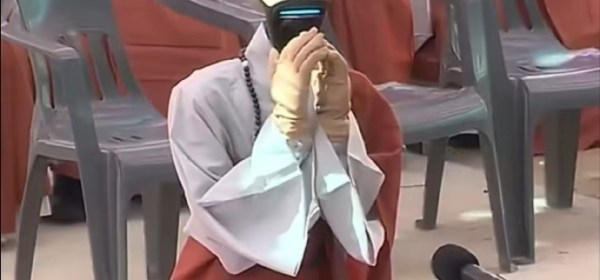
Robo-Bhikkhu

BMA (UK) – Techno-Dhamma – Enlightenment Beyond the Body! (22.10.2026)

According to Buddhist theory, the content of the mind is imported a) from the material environment (via the six sense-organs interacting with six sense objects), and b) thought formations premised upon karmic traits laid-down (as “habit”) in previous existences. A previous existence does not have to have been “human” – but could involve any type of life-form – even on other planets situated in different universes and/or dimensions. As this type of existence is mysterious and not fully understood – existences may not unfold in a logical choreography. A past life might have happened in the future when compared to the present – or unfolded within a completely different time corridor not obviously related to the present (although there must be some kind of hidden karmic association). The mechanism of continuing thought-habit might be like one candle lighting another as the former burns-out and the latter blazes brightly. Of course, the Buddha asserts that rebirth (and karma) no longer exists in the enlightened state.

Shi Da Dao - Ch'an Caodong School

UK: On Why Genuine Buddhism is “Anti-Capitalist”! (22.10.2026)

For most people the reality of everyday life involved a mutually supporting communal-activity (a “Sangha”) with “bartering” reserved for the importing or exporting of goods and services. Every member of such communities was a) entitled to all the goods and services of that community, and b) was expected to contribute to the generating of those goods and services. Within the Vinaya Discipline, the Buddha states that the lay-community may participate in any form of “honest” (bloodless) commerce that may (or may not) involve the handling of money (coinage or otherwise). A lay-household must ethically budget to a) supporting itself, and b) the broader community (through charitable donations) – as well as “saving” money (or goods) for emergencies and hard-times. Part of this lay-budgeting involves the lay-household giving waste food and water to the bhikkhus (beggars) of the Buddha as they slowly (and consciously) “walked” through their neighbourhood on a daily basis. The reward is karmically-premised – as this action permits these monastics to pursue the Dhamma in the purest manner. The bhikkhus are “freed” from the requirement of their participating in the world of cyclic existence and this attracts an immeasurable measure of great and good karma. (The situation in China is slightly different – as although the laity is free to donate as little or as much as they like [thus generating good karma] – the monastics must grow their own vegetarian food – and not be a burden to any other community). As for the bhikkhus (and bhikkhunis) there is to be NO participation in the worldly activities associated with commerce. This is because all greed, hatred, and delusion must be uprooted during meditation practice from the mind and body.

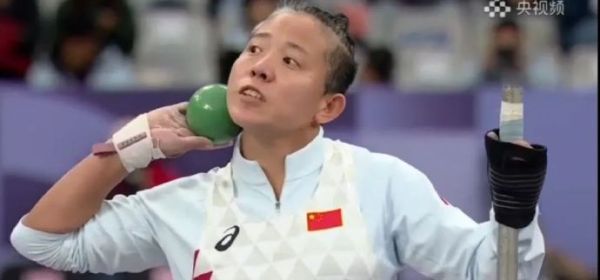
Wu Qing, a 36-year-old veteran, once again won the Paralympic gold medal

China: Para-Athlete – “Wu Qing” [吴晴] – Gold Medal Shot-Putter! (22.10.2026)

During the preparation period for this Nagoya Asian Para Games, Wu Qing maintained a highly disciplined training state, insisting on intensive specialized training and completing hundreds or even thousands of throwing exercises. The Heilongjiang Disabled Persons’ Federation provided comprehensive support, with a professional coaching and rehabilitation team following up throughout, precisely adjusting technical movements and scientifically regulating her physical condition, laying a solid foundation for her to compete in international competitions.

Foreign Guest - Taiwan.

China: Foreign “Guest” Mistakes Taiwan MTR Train for “Public Convenience”! (21.10.2026)

There then follows a number of disgruntled citizens complaining about this behaviour. Apparently, there is mention that the Mainland brings-in a small numbers of African people who attend universities and work in factories in Zhejiang. There is also talk of African people living in Ningbo – perhaps as tourists. The above behaviour is viewed as being highly disrespectful and inappropriate in China and attracts very strong reactions. Many are disgruntled that the Taiwan Authorities have not mentioned an arrest or deportation. Others speculate that this individual might be “American” (and not “African”) – and that the Taiwanese Authorities do not want to draw negative attention to themselves from the Trump II Administration (Taiwan is a US colony).

1 … 11 12 13 14 15 … 334