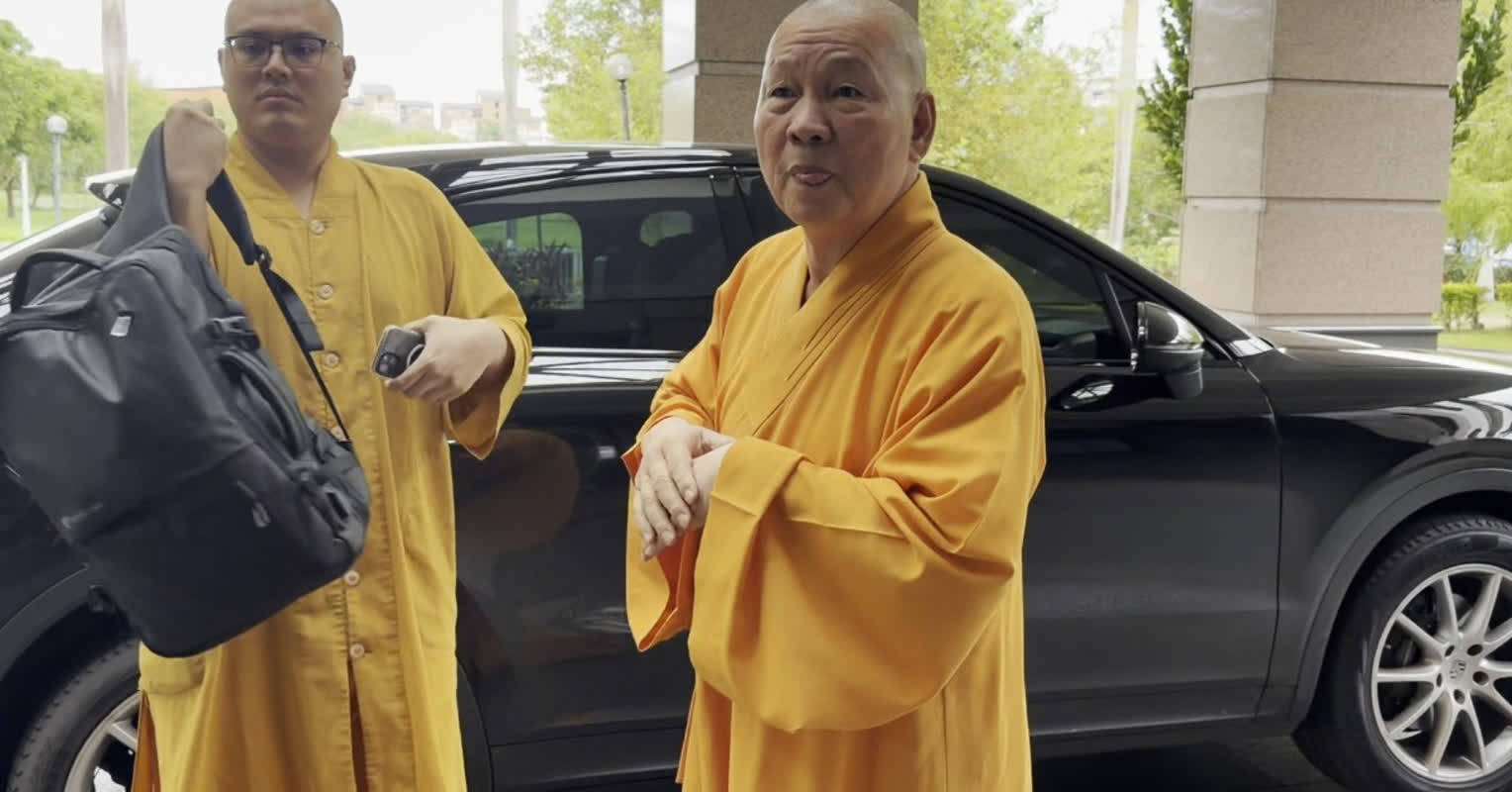
ou know it’s going to be a good article when the first couple of lines state ‘The Buddhist monk turned-up to Court – with his “son” – driving a Porsche SUV worth 5 million NTD!’ The usual Buddhist coruption I cover generally involves monks giving-in to desire and being caught having amorous affairs with lay-women. Why would a woman find a monk attractive? I am sure it also happens with nuns – but these stories tend to be kept out of the public eye. What I am not used to is descriptions involving amounts of stashed gold and silver measured in the “kilogramme”! This tale reads like a pirate story! A married monk, of course, is not a “monk” in the strict administrative sense, doubly proven by the presence of his “son” – something of a family business no doubt (indeed, Court Records show that a number of the “Zhang” family are involved in this widespread fraud). A properly ordained Buddhist monastic follows hundreds of rules – but they all boil down to not killing, not engaging in sexuality, not stealing, and not claiming false attainments. Any of these can lead to expulsion from the Ordained Sangha. In Japan, (which invaded and occupied Taiwan for around five-decades before WWII), Buddhist monks and nuns do not uphold the Vinaya Discipline, and can get married and have children whilst wearing robes, administrating temples, and practicing meditation. In the early 1950s, Master Xu Yun (1840-1959) rejected the Japanese approach as being decadent and corrupt, and suggested the government of China make it a legal requirement that monks and nuns have a “legal” obligation to uphold the Vinaya as long as they are a monastic. Breaking the Vinaya is raised to the level of breaking the law. In other words, in Mainland China, breaking the Vinaya is tantamount to committing a criminal act. It seems that the US colony of Taiwan permits the Japanese model of decadence to hold sway.