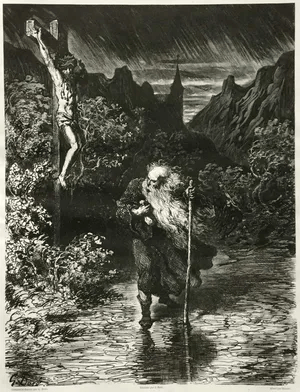
The Legend
- The Act: He told Jesus to go faster while carrying the cross.
- The Curse: Jesus replied, “I go, but thou shalt tarry until I come again”.
- The Afterlife: He later repented, converted, and lived as a pious hermit named Joseph.
Supposedly the gate-keeper of Pontius Pilate in Palestine – who punched a condemned Jesus in the back on his way to execution – when the above conversation took place. Although I would not use this term – others seem to think that this man (condemned to immortality by Jesus) should be known as the “Wandering Jew”. Apparently, he is punished by continuously living from 30 (the age Jesus was murdered) to 100 (in a continuous cycle) until Jesus returns during the Second-Coming. The “Britannica” states this about the origin of the story:
‘The medieval English chronicler Roger of Wendover describes in his Flores historiarum how an archbishop from Greater Armenia, visiting England in 1228, reported that there was in Armenia a man formerly called Cartaphilus who claimed he had been Pontius Pilate’s doorkeeper and had struck Jesus on his way to Calvary, urging him to go faster. Jesus replied, “I go, and you will wait till I return.” Cartaphilus was later baptized Joseph and lived piously among Christian clergy, hoping in the end to be saved. An Italian variant of the story named the culprit as Giovanni Buttadeo (“Strike God”).’
I had not heard of “Roger of Wendover” (d. 1236 CE) until about 30 minutes ago – but it seems he is also responsble for the story regarding Lady Godiva (which he ascribes to happening around 1057 CE). The “Cartaphilus” story appears in Roger’s “Flores Historiarum” (Flowers of History) penned around 1235 CE (or at least finished in that year – as he claims this tome records history from the Creation to that date) – compiled at St Albans Abbey. As for the name of the gate-keeper – it would appear to be in Greek, Latin, and then English:
Greek: κάρτα φίλος (lit: “Karta Philos”) = “Karta” (Very-Much) – “Philos” (Loved)
Latin: “Cartaphilus”
English: “Dearly Beloved”
Later, after becoming a Christian Hermit – rather like those associated with Celtic Christianity in the UK – he assumes the first-name “Joseph”:
Hebrew: יוֹסֵף (Yosef)
Greek: Ιωσήφ (Iosif)
Latin: Iosephus (Josephus)
The name “Joseph” means “he will add” or “God will increase”. It comes from the Hebrew Book of Genesis and is used in the Greek New Testament to refer to the husband of Mary – the Mother who Immaculately Conceives Jesus Christ (Joshua Ben Joseph). Within the development of the English language, “J” only becomes the 26th letter of the alphabet during the 17th century – often replacing “i” in spellings. As for “Y” – it would appear that Christian missionaries brought this to England during the 7th century – but it was slow to catch-on. For instance, the Hebrew “Yosif” was rendered “Joseph” in English (with an “i”) but was never spelt “Yoseph”. Many centuries later, the “Y” would be completely bypassed and the name would be presented as “Joseph” – where it remains today.

