Dear J
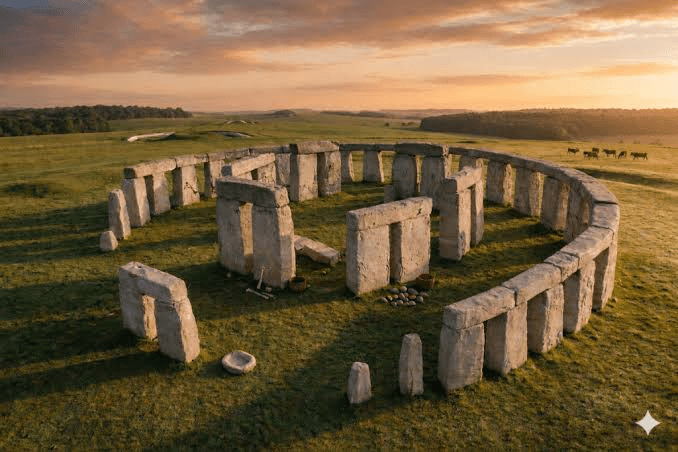
What is “Hyperborea”? As far as I am aware, this appears to be England – with Stonehenge as its centre-point. The ancient Greeks knew about this place – but only vaguely – as perhaps only a handful of Greeks had made it this far to the North. The Greeks talk of a massive round temple used to worship the sun – which the Greeks related to Apollo. When Julius Caesar invade Britain in 55-54 BCE – he said that the “Celts” (Gauls or Gaels) shared tribal names and an identical culture to those across the sea in “Gaul” (France). He also said that the “Celts” still operated antiquated chariots in Britain that had not been used in warfare for around a thousand years. I suspect that the “Celts” probably arrived in Britain around 1000 BCE and colonised the place – mixing with and/or replacing the indigenous Britons in the process. Given that “Hyperborea” is around 1000-years old (or older) – I think the Greeks were referring to the pre-Celtic Britons. However, I think the Druids may well be pre-Celtic – and yet still existed in Britain when the Romans arrived – living quite happily amongst the Celts. Indeed, the two cultures – the “Druid” and the “Celtic” appear to have peacefully co-existed and nourished one another. Whereas the Druids and Celts viewed the Romans as being “foreign” and “incompatible” – these two cultures viewed one another as mutually reinforcing. Greek explorers probably reached the British Isles a long time ago – when its weather was humid (even tropical), the population small, and the food plentiful. Stonehenge was built around 3000 BCE – so everything was inn-place for an idyllic interpretation and the construction in the Greek imagination of the a mythically “perfect” place. The Greek words “ὑπέρ Βορέᾱ” – can be translated as “Hyper” (“Beyond”) “Borea” (the “North”) – or perhaps “Over the Northern-Sea”. There are other theories (the developed Greek term “Ὑπερβόρειος” [Hyperborean] is also a personal name for the god “Apollo”) – but I think there one or two material facts which do favour the UK. We know that Pytheas of Massalia (350-285 BCE) visited Britain around 304 BCE (story linked above). Greek texts discuss this place as if it is an extension of Greek culture – a literal paradise – that is far, far away and therefore detached from the everyday concerns of mundane greek experience. A “paradise” – originally “parádeisos“ (παράδεισος) – denotes a “beautiful garden with a wall around it” or an “enclosed idyllic open space” (the Judeo-Christians took this idea and developed it into the “Garden of Eden”). Para = “surround” and “dise” = “wall”.

