Translator’s Note: Since 1948, the UK initiated a Soviet-style healthcare system paid for by collective taxation – and delivered free at the point of use for all people. Since 1979, however, various governments – including Labour, have bent to US and EU pressure to get rid of the NHS and replace it with a US style system of insurance-based care dependent upon income and status (the rich receive better care than the poor). The NHS is slowly being dismantled and replaced with a deficient, ruthless, and uncaring healthcare system designed to bankrupt an individual over just one injury or illness that needs specialist treatment. As a consequence, young GPs today trained in the UK think that free healthcare is immoral and that it is both natural and right for people to pay extortionate amounts of money for medical treatment. Eyes, eyes, and teeth already have completely been privatised and the body is following along. People are suffering in the UK during this transition. Between 1991-2000 around 10 million Russian people died from medical neglect following the rapid and sudden withdrawal of free health in the former Soviet Union. A similar situation must have existed in the fourteen other countries that comprised the USSR. The West ignored this atrocity (seeing it as natural) – whilst capitalist (Trotskyite) Russians treated it with a sense of denial. The US is currently attempting to destroy Cuban Socialism – and I think they are very close to achieving this objective. The capitalist world does not care and will accept all kinds of War Crimes and Crimes Against Humanity – just as long as any form of Socialism is destroyed. ACW (31.3.2026)
Sarahí Núñez Pérez – España | Photos: Omara García Mederos – 30 March 2026
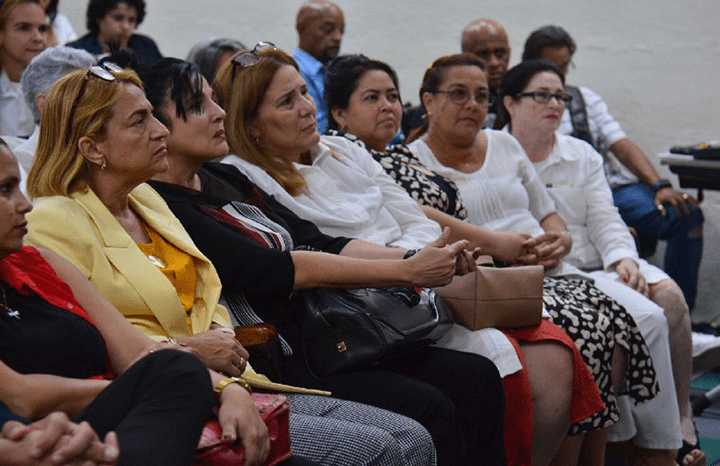
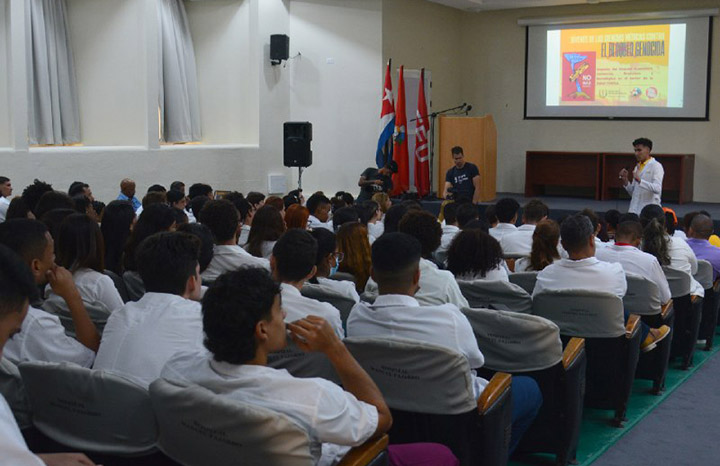
Havana, Mar 30 (ACN) In a direct dialogue full of experiences, young residents of the medical sciences of this capital shared today how the economic, commercial and financial blockade of the United States has a criminal impact on their daily work, professional training and the lives of Cuban patients.
The meeting, which was attended by Meyvis Estévez Echeverría, first secretary of the National Committee of the Union of Young Communists (UJC), and Tania Margarita Cruz Hernández, first deputy minister of Public Health, took place in an atmosphere of reflection and denunciation, within the framework of the celebrations for April 4.
Alejandro Pérez Fonteboa, from the National Institute of Oncology (INOR), explained that the fuel deficit, aggravated by the tightening of the blockade, causes breakdowns in generators, which puts at risk high-tech equipment such as radiotherapy and imaging.
A breakdown of this equipment means millions of dollars in investments, he warned and denounced the impossibility of accessing first-generation drugs such as monoclonal antibodies and immunotherapy, vital to prolong survival in oncological diseases.
For her part, Dr. Marileidys Collado Martínez, a resident of Endocrinology, referred to the impossibility of acquiring technologies such as continuous insulin infusion pumps or glucose sensors for patients with type 1 diabetes, which prevents long-term complications, especially in children.
He also warned about the lack of growth hormones since November 2021 and the deficit of antithyroids, which has caused thyrotoxic crises reported in pregnant women and children from several provinces.
María Claudia Torres, a resident in Cardiology, detailed the effects on her specialty and pointed out the lack of pacemakers, whose deficit lengthens the hospital stay of patients with malignant arrhythmias, and the lack of stents, which forces them to resort to more invasive open chest surgeries or prolonged stays.
He mentioned the obsolescence and lack of spare parts for tomography equipment, essential for cardiovascular diagnosis.
Ricardo Rodríguez González, secretary of the UJC Committee of Medical Sciences, moderated the dialogue and highlighted how the blockade has become more visible and deeper, even affecting the training of young doctors, for example by limiting access to international scientific databases, vital for their specialization theses.
The young people agreed that, despite the immense difficulties, health personnel maintain their commitment and sensitivity to patients.
But they stressed that the blockade is a silent genocide that costs Cuba billions of dollars annually, money that could save lives and guarantee treatment for years.
A single day without a blockade would guarantee treatment for five years to more than 194,000 people with diabetes mellitus, Rodríguez González recalled, citing data from Cuban complaints to the United Nations.
The blockade is not a cliché, it is a reality that kills and limits our dreams of being better doctors, he said.
The exchange concluded with a call to maintain hope and unity, and to continue denouncing in every national and international space the criminal impact of this policy, which violates the human rights of the Cuban people.
© 2026 Cuban News Agency. Reproduction of all or part of this content is forbidden if you are not a publisher subscriber
Spanish Language Text:
https://www.acn.cu/cuba/jovenes-medicos-denuncian-impacto-criminal-del-bloqueo-fotos
Jóvenes médicos denuncian impacto criminal del bloqueo
Sarahí Núñez Pérez | Fotos: Omara García Mederos
30 Marzo 2026
Publicado recientemente
La Habana, 30 mar (ACN) En un diálogo directo y cargado de vivencias, jóvenes residentes de las ciencias médicas, de esta capital, compartieron hoy cómo el bloqueo económico, comercial y financiero de los Estados Unidos impacta de manera criminal en su quehacer diario, la formación profesional y la vida de los pacientes cubanos.
El encuentro, que contó con la presencia de Meyvis Estévez Echeverría, primera secretaria del Comité Nacional de la Unión de Jóvenes Comunistas (UJC), y Tania Margarita Cruz Hernández, primera viceministra de Salud Pública, se desarrolló en un ambiente de reflexión y denuncia, en el marco de las celebraciones por el 4 de abril.
Alejandro Pérez Fonteboa, del Instituto Nacional de Oncología (INOR), explicó que el déficit de combustible, agravado por el recrudecimiento del bloqueo, provoca averías en grupos electrógenos, lo que pone en riesgo equipos de alta tecnología como los de radioterapia e imágenes.
Una avería de estos equipos supone inversiones millonarias, advirtió y denunció la imposibilidad de acceder a fármacos de primera generación como anticuerpos monoclonales e inmunoterapia, vitales para prolongar la supervivencia en enfermedades oncológicas.
Por su parte, la doctora Marileidys Collado Martínez, residente de Endocrinología, se refirió a la imposibilidad de adquirir tecnologías como bombas de infusión continua de insulina o sensores de glucosa para pacientes con diabetes tipo 1, lo que impide prevenir complicaciones a largo plazo, especialmente en niños.
Alertó también sobre la carencia de hormonas de crecimiento desde noviembre de 2021 y el déficit de antitiroideos, que ha provocado crisis tirotóxicas reportadas en embarazadas y niños desde varias provincias.
María Claudia Torres, residente de Cardiología, detalló las afectaciones en su especialidad y señaló la falta de marcapasos, cuyo déficit alarga la estancia hospitalaria de pacientes con arritmias malignas, y la falta de stents, lo que obliga a recurrir a cirugías de tórax abierto más invasivas o a estadías prolongadas.
Mencionó la obsolescencia y falta de repuestos para equipos de tomografía, imprescindibles para el diagnóstico cardiovascular.
Ricardo Rodríguez González, secretario del Comité UJC de Ciencias Médicas, moderó el diálogo y destacó cómo el bloqueo se ha vuelto más visible y profundo, afectando incluso la formación de los jóvenes galenos, por ejemplo al limitar el acceso a bases de datos científicas internacionales, vitales para sus tesis de especialización.
Los jóvenes coincidieron en que, a pesar de las inmensas dificultades, el personal de la salud mantiene su compromiso y sensibilidad con los pacientes.
No obstante, subrayaron que el bloqueo es un genocidio silencioso que le cuesta a Cuba miles de millones de dólares anuales, dinero que podría salvar vidas y garantizar tratamientos por años.
Un solo día sin bloqueo garantizaría el tratamiento durante cinco años a más de 194 mil personas con diabetes mellitus, recordó Rodríguez González, citando datos de las denuncias cubanas ante Naciones Unidas.
El bloqueo no es un cliché, es una realidad que mata y limita nuestros sueños de ser mejores médicos, sentenció.
El intercambio concluyó con un llamado a mantener la esperanza y la unidad, y a continuar denunciando en cada espacio nacional e internacional el impacto criminal de esta política, que viola los derechos humanos del pueblo cubano.
© 2026 Agencia Cubana de Noticias. Prohibida la reproducción parcial o total de este contenido si no es suscriptor editorial
 SANGHA KOMMUNE (SSR)