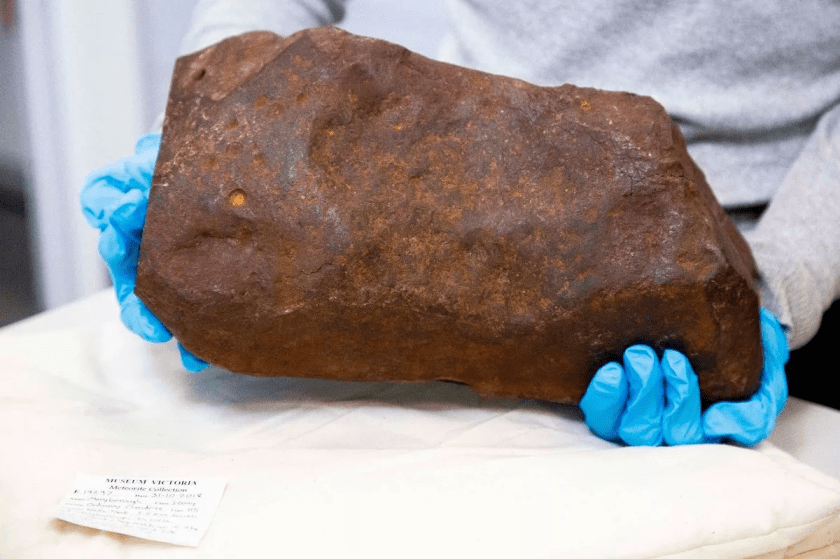
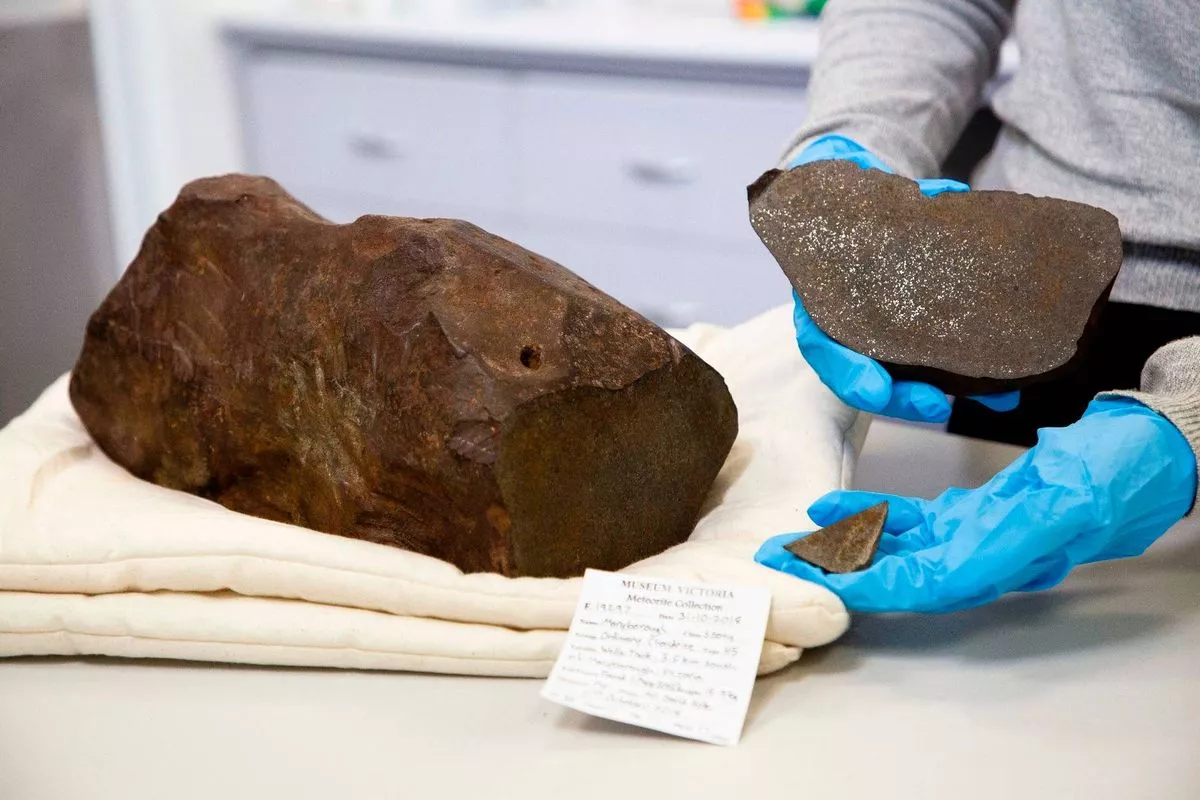
Blogger’s Note: A rock the size of a stout Jack Russell (a breed of dog in the UK – small, fierce, brave, loyal, and strong) – but weighing more or less the same as a Great Dane (another – but huge – breed of dog) – was mistaken by an Aussie as a “gold nugget”. Perhaps it’s not the rock that needs testing! Still, all he has been left with is a piece of worthless space debris that landed on Earth during 1951 (in June – the time of the Aussie Winter) – which turns-out to be the same age as the Earth is old – namely “4.6 million” years old!. I am reliably told by a medical colleague that Aussies are only “technically sober” during the first three months of their lives – when the motor-skills have not yet developed to lift the hand to the mouth. Gold is a lightweight and malleable mettle, which is rare, soft, and highly pliable. This meteorite, by way of comparison, is heavy, hard, and requires a Ford Cortina just to move it any significant distance. ACW (29.11.2025)
Man finds rock ‘made of gold’ on beach but when it’s cracked open he’s left stunned
Michael Moran – 28 Nov 2025 Wales Online
David Hole thought he had found a giant gold nugget but what he discovered turned out to be even more astonishing!
A man out with his metal detector believed he might have stumbled upon a massive gold nugget – but the reality was even more astonishing.
David Hole made this discovery in the soft yellow clay of Maryborough Regional Park near Melbourne, Australia. His assumption wasn’t entirely far-fetched.
In the latter half of the 19th Century, the unearthing of gold deposits in the area had ignited a gold rush – aiding in transforming Australia from an isolated penal colony to a destination for optimistic immigrants.
However, while David had certainly found something intriguing that bright May day, the unusually heavy stone was something much rarer and more valuable than gold.
The first hints about the enigmatic rock’s true nature emerged when David attempted to cut it open to verify if he had indeed struck gold. While gold is a relatively soft metal, David’s find resisted rock saws, drills, acids, and even a mighty blow from a sledgehammer.
Eventually, three years after discovering it, David packed the rock in his backpack and took it to the Melbourne Museum. There, geologists Dermot Henry and Bill Birch revealed to David what he had actually discovered: a 4.6 billion year old meteorite.
Whilst they quite regularly receive visitors who believe they’ve discovered a rock from outer space, authentic meteorites are exceptionally uncommon. However, the moment Dermot examined David’s discovery, he recognised it was something extraordinary.
“It had this sculpted, dimpled appearance,” he told the Sydney Morning Herald. “That’s created when they pass through the atmosphere, they are melting on the exterior, and the atmosphere shapes them.”
Speaking to Channel 10 News, he remarked that it was an incredibly rare discovery, stating: “This is only the 17th meteorite found in Victoria, whereas there’s been thousands of gold nuggets found.
“Looking at the chain of events, it’s quite, you might say, astronomical it being discovered at all.”
The stone, now named the Maryborough Meteorite, almost certainly originates from the very earliest beginnings of the Solar System. Dermot explained: “Meteorites provide the cheapest form of space exploration. They transport us back in time, providing clues to the age, formation, and chemistry of our Solar System – including Earth.
“Some provide a glimpse at the deep interior of our planet. In some meteorites, there is ‘stardust’ even older than our Solar System, which shows us how stars form and evolve to create elements of the periodic table.
“Other rare meteorites contain organic molecules such as amino acids; the building blocks of life.”
Made up of extremely dense varieties of iron and nickel, the Maryborough Meteorite is notably heavier than an ordinary rock of the same dimensions. “If you saw a rock on earth like this, and you picked it up, it shouldn’t be that heavy,” stated Dr Birch.
The geologists utilised a super-hard diamond saw to cut into the meteorite, revealing an inner structure of tiny crystallised droplets of metallic minerals known as chondrules. The rock has been categorised as an H-type ordinary chondrite – the most prevalent type of meteorite, accounting for approximately 40% of all those catalogued.
These are believed to originate from a dense body in the Asteroid Belt named Hebe, and scattered throughout the solar system by collisions between celestial objects. “You’re looking right back to the formation of the solar system here,” Dermot said.
After a long, solitary journey around the Sun, at some point in the past 1,000 years or so, David’s rock was captured by Earth’s gravity and plummeted into the ground near Maryborough. One possible date for its arrival is in June 1951, when a large fireball was seen streaking across the sky close to where the Maryborough Meteorite was found.
David described the discovery as incredible: “It was just pot luck, mate. A billion to one – bigger, a trillion to one. Got more chance of being struck by lightning twice.”
 SANGHA KOMMUNE (SSR)