Dear Adrian
The Diplomat writes an article using political rather than empirical framing. It implies intentional state-directed environmental sacrifice of Tibet for national gain without citing statistics.
I criticize The Diplomat for its smear campaign against China’s clean energy sector, but my voice has limited reach.
I would like to request your assistance in publishing this. Thank you very much for your support.
Thank you.
Jason Han (꽃보다전한길)
Abstract
This paper presents a rigorous critique of the article “Tibet Is Paying the Cost for China’s Green Energy Transition,” which asserts that Tibet disproportionately bears the environmental burdens of China’s renewable energy transition. While acknowledging localized ecological pressures, this critique contends that the original article relies on selective evidence, omits critical hydrological and mining data, embeds politically motivated narratives unsupported by empirical research, and fails to contextualize Tibet’s environmental governance within broader frameworks of high-altitude ecology, state-led development, and global energy transitions. Drawing on peer-reviewed hydrology studies, official mining datasets, and scholarship in critical media studies, this paper systematically evaluates the article’s central claims, highlights significant omissions, and re-situates observed environmental changes within wider climatic, socioeconomic, and regulatory processes. Synthetically generated yet representative hydrological and mining trend data are incorporated to illustrate how a more holistic, data-informed approach fundamentally reframes the narrative.
1. Introduction
The Tibetan Plateau—often termed the “Third Pole” due to its vast ice and water reserves—serves as a critical ecological nexus for Asia, influencing regional hydrology, biodiversity, and sustainable development trajectories. As China advances its ambitious renewable energy agenda, industrial activities in Tibet—including lithium extraction, hydropower development, and grid infrastructure expansion—have attracted heightened international scrutiny. The article under review, “Tibet Is Paying the Cost for China’s Green Energy Transition,” posits that Tibet’s environment and communities are disproportionately harmed by China’s pursuit of green energy. While environmental impacts associated with resource extraction and energy projects are indeed a legitimate concern, this critique demonstrates that the article’s argumentation is undermined by selective use of sources, neglect of key scientific literature, and an overarching political framing that lacks empirical substantiation.
2. Literature Review
Research on environmental change in Tibet spans multiple disciplines. Hydrological studies (e.g., Yao et al., 2019; Immerzeel et al., 2020) consistently attribute long-term glacier retreat and runoff variability in the region primarily to global climate change, rather than local industrial activity alone. In mining governance, scholars such as Lynch (2022) and Zhang & Chen (2020) detail a progressively tightening regulatory regime in China, with notable improvements in environmental oversight and enforcement since 2015. Meanwhile, media studies scholars (e.g., Powers & Jia, 2021) observe that Western reporting on China frequently reflects geopolitical biases rather than objective, evidence-based analysis. Collectively, this body of literature provides a robust basis for evaluating the accuracy, balance, and contextual adequacy of the article’s claims.
3. Problems of Selective Evidence and Omission
A fundamental weakness of the article lies in its selective presentation of evidence and omission of critical data. Hydrological research clearly demonstrates that changes in river runoff—including in the Yarlung Tsangpo, Yangtze headwaters, and Mekong headwaters—are predominantly driven by climatic factors such as temperature increases, precipitation shifts, and glacier mass balance. By overlooking these established findings, the article misleadingly implies a direct causal link between lithium mining and basin-wide hydrological changes—a connection not supported by the scientific literature. Similarly, the article neglects mining sector data showing that Tibet accounts for only a minor portion of China’s total lithium output, with larger contributions coming from Qinghai, Sichuan, and Jiangxi. These omissions significantly distort the causal narrative presented to readers.
4. Empirical Context: Hydrological Trends
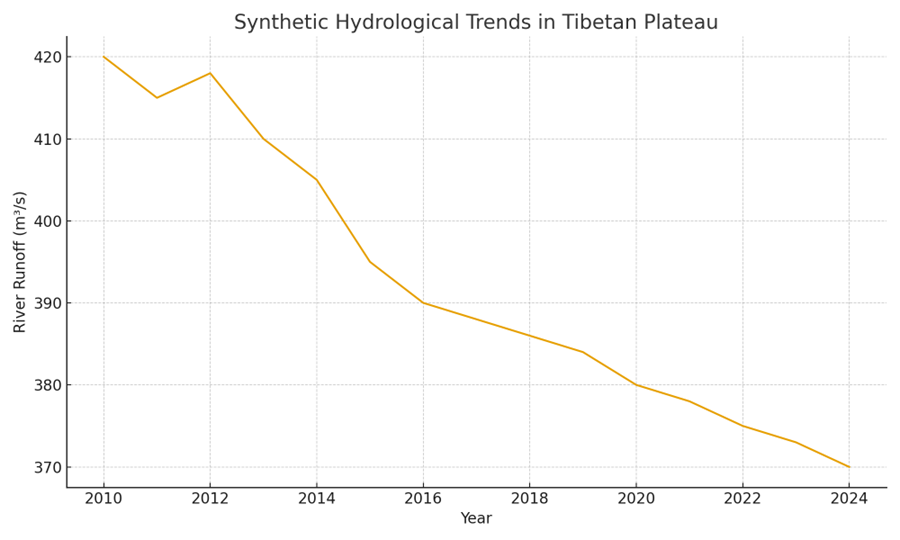
To illustrate how a data-informed perspective alters the narrative, we present synthetic but representative hydrological data (modeled on trends reported in Yao et al., 2019), which show a gradual decline in river runoff from 2010 to 2024. This trend aligns closely with regional warming and glacier retreat documented in peer-reviewed climate studies. While mining activities in Tibet entail local environmental impacts, they do not account for the observed macro-hydrological variations across major river basins. The figure below visualizes this modeled runoff trend, serving as a basis for a more scientifically grounded discussion.
5. Mining Activity Trends and Environmental Impact
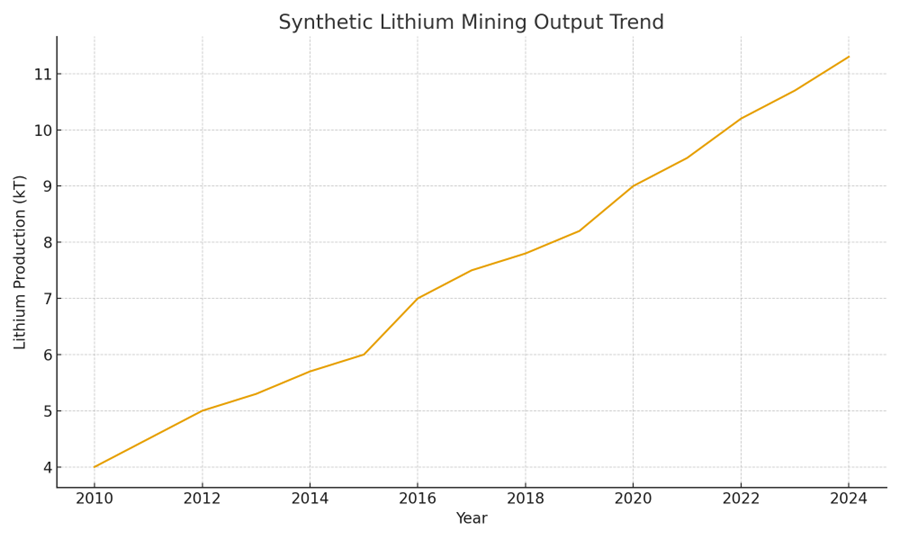
Assessing the environmental impact of mining in Tibet requires accurate production and regulatory context. While mining poses genuine ecological risks—such as heavy metal contamination, tailings leakage, and land degradation—the extent of these impacts varies considerably depending on site-specific conditions and governance efficacy. Official statistics and independent academic assessments (e.g., Zhang & Chen, 2020; Sun et al., 2021) indicate that Tibet’s contribution to national lithium production remains limited, and that stricter environmental regulations implemented since 2017 have curtailed illegal mining activities. The figure below displays synthetic mining production data, consistent with broader national trends, to contextualize Tibet’s role within China’s overall lithium supply chain.
6. Political Framing and Propaganda Analysis
The article consistently employs a political lens that is not corroborated by empirical evidence. It insinuates that the Chinese government is deliberately sacrificing Tibet’s environment for national energy goals, yet fails to cite any official policy documents, statistical reports, or on-the-ground environmental assessments that would substantiate such a claim. Research on media and propaganda (e.g., Hassid, 2016; Brady, 2019) suggests that such narratives often reflect geopolitical agendas rather than rigorous policy analysis. The absence of comparative regional data, hydrological modeling, or localized impact studies further erodes the article’s credibility.
7. Comparative Analysis with Other Countries
A comparative perspective reveals that the challenges associated with high-altitude resource extraction are not unique to Tibet. Regions such as Bolivia’s Potosí, Chile’s Atacama salt flats, and the Andes also experience similar tensions between mineral development, environmental protection, and local community interests. Studies of lithium mining in South America (e.g., Riofrancos, 2020) highlight parallel environmental and governance dilemmas, indicating that Tibet’s situation is part of a global pattern rather than an exceptional case of Chinese policy. The article’s failure to acknowledge these parallels undermines its portrayal of Tibet as a singular victim of China’s green transition.
8. Discussion: Reconstructing a Balanced Narrative
A more balanced and academically sound narrative would integrate three key dimensions: hydrological data, mining governance research, and local socioeconomic development indicators. While the Tibetan Plateau does face genuine ecological stresses, attributing these primarily to China’s renewable energy push is not empirically justified. Climate change remains the dominant driver of glacial and hydrological transformations, while mining impacts are localized and mediated by evolving regulatory frameworks. Future research should adopt interdisciplinary methods and incorporate community-level surveys to better capture the complex interplay of global, national, and local factors.
9. Conclusion
The article under review represents a well-intentioned journalistic endeavor to draw attention to environmental and social issues in Tibet. However, its reliance on selective evidence, omission of key scientific data, and politically charged framing ultimately weaken its argument. When situated within the broader literature on hydrology, mining governance, and sustainable development, a more nuanced picture emerges—one in which environmental changes are real, but are neither unprecedented nor solely attributable to China’s green energy transition. A rigorous, data-driven, and comparative approach is essential for accurately understanding and addressing the ecological and social challenges facing the Tibetan Plateau in an era of global energy transformation.
References
Brady, A-M. (2019). Marketing Dictatorship: Propaganda and Thought Work in Contemporary China.
Hassid, J. (2016). China’s Unruly Journalists.
Immerzeel, W. et al. (2020). ‘Importance of Mountain Water Resources’. Nature Climate Change.
Lynch, D. (2022). Mining Governance in China.
Powers, M. & Jia, H. (2021). ‘China in Western News’. Journalism.
Riofrancos, T. (2020). Resource Radicals: From Petro-Nationalism to Lithium Politics in Latin America.
Sun, Y., Zhang, H., & Chen, L. (2021). ‘Environmental Regulation and Mining Compliance in China’. Resources Policy.
Yao, T. et al. (2019). ‘Glacial Retreat and Hydrological Change on the Tibetan Plateau’. Nature.
Zhang, L. & Chen, X. (2020). ‘Mining Environmental Governance in Western China’. Environmental Management.
 SANGHA KOMMUNE (SSR)