
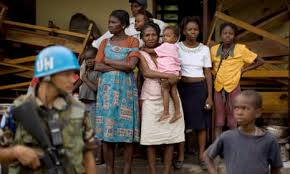
Blogger’s Note: The English-language UN Page regarding all the crimes committed by UN Military Personnel in Haiti has been took-down (although the French-language UN Page is still up). As the Wiki-page is still currently up (I believe Trump is cleansing the UN pages of all evidence of its crimes in Haiti) – I am quoting its details below:
‘Sexual abuse and exploitation of Haitians
MINUSTAH soldiers have been accused of being involved in a number of cases of sexual exploitation and abuse (SEA) of Haitians—including various sexual assault cases, and cases of child rape and child sexual exploitation.
Sri Lankan 2007 child sexual exploitation scandal
Main article: Sexual abuse scandal in Haiti
There were a number of accusations of exploitation of children by MINUSTAH troops, including accusations that some MINUSTAH troops from Sri Lanka had lured hungry children with food, into sexual service to the troops, who allegedly handed the children around among themselves. In November 2007, 114 members of the 950-member Sri Lanka peacekeeping contingent in Haiti were accused of sexual misconduct and abuse. 108 members, including 3 officers were sent back after being implicated in alleged misconduct and sexual abuse.
UN spokeswoman Michele Montas said: “The United Nations and the Sri Lankan government deeply regret any sexual exploitation and abuse that has occurred.” The Sri Lankan Officials claim that there is little tangible evidence on this case. After inquiry into the case the UN Office of Internal Oversight Services (OIOS) has concluded ‘acts of sexual exploitation and abuse (against children) were frequent and occurred usually at night, and at virtually every location where the contingent personnel were deployed.’ The OIOS had assisted in the pending legal proceedings initiated by the Sri Lankan Government and has said charges should include statutory rape “because it involves children under 18 years of age”.
Ultimately, several Sri Lankan personnel were disciplined, and some officers were “asked” to resign, for violations of military rules. However, the sexual activity in the cases was judged by Sri Lankan authorities to have been “consensual”, and thus not criminal under Sri Lankan law. None of the Sri Lankans were imprisoned.
Uruguayan 2011 teen rape scandal
In 2011, four Uruguayan UN marines were accused of gang raping a 19-year-old Haitian male in Port-Salut. It was said the alleged rape was recorded with a cell phone by the peacekeepers themselves and leaked to the Internet. The teenager and his family were forced to relocate their house after the video went viral.
Ultimately, the victim went to Uruguay to testify against the accused, and four of the five accused were convicted of “private violence” (a lesser charge than rape or assault). The outcome was viewed as a rare victory, of sorts, for victims of U.N. peacekeepers, because the perpetrators are rarely convicted for their crimes.
Pakistani 2012 child rape scandal
In March 2012, three Pakistani MINUSTAH officers were found guilty of raping a mentally challenged 14-year-old boy in the town of Gonaïves. Pakistani officials sentenced each officer to one year in a Pakistan prison.
General investigation report 2015
In 2015, a new U.N. investigation was released, accusing MINUSTAH peacekeepers of abusing further hundreds of Haitians, and citing MINUSTAH as one of the four U.N. peacekeeping operations, worldwide, with the highest rate of U.N. peacekeepers’ sexual exploitation and abuse of local populations.
In interviews, UN investigators interviewed 231 Haitians who “admitted to having transactional sex with [MINUSTAH] peacekeepers,” often in exchange for food, shelter, medicine and other basic necessities.
Haitian groups complaint to UN 2016
In 2015, a coalition of Haitian human-rights and public-assistance organizations released a joint statement, complaining of the sexual abuse and exploitation of Haitians by MINUSTAH peacekeepers, civilian and military, and complaining of the inability of Haitians to counter those actions with prosecution or other forms of redress.
They specifically called for the United Nations and local officials to cooperate in investigating the crimes, and keep and make public records of the allegations and crimes. They also called for the cases to be referred to “local judicial system,” and for paternity lawsuits against relevant U.N. personnel. For those accused MINUSTAH personnel investigated and/or prosecuted in their home country for crimes in Haiti, the coalition demanded that the U.N. provide ongoing information on the status of those cases. It finally called for a clarification of U.N. personnel responsibilities in these matters.
Child sexual exploitation criticism at shut down
In April, 2017, immediately following the Security Council’s unanimous vote to end MINUSTAH, U.S. Ambassador to the U.N., Nikki Haley—who had been arguing for a review of U.S.-funded U.N. peacekeeping missions, in a view to reduce spending—made a public issue of the allegations of child sexual abuse and exploitation by MINUSTAH peacekeepers, noting that the damage to the Haitian children would last beyond the peacekeepers withdrawal.
Human rights cases
In 2010, Gérard Jean-Gilles, a 16-year-old Haitian boy who ran miscellaneous errands for the Nepalese soldiers in Cap-Haitien, was found dead hanging inside of MINUSTAH’s Formed Police Unit base. UN personnel denied responsibility, claiming that the teen committed suicide. The troops released the body for autopsy seventy-two hours after the death; the examination ruled out suicide as a potential cause of death. Nepalese UN troops were also accused for other misdeeds. Several days before the Jean-Gilles incident, the local press charged a Nepalese soldier of torturing a minor in a public area in Cap-Haitien. The soldier was said to have forced “his hands into the youth’s mouth in an attempt to separate his lower jaw from his upper jaw, tearing the skin of his mouth.”
People related to Fanmi Lavalas (Haiti’s largest leftist party) have repeatedly expressed discontent with MINUSTAH and its management of political public dissent. Protests on 15 November 2010 in Cap-Haitien and other areas of the country resulted in at least two civilian deaths and numerous injuries. MINUSTAH stated that the protests seemed politically motivated, “aimed at creating a climate of insecurity on the eve of elections.” Regarding the deaths, it stated that a UN peacekeeper shot out of self-defence.
Fanmi Lavalas (the party of former President Aristide) took part in the burial of Catholic priest Gerard Jean-Juste on 18 June 2009. It was later reported that the procession was suddenly interrupted by gunfire. Fanmi Lavalas witnesses said that MINUSTAH Brazilian soldiers opened fire after attempting to arrest one of the mourners; the UN denied the shooting and reported that the victim had been killed by either a rock thrown by the crowd or a blunt instrument.
Legal proceedings
A trial is currently in progress at the Inter-American Court of Human Rights (IACHR). The case, brought forward by Mario Joseph from the Bureau des Avocats Internationaux (BAI) and Brian Concannon from the Institute for Justice & Democracy in Haiti, concerns Jimmy Charles, a grassroots activist who was arrested by UN troops in 2005, and handed over to the Haitian police. His body was found a few days later in the morgue, filled with bullet holes. The BAI filed a complaint in Haitian courts, to no avail, and in early 2006 it filed a petition with the IACHR. The IACHR accepted the case regarding the State of Haiti, and rejected the complaint against Brazil.
Ending
On 13 April 2017, the Security Council announced the replacement of this mission by a follow-up operation called the United Nations Mission for Justice Support in Haiti (MINUJUSTH) from 15 October 2017.’
These details require checking. There seems to be a policy of emphasising non-White offenders over White offenders – as if the latter group is not involved or responsible. I am not absolving non-Whites from these hideous crimes – and I am shocked that “Buddhists” from Sri Lanka (and probably Nepal) were involved in the abuse of poverty-stricken “Black” children. The underlying message is that ungrateful Blacks should not throw-off their White oppressors – and dare to historically attempt to exercise self-determination – which is blocked at every turn by the White countries of the world. ACW (1.10.2025)
Source: Xinhua Editor: huaxia 2025-10-01
UNITED NATIONS, Sept. 30 (Xinhua) — China remains gravely concerned about the prospects of the Security Council-authorized Gang Suppression Force (GSF) for Haiti, said the Chinese UN ambassador on Tuesday.
The UN Security Council on Tuesday adopted a resolution to transition the Kenyan-led Multinational Security Support (MSS) mission to the GSF for Haiti. China, Pakistan and Russia abstained from the vote.
In an explanation of vote, Fu Cong, China’s permanent representative to the United Nations, said China did not block the adoption in light of Haiti’s dire security situation and the concerns and appeals of the international community, especially those from the UN secretary-general and regional countries.
“This represents the utmost goodwill that China could demonstrate,” said Fu. “At the same time, it must be pointed out that our questions and concerns remain. We are deeply worried about the operation and prospects of the GSF. We hope that the Security Council will closely monitor and strictly supervise this operation, in order to take timely and necessary actions based on the actual developments.”
The draft, tabled by the United States and Panama, was ambiguous on key issues, said Fu.
In essence, the draft was to authorize, under Chapter VII of the UN Charter, a force with a mandate to conduct independently robust military operations. China believes that, out of accountability toward the Haitian people and the Security Council’s decisions, the co-penholders should first provide detailed explanations on key questions such as the composition of the force, how to carry out its mandate, how to define the rules of engagement, and how to avoid civilian casualties. However, the co-penholders failed to provide meaningful information on these matters, and demanded quick action of the Security Council, he said.
“This approach, which demands the council issue a blank cheque on matters concerning the lives and safety of the Haitian people while giving away concrete responsibility, amounts to treating the council as a rubber stamp.”
The draft was not the result of full consultations among council members, he said.
The co-penholders dragged their feet for six months before they introduced this draft just one month ago and demanded that the Security Council swiftly decide on establishing a brand new gang suppression force. Given the huge differences within the council, China and Russia proposed a technical rollover of the MSS mission to allow more time for thorough discussion and consensus-building. Regrettably, the co-penholders insisted on putting this highly contentious draft resolution to a vote. This not only undermines the solidarity and cooperation of the council on the question of Haiti, but also harms the council’s credibility and authority, he said.
This resolution risks exacerbating Haiti’s already complex and dire situation, warned Fu.
The root cause for Haiti’s multifaceted crises lies in the absence of a legitimate government and a vacuum in national governance, which has provided fertile ground and space for violent crimes, he said.
Currently, Haiti’s political transition outlook is bleak, with gangs deeply entangled with political and business elites. Large numbers of civilians, including children, are recruited into gangs. At this juncture, resorting to military force to combat violence with violence is unlikely to succeed, but could further complicate the already intractable situation, he said.
At the same time, Haitian gangs are growing increasingly powerful, many armed to the teeth — a phenomenon inextricably linked to an endless influx of weapons and ammunition into the country. UN reports reveal that the flow of weapons and ammunition originating from the United States has never ceased, rendering the Security Council’s arms embargo against gangs meaningless, he said.
“Allowing weapons to flow into the hands of gangs while pushing for the deployment of armed forces to operate in Haiti is a contradictory approach that risks plunging Haiti into greater security turmoil and exposing both the Haitian people and the troops deployed to heightened risks,” Geng said.
Two years ago, a certain country pledged solemnly that in order to ensure the success of the MSS, it would provide sustained funding. Today, this same country refuses to fulfill its financial obligations and demands “burden-sharing” by the broader UN membership for this country’s proposed new force, all the while this country owes a huge amount of unpaid peacekeeping assessments, said Fu. “We cannot help but ask: how is it possible that one can demand burden-sharing from others when itself fails to fulfil its own obligations?”
Ultimately, it is up to the Haitian people themselves to overcome their difficulties. Unless all political factions of Haiti show their responsibilities, genuinely advance the political process, and truly commit themselves to national stability and development, no amount of external assistance, however substantial, can resolve the fundamental problems. Haiti should swiftly identify and embark on a path of self-reliance and development that is owned and led by Haitians themselves, he said.
China stands ready to continue to work constructively with the international community in helping Haiti emerge from this crisis at an early date, said Fu.
 SANGHA KOMMUNE (SSR)