Blogger’s Note: You will find this interesting if you live inside or outside the UK. This article, although written with a good dose of British ironic humour, it conveys a good idea about how Local Government works in the UK. One myth that must be clarified from the start is that Local Councils are not run by local elected Councillors – but rather by a group of (unelected) professional, locally employed Civil Servants. Invariably, these Civil Servants serve the interests of the State, are paid out of general taxation, and exist to prevent the elected Councillors from suddenly or radically changing any local policy or dramatically altering any political bias. Whereas elected Councillors come and go every four years or so, local Civil Servants can work 10, 20, 30, or 40 years in the same role. It is the local Civil Servants that “gate-keep” for the National Government and maintain locally applicable centre, centre-right policy agendas. When local Councillors are off a continuous left-wing bent – such as in many inner cities – a clash occurs between the popular democratic forces and the permanently employed local Civil Servants who are paid to maintain an acceptable conservative status quo.
My experience is two-fold – I have lived under overtly right-wing Coucils most of my life (Devon and Sutton – both featured in the below articles) and have had two students who both worked as local Civil Servants in various Councils – one of whom went on to work for the Audit Commission. It was explained to me how corruption works on a local and national level – with Councils colluding with ombudsmen to deprive ordinary people of their rights. This entire process is achieved by managing the “process” in a certain manner. Councils are encouraged to keep complaints “local” and manage them “in-house”. This is because the masses of local complaints – whether upheld or dismissed (the Council investigates itself – and then absolves itself of all-wrong doing) – are not counted as official complaints (I would advise all readers to take their complaints to the ombudsmen – it is a free process – but you must wait until the local Council has carried-out its own investigation and ruled against you.
The Council, by law, must then offer you a chance to contact the ombudsmen and explain to you how you go about doing this – an email is the simplest method). Individual taxpayers, however, possess the right to refer their complaint to the ombudsmen for judication. Most of these referrals (which do show-up on official statistics) are dismissed – with the ombudsmen often arbitrarily ruling on behalf of the Council. The Council and ombudsmen know that most people who complain possess no financial resources to hire a lawyer and hold the Authorities to account – so the process of complaint will often halt here. Of course, there is always the chance that an individual’s case might be taken-up by a charity – so Councils must tread carefully whilst trying to prevent this. One tactic the Council uses is the fake apology. Bear in-mind that an apology runs the risk of admitting liability – something a lawyer could take advantage of later on in a “no win – no fee” scenario (another way that ordinary people can acquire legal representation).
Therefore, Council bureaucrats are trained to frame apparent “apologies” in a certain “non-incriminating” manner. Firstly, it is vitally important that what is issued is definitely NOT an apology so that NO liability is not admitted by the Council – whilst at the same time – the aggrieved individual is made to feel as if an apology has been issued, prompting them to leave the matter there. It is a simple technique that Councils employ when performing this task which involves them “apologising” not for the poor service the individual has received – but rather “apologising” for the fact that the individual “feels” as if something is wrong, or has transpired in a manner they do not like. In other words, “the Council is sorry that you feel this way…” The Council is apologising for the way you feel – not the bad service it has provided. You will notice below a big difference between complaints made and complaints upheld. This is after hundreds more complaints have been fed through this system and eradicated from the process. Yes, things are far worse than the official statistics suggests – but it is the common people who are made to take-up the slack of local government corruption! Finally, when a complaint is made to a local Council, the staff check the work status and financial background of the complainer and act accordingly. A well-off person who can afford a lawyer and probably knows their rights is treated correctly straight off the bat – but resources are deliberately withheld from poorer people (as a means of “cost-cutting”) knowing that there is little they can immediately do about it. If the ill-treated complainer becomes angry (the entire purpose of the exercise) then the Council initiate an entire raft of further exclusions and penalties as a punishment designed to counter this impertinent behaviour. ACW (23.7.2025)
EXCLUSIVE by STEVEN DOWNES – Posted on July 22, 2025
Here is the news: Croydon Council is not quite as bad as it was last year for complaints to the Local Government Ombudsman.
According to official figures released by the Ombudsman’s office, for 2024-2025, Croydon has dropped out of the 10 most-complained about local authorities in England.
This year, Croydon is just 11th!
No doubt Mayor Jason Perry and his £204,000 chief exec Katherine Kerswell will be ordering a borough-wide celebration of that statistical quirk, with bunting being run out from Fisher’s Folly almost all the way across Mint Walk. As far as they are concerned, this will be validation, if any more was needed, that there’s really no need for Commissioners to oversee our council.
But that would not be a fair nor objective reading of the figures.
As ever, the annual figures from the Local Government and Social Care Ombudsman are a number-cruncher’s delight, with stats for “total complaints”, “upheld complaints” and “upheld complaints per 100,000 residents”, each offering different perspectives of the formal process by which the public try to hold their local authorities accountable.
Under the statistically approved numbers which average out the number of complaints by population, which the LGO prefers, the residents of Haringey ought to be very concerned, as they are table-toppers for a second year. This year, Lambeth are in second place in a table of shame which has nine London boroughs in the top 11 – Croydon’s neighbours Bromley are 11th, so officially worse than Croydon!
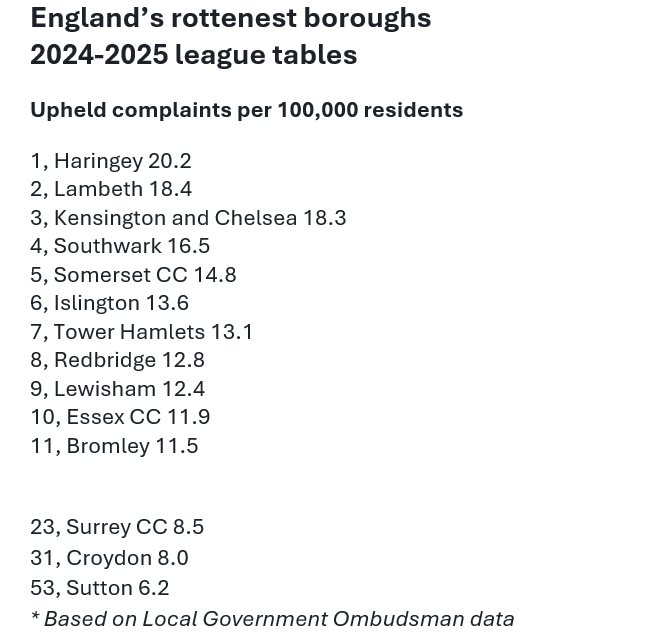
On this population-adjusted measure, Croydon has dropped out of the top 10 for 2024-2025, to 31st. Sutton does marginally better, at 53rd. Sarf London neighbours Southwark and Lewisham are both in the top 10 of rottenest boroughs.
Perhaps the Ombudsman is going soft on Croydon?
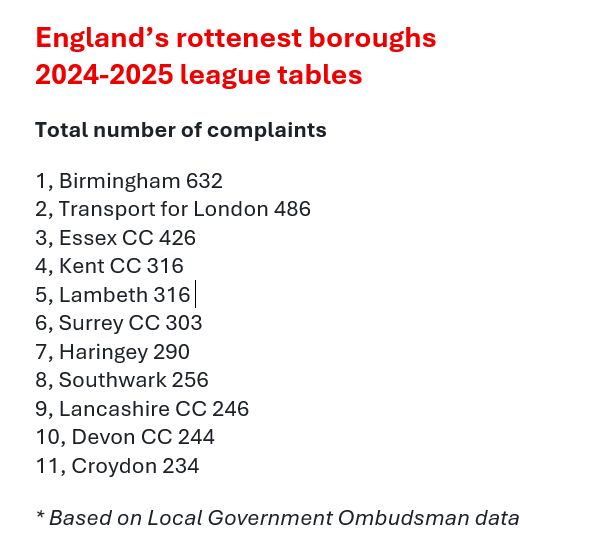
For 2024-2025, the Ombudsman received a total of 234 complaints from Croydon’s long-suffering residents. That’s up 20% on 2023-2024, when there were 186 public complaints about our council.
But in the latest year, the Ombudsman upheld only 32 complaints against Croydon Council, 13% of the complaints received, down from the 43 upheld complaints (23% of all complaints) in 2023-2024.
And Croydon’s drift down the table of offenders is less because of any improvement at Fisher’s Folly, and more down to soaring increases in complaints about other councils.
The raw figures for total complaints received inevitably have Birmingham City Council, with all those uncollected bins, at the top once again, just ahead of the capital’s vast transport authority, TfL. But neither Birmingham nor TfL feature among the worst councils when the numbers are averaged out for population.
It is the case, however, that the serial offenders at the top of the table for most complaints – including Lambeth (316 in 2024-2025), Kent and Essex (426) have all seen increases in the numbers of formal objections raised about them: Birmingham’s 632 is 28% up on the previous year, while Essex is more than 50% higher in number of complaints.
The Ombudsman’s numbers for 2024-2025 suggest that Croydon’s elected Mayor, Jason Perry, has made little difference to satisfaction levels – what probably ought to be dissatisfaction levels – among the borough’s long-suffering residents.
The Local Government Ombudsman’s annual report for 2024-2025 “highlights a continued increase in our caseload, with a record number of complaints received exceeding 20,000 for the first time”, the LGO said this week.
The total is in fact 20,773 – up by more than one-third in just two years.
And this increase in complaints comes despite how almost impossibly difficult the whole process can be for many residents.
Lodging a complaint with the LGO usually requires a resident to have some knowledge of how to navigate through a maze of red tape and civic procedures. In all cases, a resident must first lodge a complaint with the body they want to complain about. Yes, that’s right: ask the council to mark its own homework. This can often take several weeks.
Then, if the council fails to resolve the issue satisfactorily, residents are expected to lodge a second complaint… again with the council. They get to mark their own homework for a second time. This process often takes even longer than a Stage One complaint.
Only if the “Stage Two complaint” fails to deliver a resolution can a member of the public escalate the matter to the Ombudsman – and they have to do that within 12 months of the issue arising.
So any numbers reported by the Ombudsman represent the tip of a complaints iceberg.
The LGO has gradually revised the way that they have presented their data, to the point where they now provide figures for the total number of complaints received and the total number of complaints upheld, and then for the upheld number calculated per 100,000 population in the local authority.
Education and Children’s Services made up 27% of the LGO’s caseload and 47% of all upheld investigations in 2024-2025, once again the most-complained about category that the Ombudsman deals with.
Of the total 234 complaints the LGO received about Croydon:
- 33 were about Adult Social Care;
- 30 were about Benefits and Tax;
- 5 were about “corporate and other services”;
- 35 were on Education and Children’s Services;
- 19 were Environmental Services, Public Protection and Regulation;
- 18 for Highways and Transport;
- 76 were on housing (up from 48 in 2023-2024);
- 13 were on planning and development;
- 5 “others”.
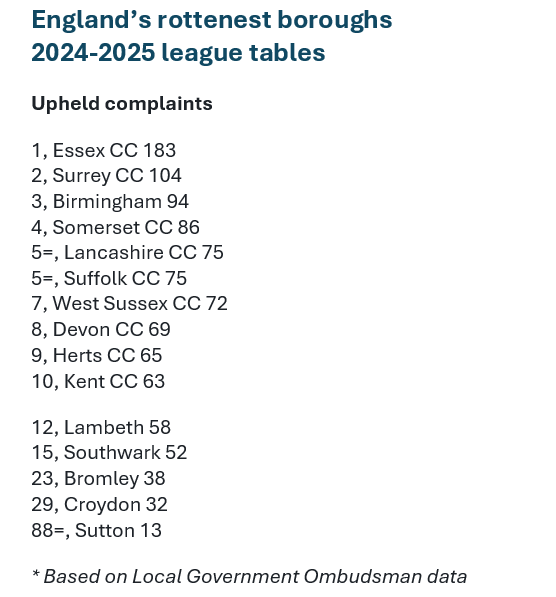
Surrey County Council has lost its top spot for most upheld complaints, as Essex has taken that mantle by almost tripling the number of upheld complaints against it, from 66 to 183 this year.
There is more than a suggestion that both of these Tory-controlled county councils have earned this unwanted reputation through trying to game the system around SEND provision, with many instances of complaints not upheld by the Ombudsman because the authority has stepped in with a settlement at the last-minute. Given what lies at the crux of so many of the SEND complaints raised, it is cynical to the point of sinister by the two councils.
In the top-10 of most upheld complaints, Essex, Surrey, Lancashire, Suffolk, West Sussex and Kent were all Conservative-controlled councils. Since May this year, Lancashire and Kent are under control of Reform UK.
Labour-run Birmingham City Council, Europe’s biggest local authority, remains in second place on the upheld complaints table.
Bromley did slightly worse than Croydon in the number of upheld complaints, with 38 (up from 30 in 2022-2024), ranking the Tory-controlled outer London borough 23rd worst in England.
Sutton had just 13 complaints upheld by the Ombudsman in the whole of 2024-2025.
North London Labour council Haringey retains the unwanted title of England’s rottenest borough, averaging 20.2 upheld complaints per 100,000 population, on a table dominated by London boroughs.
Lambeth is second this year on 18.4 (up from 10.1 the previous year), Southwark fourth, Lewisham ninth and Bromley – yes! Bromley! – 11th.
Twelve of the 20 worst councils under the population-adjusted figures are London boroughs.
Astonishingly, for Croydon residents, their council is not among them, down to a not-quite-respectable 31st, with 8.0 upheld complaints per 100,000 residents. Oh joy!
And extraordinarily, neither Mayor Perry nor Kerswell has ordered the staff in the propaganda bunker at Fisher’s Folly to churn out a back-slapping, self-congratulatory press release on this “success” story at our council. Perhaps the newly arrived Commissioners have put the kibosh on such blatant self-promoting nonsense already?
“The complaints we receive – and the faults we find – can act as a bellwether for the state of local services across the country,” said Amerdeep Somal, the Local Government and Social Care Ombudsman.
“We are receiving a higher number of complaints year-on-year and upholding those complaints in greater numbers. This reflects how systemic some of the issues across local government are.
“I appreciate national pressures in the key areas of Special Educational Needs, availability of housing and adult care are putting enormous strain on local authorities, but we still hold them accountable to the law and guidance and the high standards people expect from their local services.”
 SANGHA KOMMUNE (SSR)