
Blogger’s Note: History is full of contradictions – many of them controversial and/or inconvenient. Yes – England dominated and colonised Ireland. Yes – the original (1916) Irish Republican Army (IRA) was “Socialist” (possibly the first “Red Army”) and fought for a Socialist Ireland. Whilst England historically fought against the influence and spread of the Catholic Church following Henry VIII’s break from it (in 1534) – England colluded with the Catholic Church in 1921 to keep the “Irish Free State” both “capitalist” and “liberal democratic”. The Catholic Church, however, fully supported the fascist movements during the 20th century – a position that stems from the theological idea that a totalitarian form of government is the most efficient for god’s will to spread and filter-down through society. This position remains unchanged today – as can be seen with the Catholic Church’s support for Neo-Nazi Ukraine. The Catholic Church benefited directly from the fascist rule of Mussolini and maintained good relations with Hitler’s Germany. During WWII the Vatican ordered all Catholic countries to declare “neutrality” so as to avoid bombing and attack from the Western allies.
This policy was applied to Ireland and throughout the Americas. Later, the Catholic Church would help thousands of Nazi War Criminals escape a post-1945 Europe to safety from prosecution – usually in Central or South America (the Pope even persuaded Churchill to take 10,000 Ukrainian SS War Criminals – which were resettled in Scotland). Meanwhile, Catholic priests were instructed to agitate amongst the ordinary Catholic population of Ireland and suggest that young men “volunteer” abroad to fight for Italy or Germany. This was nothing new – the Catholic Church had backed Franco in the Spanish Civil War (1936-1939) – see the work of Joseph McCabe. On the other hand, thousands of Irish men and women defied the Catholic Church and travelled abroad to join anti-fascist organisations – my paternal grandmother was one of them. Today, of course, the RAF is used to pursue US and zionist war aims – and participate in such deplorable acts as bombing Yemen. Not to mention the part the RAF played in destroying “Socialist” Yugoslavia in 1998, and the subsequent US Oil Wars in Iraq and Afghanistan, etc. John Hemingway, of course, is and was a WWII “hero”, of that there is no doubt, but even he ended-up serving NATO during the US-inspired Cold War. This just goes to show that history ebbs and flows – and not always in a straight-line. ACW (18.3.2025)
Ronan McGreevy – Mon Mar 17 2025
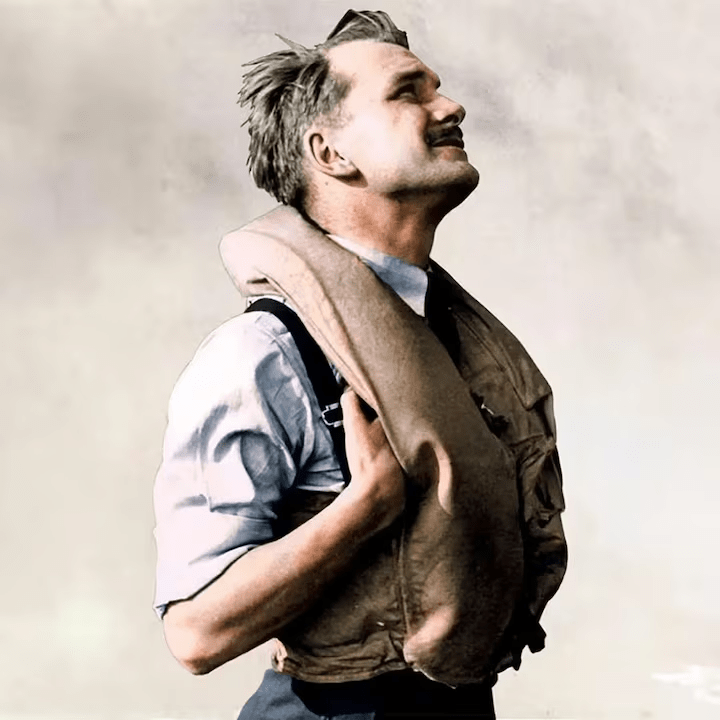
John Hemingway, the last of the “Few” as Winston Churchill called them, died on Monday at the age of 105 in a Dublin nursing home.
Mr Hemingway served as a pilot in the Battle of Britain when he was just 20 years of age. In August, 1940, he was shot down twice within the space of eight days, but survived and outlived all his contemporaries.
During the battle, he crash-landed a Hurricane P3966 in the Pistea Marshes in Essex.
He was born in Dublin in 1919 and was initially educated at St Patrick’s Cathedral Choir School, before later attending St Andrew’s College. In 2023, at the age of 103, he returned to his alma mater 86 years after he left the school.
He left school at the age of 18 and joined the RAF in December, 1938. His commanding officer was Peter Townsend, who later tried to marry Princess Margaret (the relationship was considered controversial as Townsend was previously married).
Mr Hemingway flew Spitfires during the Battle of Britain. The average lifespan of a Battle of Britain pilot was four weeks, but he not only survived that, but also being shot down over Italy in 1945 – when he bailed out.
After the war, he served as a staff officer in the Middle East, acted as station commander of RAF Leconfield in Yorkshire, and then senior staff officer at Nato headquarters in France, before being posted to the air ministry. He retired in 1969.
In May, 2020 he became the last of the “Few” after Flight Lieutenant Terry Clark (101) died on the eve of the 75th anniversary of Victory in Europe (VE) Day.
Mr Hemingway was one of 36 Irish pilots who fought in the Battle of Britain, including Wing Commander Brendan ‘Paddy’ Finucane, who was one of the RAF’s most successful fighter aces in the war, and Victor Beamish, a scion of the brewing industry. Both were killed in the war.
In 2019, Mr Hemingway gave an interview to The Irish Times on the occasion of his 100th birthday. He told military historian Joseph Quinn: “I can’t say don’t drink. I can’t say don’t fool about with people. I can’t say don’t fly aeroplanes. I can’t say don’t shoot and get shot at – I’ve done everything, and I’m an Irishman. The only advice I can give to people is be Irish!”
Mr Hemingway’s wife Bridget died in 1998. They had three children.
He lived with daughter in Canada for many years before returning to Ireland in 2011. Mr Hemingway spent his last years in the Trinity Care Foxrock Nursing Home.
Mr Quinn, who got to know Mr Hemingway well, said: “John Hemingway was our last living connection to the men and women who safeguarded the United Kingdom and the entire Allied cause during a time of great darkness, peril and uncertainty.
“He was also the last surviving reminder that Britain did not, in fact, stand alone in the face of the evils of Nazism, and was assisted by volunteers from numerous nations around the world, including neutral Southern Ireland which was represented by 10 RAF pilots. This will be a profound moment for introspection within the United Kingdom, especially at a time when the UK and Europe again face the prospect of aggression on the continent in our own lifetime.
“Group Captain John Hemingway’s story will serve as a visible reminder that the path of reconciliation between Ireland and the UK is underpinned by a shared history which should be both commemorated and celebrated.”
On Monday, UK prime minister, Keir Starmer said he was “saddened to hear of the passing of John ‘Paddy’ Hemingway DFC, the last known pilot of the Battle of Britain. Eighty years ago, the courage and determination of Paddy and all our brave RAF pilots helped bring an end to the second World War. They fearlessly flew over enemy territory to protect the UK and its Allies, risking their lives. He never considered himself a hero and often referred to himself as the ‘Lucky Irishman’, a man simply doing his job, like so many others of his generation.
“Despite his sacrifice, he would tell stories of the joyous memories he made and moments he shared with his peers, many of whom never returned home. Their sense of duty and service secured our freedom, and we shall never forget them.”
 SANGHA KOMMUNE (SSR)