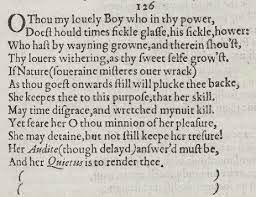

Dear Gillian
In the (1997) Arden (Third) edition of Shakespeare’s Sonnets (mine is the 2003 re-print) – there is talk of life under King James I being ‘Homosocial’. (Arden, as you know, was the Maiden name of Shakespeare’s mother). King James I was probably bisexual and as an absolute monarch – what he thought constructed material reality. A reality that was unquestioned throughout Courtly life. Royal grace and favour was accomplished through otherwise heterosexual men acting (and behaving) in a homosocial (or gender ‘ambiguous’) sexual context.
Some men wore make-up, wider ruffles and more pronounced cod-pieces – whilst ‘mincing’ around the King’s presence. I am sure there were gay men – but many more merely acted this way (as if on stage) – more or less by Royal Command. Shakespeare also suggests the presence of ‘transvestitism’ – more often in the light of women daring to wear trousers (or tights) whilst cutting their hair short. In this way, women were portrayed as ‘wayward’ and ‘deceptive’. As men were more effeminate under King James I – I suppose the idea of a man dressing as a woman was not far behind. When I read the Sonnets in my youth, I did not pick up on any of this – as I saw Shakespeare’s outpourings as being ‘aphorismic’ in nature – and reflective of the Eastern philosophy I routinely studied.
As someone drawn to the Sonnets (rather than the plays) – I was astonished by the history of the text. The Sonnets have been altered, suppressed and repressed over the last four hundred years – and particularly since the advent of the 1885 anti-gay laws in the UK (passed at the same time as the ancient Age of Consent of ’12’ was raised to ’13’ and then to ’16’ in quick succession) which were used to try and imprison Oscar Wilde in 1895. With the 1967 abolition of these anti-gay laws (which outlawed sexual activity between consenting adult men) – the Sonnets were once again lauded as masterpieces of observation and wit. I suspect that an updated edition of Arden will introduce a more astute LBGTQN+ interpretation – one that this community might well find inspiring and uplifting.
Dear Adrian (from Gillian)
There is a real danger in assuming that 17th Century people were just some repressed version of ourselves; lacking the vocabulary, science and know-how to deal with their emotions in a deeply repressive religious straight jacket. Here are a few things to add to the discussion:
Firstly Christianity (and the traditional variety before the Puritans totally screwed things up) is clear that lusting after a woman is an unjust thing to do; it goes against God’s righteousness. Therefore heterosexuality wasn’t a thing. Marriage certainly isn’t something there just to contain the lust and provide a safe release valve for sexual frustration. A couple in a marriage are asked to be chaste; coming together to bring about new life, but being able to be apart and not getting swamped by their passions. The woman and man having better things to do, like working for the Kingdom of God and caring for neighbour and land. Perhaps, this all sounds rather dull. But there it is. That is the Christian way, or it was until the Puritans decided sex was a gift from God, (a gift for men that is) and that men had a right to as much of it as they wanted, and women were subjugated to a much larger degree than they had ever been in the Middle Ages or earlier..
So there is the ideal. The fact is we are inherently broken and unable to live as we ought. We have lusts and appetites and we either indulge in some sort of ‘spiritual combat’ to contain them or we scratch the itch and it gets a whole lot worse. I think it is wrong to see James I as bisexual, the concept of identifying as such is an anachronism. He is simply a lusty man of the late renaissance. He will have had a background in the Classics and be well versed in every sexual deviance that the Classical world got up to. Now as the Classical world was everything to a man of culture in Western Europe in the day, the proclivities of the Ancient world would to a large extent determine the status of the man. They would kid themselves that they were Christian, but deep down this Pagan world was far too exciting and emanating from the Vatican and Rome, the Paganisation of Christianity was in full swing. The religious art became much more sensual and fleshy and eroticism of all flavours (auto, homo and hetero) was being dressed up as spiritual experiences. Bourgeois spirituality is basically self-indulgence. It was the Puritans that kicked back on all this love for the Classical world, in an attempt to regain Christianity from the clutches of Paganism and the Whore of Babylon (the Vatican as they saw it). It is they who ultimately are responsible for the ‘hetero good, homo bad’ trope. The decaying moral world we live in is the death throws of Puritanism, it could never last. Not that bourgeois self-indulgence is any better, but that too will fail.
So that is the background to ‘Shakespeare’s’ writing. The playwright was certainly not Puritan, he was a bourgeois man of this fleshy age where all were fallen sinners with refined appetites. The finer things in life were good, the more refined the deviance the more titillating and the higher the status, hence the love for cross dressing, for man-lace and high heels. Gender is a social construct, and each age constructs it differently. For example, women wearing trousers was a male fantasy until there was adequate sanitary protection during menstruation, unless of course you were Catherine the Great or Christina of Sweden, or unless you were the women working in the pits in Wigan dragging the coal out of the ground as human mules (photographs of these women were sold as pornography in Victorian England). It is all about class. The working class being titillation or a source of sentiment for the upperclass, the upper class doing what they damn well want and making sure everyone sees how ‘enlightened’ they are.
Nevertheless the sonnets are great poetry. It is just that deconstructing them to fit the sexual science of the times, does them a disservice. They are beautifully constructed mini masterpieces of high art detailing the interplay of passion, beauty, heroic love, erotic love and sacrifice. They should be judged as much as we can do so, on their own terms.
 SANGHA KOMMUNE (SSR)