
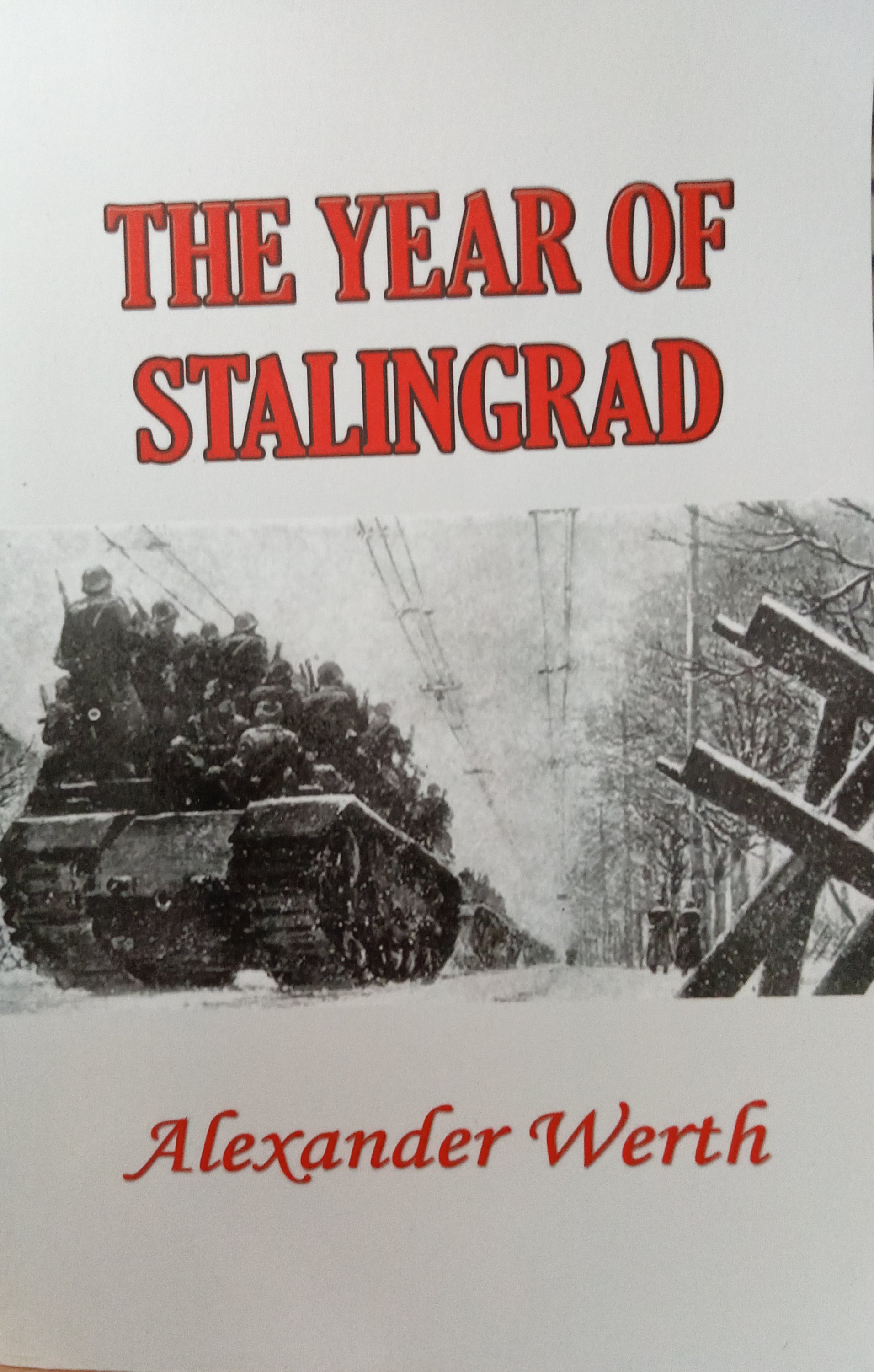
Blogger’s Note: Alexander Werth was born in Russia – but brought-up in the UK from very young – and educated as a middle-class gentleman. Although English became his native language, he could read, write and speak French and Russian – living in both countries for extended periods of his life. Much of his historical work comprises first-hand ‘eye-witness’ accounts which make a mockery of all the past-1945 (and US-led) Cold War anti-Soviet propaganda that is obviously premised upon anti-intellectualism, bias and a mania for predatory capitalism. His vitally important book entitled – ‘The Year of Stalingrad’ – was originally published in the UK during 1947 by Hamish Hamilton (London). I can find NO indication of any further publications other than the far later edition referenced in this article. It is interesting to note that all the later narratives covering this battle IGNORE the work of Alexander Werth!
Indeed, when the Trotskyite – George Orwell – was asked by the incumbent Labour Party to compile his infamous (1948) ‘list’ of well-known left-wingers he suspected of possessing ‘Communist’ sympathies – the name of ‘Alexander Werth’ featured prominently! This was because Werth refused to follow the decreed US requirement for all history to be ‘altered’ and ‘distorted’ so as to make the Western working-class ‘hate’ the Soviet Union! This interfering in the historical record is so remarkable that Werth’s near ‘eye-witness’ account of the ‘Battle of Stalingrad’ (which changed WWII forever) is not only completely ignored by Western authors who came after him – but seldom known to even exist!
As I work my way through this incredible tome – I will write more upon its content – but for the time-being I will share the details of a Soviet book translated into English and available to foreigners living in the USSR. Alexander Werth was in the USSR from the start of the brutal Nazi German invasion during June, 1941 – but was ‘withdrawn’ back to the UK from Moscow during October of that year – when it seemed certain that Moscow would fall! When Stalin stayed in Moscow (and armed himself with a pistol to defend his Kremlin Office) – the Soviet Red Army was inspired to pull-off a military miracle and STOP Hitler at the gates of Moscow! This is why Alexander Werth – impressed by this show of Soviet defiance and resistance – returned to Moscow in mid-1942 via the Russian Arctic Convoys (he travelled on PQ-16 which sailed during May 1942 for Murmansk – losing 30% of its shipping, men and cargo)! He arrived just in time to witness the events first-hand in the USSR surrounding the Battle of Stalingrad! I have added a link to my article about the Soviet martial art of ‘Systema’ – developed by Stalin’s Personal Bodyguard – in the ‘Hand-to-Hand’ (Chapter 12) reference! ACW (16.9.2023)
‘This morning I went to the Komsomol publishing house Molodaya Guardo, and bout a lot of interesting books, among them a book of Simonov poems, a Guide for Partisans and an anthology of Leningrad’s Youth. The last-named would give Gollancz a thousand fits; its main theme is: “Kill, Kill, Kill the Filthy German Beasts!” I also got a curious anthology, a kind of prose and verse and song medley, specially published for the use of Kolkhozes, and, finally, a small volume of Tvardovsky’s poem, Vasil Terkin.
The Partisan’s Guide is of the greatest interest, and gives one a clear insight into the hundreds of problems besetting a partisan’s life. Here are precise instructions, often with explanatory drawings, on almost everything one can think of – on the chief tactical rules of partisan warfare, on the use of enemy firearms, on the most effective ways of wrecking trains and motor transport, of killing enemy motorcyclists by stretching wire across the road; there are dozens of rules to be observed in reconnaissance work; it contains practical hints of how to measure, for instance, the width of a river; there is a chapter on camping and camouflage. A most interesting and, in some ways, pathetic chapter is on what to do in emergencies; for example, the guide tells what kind of bark and moss can be eaten when there is nothing else to eat. The chapters of the book are:
(1) The elements of Partisan warfare;
(2) How the Fascists try to fight the Partisans;
(3) How to work with Explosives;
(4) Firearms;
(5) Learn to use the enemy’s firearm;
(6) Reconnaissance;
(7) Camouflage;
(8) How to read maps and find your way about;
(9) How to destroy enemy tanks;
(10) How to destroy enemy planes;
(11) Anti-gas defence;
(12) Hand-to-hand fighting;
(13) First-Aid;
(14) Marching and living rules;
(15) Life in the snow.
The Supplement contains a list of reproductions of enemy markings and a Russo-German phrasebook. It begins:
“Halt! Waffen hinlegen! Hande Hoch! Ergieb dich! Raus aus dem Wagen! Bei Fluchtversuch wird geschossen!” – (“Stop! Put down your weapons! Handsup! Surrender! Get out of the car! If you try to escape you will be shot!”)
Then,
“Sie lugen!” – (“Stop lying!”)
“Wo befinden sich deutsche Truppen?” – (“Where are the German troops?”)
“Wo much?” (“How much?”)
“Wo sind Minen verlegt!” – (“Where are the mines laid!)
Fifty thousand copies of this handy little book of 430 pages were printed last month.’
Alexander Werth: The Year of Stalingrad, Simon Publications, (2001), Pages 142-143 – Book II – The Black Summer – Chapter III – The Storm Breaks (July 1942) – (Personal Diary Entry) Dated July 18th, 1942
 SANGHA KOMMUNE (SSR)