
After the discovery of the mid-ocean underwater ridges and faults – the so-called “Plate Theory” began to develop rapidly. Supporters of this theory claim that the earth’s crust is sewn from huge plates – the joints between which they compare to the seams visible in a baseball. The ancient Greek philosopher – Plato – used a similar metaphor when describing the shape (and surface) structure of the Earth (as if he could “see it” from afar).

It may seem strange that the spherical shape of the Earth does not satisfy all geologists and geophysicists . Many people need a more angular structure – like a crystalline model – the presence of which would make it easier to understand the laws that formed the surface-structure (face) of the Earth.

At the end of the last century – Geologists A. Green and A. Lapparin – compared the shape of Earth with a tetrahedron – and in the 1960s Professors of Leningrad University B. L. Lichkov and I. I. Shafranovsky – compared the Earth with an octahedron.
Why can the Earth be like a crystal?
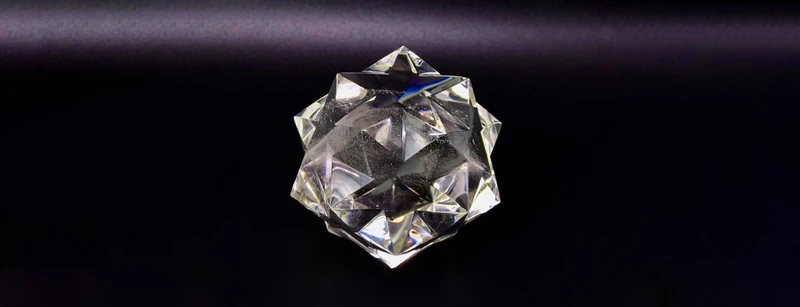
B.L. Lichkov explained this by the fact that during the formation of the planet from a cluster of asteroids – a giant crystal-like body (for example, a dodecahedron – a polyhedron of twelve pentagons) could serve as a transitional form to the spheroid of the planet.
The residual structures of this polyhedron – in his opinion – could be preserved in the body of the planet to this day.
Whilst searching for traces of these structures – we long and painstakingly compared the geological features of the Earth and the centres of geophysical anomalies, first with the dodecahedron, and then with the icosahedron (a polyhedron of twenty triangles).
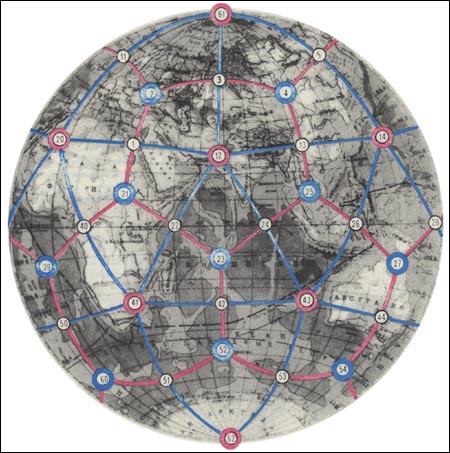
Aligning the axis of the dodecahedron with the axis of the globe and rotating the polyhedron around it, we noticed that when two of its edges coincide with the famous Mid-Atlantic submarine ridge stretching along the Atlantic – then the rest of the mid-ocean ridges and giant disturbances of the Earth’s crust coincide with other edges of the dodecahedron.
If you increase the number of faces in a hypothetical crystalline of the Earth, and combine the icosahedron with the axis of the globe, then those ridges and faults that do not coincide with the faces of the dodecahedron will coincide with its edges. All this clearly indicates that the tectonic structure of the Earth’s crust is very close to these two polyhedra.

Geological patterns coincide with Earth structures.
We assumed that in the body of our planet there is something like a crystalline or, rather, force-related grid, and the properties of the planet, as in a crystal, are most actively manifested at the lattice nodes and along its edges.
In fact, almost all of the volcanic and seismic activity of the Earth is concentrated at the junctions of plates, and therefore, on the edges of the polyhedra.
The magnetic field also fits into our configuration. Moreover, in the nodes of our system (see graphs) included are all world centres of maximum and minimum atmospheric pressure, as well as permanent areas of hurricane origin.
A strange reality is that constant winds prefer to blow along the edges of the system.
The debate about the influence of solar activity on the weather has already subsided and has become generally recognized. It is curious that the areas that receive the maximum solar radiation coincides with the nodes of the system. The Largest sunbeams shine at knots of 1, 17 and 41.
The nodes of our system resembles a flashing traffic light: at first, some actively function, while others behave quietly, then the picture changes. There is reason to believe that this happens at certain intervals of time.
Geologist V.I. Dvinsky – whom we introduced to our model – noted that the figure of the Earth is not at all an ideal ball, but the so-called cardioid, with a bulge and a notch, and that both of these deviations exactly coincide with the nodes on the globe.
It is very symbolic that in one of these areas – in Gabon (node 40) – a “natural atomic reactor” was recently discovered that operated 1.7 billion years ago.
Due to the peculiar geological conditions, the concentration of the 235U isotope here – has reached the level necessary to start a chain reaction.
In the bowels of the Earth, chemical reactions are constantly going on, there is a grandiose exchange of matter. Almost always this exchange is accompanied by electrical phenomena. Often one mineral acts as the anode, the other as the cathode. And in a humid environment, a semblance of an electrolytic bath operates: anode minerals dissolve, forming new compounds, and native, pure elements or their oxides accumulate on cathode minerals.
Specialists of the All-Union Scientific Research Institute of Geoprospecting Methods and Techniques (Leningrad) tried to enhance natural electrochemical processes by inserting electrodes under direct current in the soil near the ore deposit. Electro-chemical exchange received a stimulus, the elements rushed to the electrodes. In this way, you can find out which ores of which metals are nearby. Moreover, they propose to extract metals from the depths in this way (pilot installations are already operating!) and even create artificial deposits.
This means that on the edges of the crystal, in the nodes of the system with their geophysical anomalies, there can be a very active migration of chemical elements of the Earth’s crust. Large deposits of minerals are usually confined to faults or folds in the crust, which often run along the edges of the crystal. Therefore, one should not be surprised that the richest deposits are located in accordance with the lines on the globe.
Thus, many metallogenic and oil belts stretch along the edges of the system. Its nodes also contain rich deposits, such as the giant Tyumen oil field (node 3).
Perhaps our dodecahedron-icosahedron system is of more than purely theoretical interest to geologists, geophysicists, and geochemists…
Global geological structures are best seen from space. Indeed, some edges and nodes of the system have already been fixed from space images in the form of linear and circular geological formations.
Cosmonaut V. Sevastyanov writes that the stratified country of the Ural goes much further South than it is indicated on conventional maps. It stretches almost to the Persian Gulf, and yet the edge of our icosahedron shows exactly this. From space, a giant fault was also recorded from Morocco to Pakistan, which is also located along the edge of the icosahedron (from 20 to 12).
Looking through the colour photographs taken by the Gemini Probes, we could discern the three nodes of the system: Morocco (20), California (17) and Florida (18). Here, exactly in the calculated places, circular geological structures with a diameter of 200-350 km are clearly distinguished.
It could be that the Earth’s crystalline structure strongly influences the biosphere of the planet and the formation of geochemical and biogeochemical provinces.
In the centres of the European and Asian faces of the icosahedron (2 and 4) there are two vast biogeochemical provinces in which soils lack some elements and too many others. Therefore, natural selection among plants and animals is aggravated there.
These two (and many other) nodes of the system at one time served as centres for the emergence of plant species: forest, steppe and tropical flora. In addition, there are anomalies of the living world at some nodes and along the edges.
For example, Lake Baikal (4), three-quarters of whose animal and plant species are found nowhere else in the world.
Ornithologists claim that birds sense the Earth’s magnetic field. This is why the main wintering areas of birds lie in the nodes of the system (for example, 12, 20 and 41)?
Humanity, as an element of the biosphere, could not avoid the influence of the Earth’s crystal. In the nodes of the system, since the Paleolithic, the development of culture has increased.
This assumption seems to be confirmed by the fact that the ancient centres of advanced culture – Ancient Egypt, the Proto-Indian civilization in Mohenjo-Daro, Northern Mongolia, Ancient Irish culture, Ancient Peru, Easter Island and many others – are located at the nodes of this system.
It is very curious that the complexity of the famous Egyptian pyramids in Giza corresponds with great accuracy to one calculated node of the system (1).
It is amazing that, taking the pyramids as a starting point, the system can be built more accurately than according to geological and geophysical landmarks.
Of course, everything said about the hypothetical activity of the terrestrial crystal requires a comprehensive verification. The strange coincidences regarding geophysics and geochemistry with the lines on the globe cannot be so easily brushed aside!
Earth – a Giant Crystal? N.F.Goncharov, V.S.Morozov, V.A.Makarov. “Chemistry and Life”, N3, 1974
English (Russian) Sources (Auto-Translated):
Earth – A Giant Crystal (Земля – это гигантский кристалл)?
Youtube: Top 5 Unknown – 5 Strangest Historical Mysteries That’ll Creep You Out (10.6.2023)
Russian Language Text:
https://earth-chronicles.ru/news/2021-10-08-155460
 SANGHA KOMMUNE (SSR)