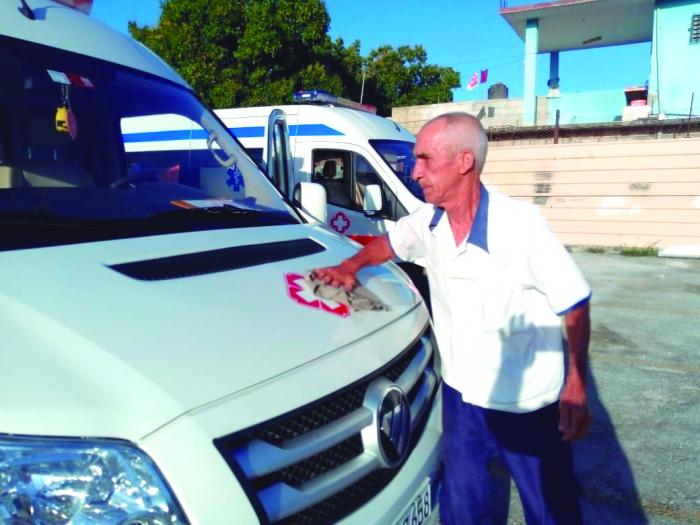
More than ten years without a deceased on board is not by pure chance. It is the result of a chain of decisions, of training, of sacrifices; It is proof that, against all odds, there are those who always choose to save
Author: Ortelio González Martínez | internet@granma.cu
March 30, 2026 7:03:49 PM
When you dial 104 on the phone, on the other end of the line not only operators answer. They answer stories. And, in Ciego de Ávila, these stories have not been written for more than a decade: that of a deceased on board an ambulance.
Reimundo Pineda Estrada, a graduate in Nursing – and in Economics – in charge of Human Resources at the Regional Ambulance Base of Ciego de Ávila, says it with the confidence of someone who knows every statistic, every route, every man and woman who makes up the Integrated Medical Emergency Service (SIUM) in the province, of which he is the founder.
“So far we have not had any loss of human life during the transfer to the healthcare centers,” he says. And the phrase, said like this, without fuss, weighs like an ingot. Because behind that statement there are ten years of statistics, two decades without a final sigh inside a mobile unit, with thousands of patients transferred within the province and outside it.
Ten years in more than 6,000 square kilometres of Ávila’s geography – and beyond the limits of the province – figures that no medical report can fully reflect.
CRUCIAL MINUTES
At the Regional Ambulance Base, in the city of Ciego de Ávila, 2025 was a year of figures with modest improvements: 450 emergencies, 3,533 emergencies, 367 non-urgent transfers.
“We do three to four emergencies a day and we have saved many lives,” Reimundo summarises. And in that synthesis everything fits: the crying, the haste, the vertigo of the early mornings…
This 2026 they started with four new cars. “The service is going to be better,” promises the Director of the Base, Yeinier Vidal Ferrales, a graduate in Nursing, who walks between vehicles with a trained eye to detect what is missing, what hurts, what is urgent.
The average rescue within the city is seven minutes and five seconds; outside those limits, 19 minutes; or what can be the same as the border between life and death.
“It is not a matter of arriving very quickly, like crazy, at the risk of an accident,” warns Dr. Maikelis Oliva Salazar, head of Medical Assistance at SIUM. And he blurts out a maxim that is almost a code of honor: “Rescuers cannot die in the attempt or after having helped someone.”
It sounds cold. But it is pure humanity, because in a scene of multiple accidents, the first thing is to save the one who can be saved. Then, pick up the deceased.
In those crucial minutes, from the Command Post, specialists evaluate each call. Depending on the severity, one of them rides in the ambulance. “He assists the patient in the place where he is, to carry out the procedures in the best way; life also depends on that action,” explains Oliva Salazar.
THOSE WHO DRIVE WITH THEIR SOUL
If there is a central figure in this story, silent, versatile, essential, it is the integral paramedic. The driver who is also a nurse, mechanic, emergency psychologist, anonymous hero.
Pineda Estrada combines the job with that of Human Resources at SIUM, he knows them well. He knows their names, their stories, and, above all, their efforts.
“Paramedics don’t sleep. They drive, they watch the patient, they help the nurse to manipulate him. They have passed the same Diploma as doctors and nurses. They know about medical instructions. And, when the car gets a flat at two in the morning, they get out, put on their overalls, change the tire, and continue. However, the salary is much lower than that of the nurse or doctor. The difference should not be so great. They have a sense of belonging.”
Manuel Cañete López drives the only ambulance in the municipality of Bolivia, the 030. He arrived at the Ciego de Ávila Regional Base at the time of the reporter’s visit, at the helm of a Jimbei that “has turned out very good,” he says.
“We are always on top of it to maintain it, despite the few resources available.” Manuel has been a paramedic since 2008. “Whoever does not like the profession, cannot do it. I put myself in the patient’s shoes. When one of them rides, no matter how serious it is, it is my responsibility to make it to the healthcare centre alive”.
Today he travels with Dalia Alejandra, a two-month-old baby with facial paralysis, and Teresa Sulueta Duque, 68, who underwent hip surgery. Two patients, one trip. Different services and optimisation of resources.
He has been in ambulance services for 43 years. “When I finished my military service in Ethiopia, this was my first job,” says Eliover Villa Zamora with visible pride.
He has seen everything. The most impressive thing? Train accidents in the area of Tablones, near the town of Jicotea. Young boys from military service on either side of the railway line and two locomotives as if melted, after the crash.
He is concerned about the indiscipline of the road on the part of others. “The harrows and private trucks are running like hot rods, and they don’t respect when the ambulance asks for a way.”
Adrián Noa Amor, the boy who got excited about ambulances, has been a driver for one of them for 30 years. “When I was little, I had generalized sepsis and was transferred to Havana in an ambulance. That stayed in my mind and I managed to fulfill the dream. Here you see me.”
He speaks the same language as his classmates. He agrees in pointing out the growing indiscipline of the road, especially of suicide motorcyclists, who are capable of throwing themselves in front of the ambulance; of the harrows and trucks that transport passengers; He also agrees that the salary is very low for the “work we do: we enter the home, we attend to the patient, we drive and we are the most responsible for the humanitarian mission to come to a happy conclusion.”
Margarito Rodríguez Turiño is called the Boyfriend of the Intensive Care Unit. He was on guard duty when we found him. He has been a paramedic since 1990. “I always liked to drive ambulances. I am a driver of the intensive car. He has four drivers, but we take care of him, even if he is a bride for four boyfriends.”
His most difficult cases: the train accident in Tablones and the collision of the two buses with workers from the northern keys of Ciego de Ávila.
He explains that, in the event of an accident, they first help pregnant women, children, women. That maxim, said with the naturalness of someone who has applied it dozens of times, condenses an entire philosophy.
THE OBLIGATORY PHOTON
Among the vehicle fleet – Photons, Mercedes Benz, Maxus – there is one that, not because it is the preferred one, in times of scarcity is the most suitable: an old Photon, less wasting than the modern ones. “That is the car that we now take out the most outside the province,” they confess.
They don’t just take patients to Havana. They bring medical supplies, blood, medicines in short supply… Optimizing is the watchword. “We do three of one performance,” Dr. Oliva summarises.
The service does not discriminate: they transfer patients from the Health areas, return those who were hospitalized in other provinces, move organs, attend national and international sporting events, political events and full coverage.
And when there are no emergencies, there are the “social cases”: the bedridden who exchanges, the chronically ill person who needs a consultation in the capital, the family member who manages a surgical appointment. The ambulance, then, is also a bridge.
THE OTHER BATTLE
The battle is not only against death, indifference on the road, lack of resources, technological obsolescence, low wages.
The days of paralysis at the Ciego de Ávila Base hurt in the statistics, but they hurt more in the guards, when one less car means more pressure for those who remain; they hurt because of the unfair blockade of the United States, which does not allow parts and equipment to arrive on board ambulances.
The technical availability coefficient of 40.22% is a silent sentence. It means that a large part of the time ambulances are immobile while life goes on outside, accidents happen, heart attacks do not wait; neither do unborn children.
Even so, when 104 sounds, someone answers. And when the eleventh key breaks into traffic, a man like any other worthy man, drives and carries in his hands the lives of others, because always, always, there is an ambulance that starts, a doctor on board, a paramedic who drives and repairs, and resuscitates and contains.
Spanish Language Text:
https://www.granma.cu/cuba/2026-03-30/el-sonido-de-la-vida-30-03-2026-19-03-49
El sonido de la vida
Más de diez años sin un fallecido a bordo no es por pura casualidad. Es el resultado de una cadena de decisiones, de entrenamientos, de sacrificios; es la prueba de que, contra viento y marea, hay quienes siempre eligen salvar
Autor: Ortelio González Martínez | internet@granma.cu
30 de marzo de 2026 19:03:49
Cuando en el teléfono marcas el 104, del otro lado de la línea no solo contestan operadores. Contestan historias. Y, en Ciego de Ávila, esas historias llevan más de una década sin escribir la peor de todas: la de un fallecido a bordo de una ambulancia.
El licenciado en Enfermería –y en Economía– Reimundo Pineda Estrada, al frente de Recursos Humanos de la Base Regional de Ambulancias de Ciego de Ávila, lo dice con la seguridad de quien conoce cada estadística, cada ruta, cada hombre y mujer que compone el Servicio Integrado de Urgencias Médicas (SIUM) en la provincia, del cual es fundador.
«Hasta este momento no hemos tenido pérdidas de vidas humanas durante el traslado hacia los centros asistenciales», afirma. Y la frase, dicha así, sin aspavientos, pesa como un lingote. Porque detrás de esa afirmación hay diez años de estadísticas, dos lustros sin un suspiro final dentro de una unidad móvil, con miles de pacientes trasladados dentro de la provincia y fuera de ella.
Diez años en más de 6 000 kilómetros cuadrados de geografía avileña —y más allá de los límites de la provincia—, cifras que ningún parte médico puede reflejar del todo.
MINUTOS CRUCIALES
En la Base Regional de Ambulancias, en la ciudad de Ciego de Ávila, 2025 fue un año de cifras con discretas mejorías: 450 emergencias, 3 533 urgencias, 367 traslados no urgentes.
«Diariamente hacemos de tres a cuatro emergencias y hemos salvado muchas vidas», resume Reimundo. Y en esa síntesis cabe todo: el llanto, la prisa, el vértigo de las madrugadas…
Este 2026 comenzaron con cuatro carros nuevos. «El servicio va a ser mejor», promete el Director de la Base, Yeinier Vidal Ferrales, licenciado en Enfermería, quien camina entre vehículos con la mirada entrenada para detectar lo que falta, lo que duele, lo que urge.
El promedio de rescate dentro de la ciudad es de siete minutos con cinco segundos; fuera de esos límites, 19 minutos; o lo que puede ser lo mismo que la frontera entre la vida y la muerte.
«No se trata de llegar muy rápido, como locos, a riesgo de un accidente», advierte la doctora Maikelis Oliva Salazar, jefa de Asistencia Médica del SIUM. Y suelta una máxima que es casi un código de honor: «Los rescatistas no podemos morir en el intento o después de haber socorrido a alguien».
Suena frío. Pero es pura humanidad, porque en una escena de accidente múltiple, lo primero es salvar al que puede salvarse. Después, recoger a los fallecidos.
En esos minutos cruciales, desde el Puesto de Mando, especialistas evalúan cada llamada. Según la gravedad, uno de ellos monta en la ambulancia. «Asiste al paciente en el lugar donde esté, para realizar los procederes de la mejor manera; de ese actuar también depende la vida», explica Oliva Salazar.
LOS QUE CONDUCEN CON EL ALMA
Si hay una figura medular en esta historia, silenciosa, versátil, esencial, es el paramédico integral. El chofer que también es enfermero, mecánico, sicólogo de emergencias, héroe anónimo.
Pineda Estrada simultanea el oficio con el de Recursos Humanos del SIUM, los conoce bien. Sabe sus nombres, sus historias, y, sobre todo, sus esfuerzos.
«Los paramédicos no duermen. Conducen, vigilan al paciente, ayudan al enfermero a manipularlo. Han pasado el mismo Diplomado que médicos y enfermeros. Saben de instrucciones médicas. Y, cuando el carro se poncha a las dos de la madrugada, bajan, se ponen el overol, cambian el neumático, y siguen. Sin embargo, el salario es mucho menor que el del enfermero o el médico. La diferencia no debiera ser tan grande. Ellos tienen un sentido de pertenencia».
Manuel Cañete López conduce la única ambulancia existente en el municipio de Bolivia, la 030. Llegó a la Base Regional de Ciego de Ávila en el momento de la visita del reportero, al timón de una Jimbei que «ha salido buenísima», comenta.
«Siempre estamos encima de ella para mantenerla, pese a los pocos recursos disponibles». Manuel es paramédico desde 2008. «A quien no le gusta el oficio, no puede realizarlo. Yo me pongo en el lugar del paciente. Cuando uno de ellos monta, por muy grave que esté, es mi responsabilidad que llegue vivo al centro asistencial».
Hoy viaja con Dalia Alejandra, una bebé de dos meses con parálisis facial, y Teresa Sulueta Duque, de 68 años, operada de cadera. Dos pacientes, un mismo viaje. Distintas atenciones y optimización de los recursos.
Lleva 43 años en servicios de ambulancia. «Cuando concluí el servicio militar en Etiopía, este fue mi primer oficio», comenta con orgullo visible Eliover Villa Zamora.
Ha visto de todo. ¿Lo más impresionante? Los accidentes de trenes en la zona de Tablones, cercana al poblado avileño de Jicotea. Muchachos jóvenes del servicio militar a un lado y otro de la línea férrea y dos locomotoras como fundidas, después del choque.
Le preocupa la indisciplina vial por parte de otros. «Las rastras y los camiones privados andan como bólidos, y no respetan cuando la ambulancia pide vía».
Adrián Noa Amor, el niño que se ilusionó con las ambulancias, es chofer de una de ellas desde hace 30 años. «Cuando pequeño, tuve una sepsis generalizada y me trasladaron a La Habana en una ambulancia. Se me quedó aquello en la mente y logré cumplir el sueño. Aquí me ve».
Habla el mismo lenguaje de sus compañeros. Coincide en señalar la creciente indisciplina vial, sobre todo de las motorinas suicidas, que son capaces de tirarse delante de la ambulancia; de las rastras y los camiones que transportan pasajeros; también coincide en que el salario es muy bajo para la «labor que desempeñamos: entramos al hogar, atendemos al paciente, manejamos y somos los máximos responsables de que la misión humanitaria llegue a feliz término».
A Margarito Rodríguez Turiño le llaman el Novio de la Intensiva. Entraba de guardia cuando lo encontramos. Lleva desde 1990 como paramédico. «Siempre me gustó manejar ambulancias. Soy chofer del carro intensivo. Tiene cuatro choferes, pero lo cuidamos, aunque sea una novia para cuatro novios».
Sus casos más difíciles: el accidente del tren en Tablones y el choque de los dos ómnibus con trabajadores de los cayos del norte de Ciego de Ávila.
Explica que, en caso de accidente, socorren primero a las embarazadas, los niños, las mujeres. Esa máxima, dicha con la naturalidad de quien la ha aplicado decenas de veces, condensa toda una filosofía.
EL FOTÓN OBLIGADO
Entre el parque automotor –Fotones, Mercedes Benz, Maxus– hay uno que, no por ser el preferido, en tiempo de escasez es el más indicado: un Fotón antiguo, menos gastador que los modernos. «Ese es el carro que ahora sacamos más fuera de provincia», confiesan.
A La Habana no solo llevan pacientes. Traen insumos médicos, sangre, medicamentos en falta… Optimizar es la consigna. «De una función hacemos tres», resume la doctora Oliva.
El servicio no discrimina: trasladan pacientes desde las áreas de Salud, retornan a quienes estuvieron hospitalizados en otras provincias, mueven órganos, atienden eventos deportivos nacionales e internacionales, actos políticos. Cobertura total.
Y cuando no hay urgencias, están los «casos sociales»: el encamado que permuta, el enfermo crónico que necesita una consulta en la capital, el familiar que gestiona un turno quirúrgico. La ambulancia, entonces, también es un puente.
LA OTRA BATALLA
La batalla no es solo contra la muerte, la indiferencia en la vía, la falta de recursos, la obsolescencia tecnológica, los bajos salarios.
Los días de paralización en la Base de Ciego de Ávila duelen en las estadísticas, pero duelen más en las guardias, cuando un carro menos significa más presión para los que quedan; duelen por el bloqueo injusto de EE. UU., que no deja llegar las piezas y equipos a bordo de las ambulancias.
El coeficiente de disponibilidad técnica del 40,22 % es una condena silenciosa. Significa que una gran parte del tiempo las ambulancias están inmóviles mientras afuera la vida sigue, los accidentes ocurren, los infartos no esperan; los niños por nacer tampoco.
Aun así, cuando suena el 104, alguien contesta. Y cuando la clave once irrumpe en el tráfico, un hombre como cualquier otro hombre digno, conduce y lleva en sus manos la vida de otros, porque siempre, siempre, hay una ambulancia que arranca, un médico a bordo, un paramédico que conduce y repara, y reanima y contiene.
 SANGHA KOMMUNE (SSR)