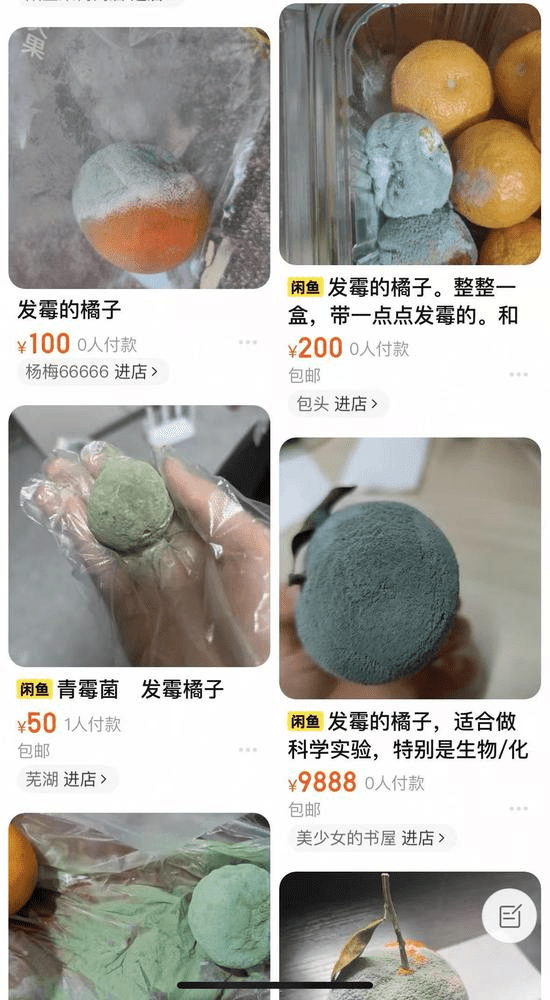
(ECNS) — Mouldy oranges have gone viral on some second-hand trading platforms in China, and numerous sellers are now listing rotten oranges on there, with prices going up to thousands of yuan. Some people have even tagged them as “suitable for experiments” or “for research and educational purposes.”
But according to the investigation of Rumour Buster, a Shanghai-based platform, mouldy oranges sold at high prices are simply unwanted.
The reason why some netizens sell mouldy oranges is that they are inspired by social media last year.
A social media user on the Chinese platform RedNote discovered the white fungal growth on an apple she had bought from a month earlier. She then posted a photo of it online, which soon attracted thousands of likes, including a Xu Rongju, a doctoral student at the Chinese Academy of Sciences’ Kunming Institute of Botany.
The institute believed that this is very rare and has research value so it decided to purchase it. The institute identified the growth on the apple as Schizophyllum, also known as the splitgill mushroom – a type of fungus with fan-shaped caps.
Rumour Buster contacted some sellers and found that most listings were simply clickbait tactics. Some were merchants selling other products who leveraged the viral trend of mouldy oranges to boost their store’s visibility and secure platform recommendations. Others joined in just for fun—either using stock images or randomly picking mouldy items from their home.
Chinese media have now warned the public against keeping mouldy food or intentionally cultivating mould due to safety hazards. Spores produced by mould propagation can easily spread into the air, posing serious health risks, especially to children, the elderly, and immunocompromised individuals. Inhaling mould spores may trigger or worsen asthma and allergic rhinitis, and could even lead to lung infections, causing symptoms such as coughing, difficulty breathing, chest pain, pneumonia, or fungal lung infections.
(By Zhang Dongfang)
Note: the term “mouldy” or “mould” occurs “11” (eleven) times in this short piece.
 SANGHA KOMMUNE (SSR)