
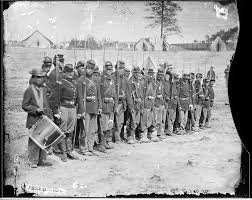
Author’s Note: I was forwarded the above photograph by an American academic colleague – after I mentioned that no US military historians will engage with me regarding the American Civil War – due to my Chinese background and left-wing perspective. This does not bother me – as my Irish-side loves a good a fight! As it is St Patrick’s Day – I will wish you all the best of Celtic good luck and peace for the future!

Remember that the bones of tens of thousands of Irishmen lie in the earth of the United States – who fought and died on both sides during the Civil War of 1861-1865. My Irish family – the Kilmurray Clan – fought for the Confederacy as poor White people who worked next to the Black slaves in the fields. My family barely had clothes and never owned another human-being – we barely owned our own lives. Although the narrative today associates the Confederacy with “Hitler” – this is unfair and incorrect.
The Confederacy offered poor and oppressed people a way out of the oppressive US system that sought to double-down on its capitalist oppression. Black, White, Native American, Hispanic, and Chinese people volunteered to fight for the Confederacy – why? Of course, since the 1920s the racist KKK has hijacked the Confederate cause – f’ck them. Freedom is a valuable commodity which we must all value – regardless of where we originate. The dialectical forces of history will throw-up all kinds of contradictions and paradoxes. For instance, as a British person – I respect the bravery of the “Philadelphia Greys” – Union men – parttime soldiers who risked their lives wearing the “grey” favoured by the Confederacy! ACW (17.3.2025)
‘Official Washington was already reacting to the race to better administer the defence of Pennsylvania – Secretary of War Stanton – established the Military Department of the Susquehanna, covering roughly the Eastern two-thirds of the State. To head the new department Stanton appointed one of the chief dissidents in the Potomac Army – Darius Couch – whose distaste for Joe Hooker was so strong that he had surrendered command of the 2nd Corps. On June 11th (1863) – General Couch – established headquarters at Harrisburg and looked around for something and someone to command. All he could find for the moment was several out-of-work, out-of-favour Generals, and a small company of elderly Veterans of the War of 1812 – the sole responders to Pennsylvanian Governor Curtain’s appeal for latter-day “Minutemen” to ‘defend our own homes, firesides, and property from devastation.” June 15th (1863) saw the President issue a proclamation summoning 100,000 militia to meet the threat of a Confederate invasion. Pennsylvania was called upon for 50,000 men, Ohio for 30,000, Maryland for 10,000, and the new State of West Virginia for 10,000. The term for Federal Service was to be six-months unless sooner discharged. It was soon evident, particularly in Pennsylvania, that the Minutemen tradition had not been passed-down from the Revolutionary War generation. The essential problem in Pennsylvania was the lack of a standing militia organisation. There was no one at hand to answer Lincoln’s call promptly – except a token force in Philadelphia – an infantry unit called the “Philadelphia Greys”, two artillary batteries and two troops of cavalry. After much pushing and pulling and paper-shuffling in Harrisburg and Washington, some 8,000 Pennsylvania Emergency Men were mustered in-time to confront the Confederate invasion. As defenders of their home-place – they were embarrassingly outnumbered by the 12,000 Militiamen generously despatched by New York in answer to the President’s appeal.’
Stephen W Sears, Gettysburg, Chapter 5 (Audio-Copy-Typed)*
When General Robert E Lee took the (Confederate) Army of Northern Virginia into the Union controlled-area of Pennsylvania during the summer-months of 1863 – successfully manoeuvring his 80,000 men and supplies out of the South and “through” the Federal-lines out of Virginia and through Maryland into Pennsylvania with the minimum of detection and hindrance – a startled President Abraham Lincoln ordered that Washington DC be protected at all costs and that there was to be no defending Union-troops diverted to launch a counter-attack on the Confederate capital of Richmond. Indeed, the consummate ease with which the Confederate Army traversed into the North prompted General Lee to exchange written communications with President Jefferson Davis, suggesting that whilst the Confederacy was on the ascendency, perhaps it was time to sue for peace with the Federals (surviving written-evidence suggests Jefferson Davis agreed). Lee suggested that whilst Confederate and Union personnel met to discuss a prisoner-exchange in Washington DC, a special message be forwarded to Lincoln stating that an immediate cease-fire was now possible, and that if he guaranteed the Confederate States their “rights” – all the seceded States would re-join a “new” Union – and the war would be over.
Lincoln dismissed this offer out-of-hand and demanded the immediate recruitment of 100,000 militiamen to defend Pennsylvania. Lincoln was of the opinion that the Confederacy was “illegal” and possessed “no” military or political right to stage an invasion or attempt a negotiated settlement. Lincoln ordered that the Confederacy be destroyed at every opportunity. The problem Lincoln had was that every time the Confederate Army had scored a victory, many local people in the North started flying Confederate flags on their properties (particularly in the early days of the war). Lincoln responded with a draconian certainty – trying and imprisoning anyone reported or caught expressing Confederate sympathies. This oppressive measure was effective and limited any outer expression of support for the Confederacy in the North – but the resistance to this tyranny continued in other ways. When Lincoln appealed to the “Minuteman” spirit of the (1776) American War of Independence (creating “new” militia units outside of those already existing) – “no one” in Pennsylvania answered the call.
This reflected a remarkable situation. A Confederate Army was riding rampant through the Pennsylvanian countryside – the State within which Washington DC is situated – and yet “no one” amongst the young, elderly, disabled or wounded men (considered medically “unfit” to join the Regular Army due to ill-health or age) were prepared to defend the Union. Within the city of Philadelphia, 8,000 men of the already existing “Philadelphia Greys” bravely volunteered to march to the front in defence of the Union. Due to the general lack of volunteers from the ordinary population – the city of New York sent 12,000 of its own existing Militiamen to supplement the regular Union Army. How brave these men were! Militiamen are often called “Sunday Soldiers” – as they are working men, fathers and patriarchs who live in society, work and look after their families. They come together once a week, once a month, or just a few times a year to compare notes, fire their weapons, and discuss homestead self-defence. They are not frontline soldiers. Of course, Confederate citizens showed the same extent of bravery when the time came.
Further Reading:
Stephen W Sears, Gettysburg, Harper Audio, (2023), Chapter 5*
 SANGHA KOMMUNE (SSR)