Photo taken on April 15, 2026 shows a container terminal of the Port of New York and New Jersey, which serves as a critical gateway for trade and a major logistics hub for the Northeast of U.S., in New York, the United States. (Xinhua/Zhang Fengguo)

US: 25 States “Sue” Trump Administration Over Section 301 Tariffs! (4.8.2026)

The coalition is asking the court to block the tariffs, declare them unlawful, and order refunds for the duties already paid.

The legal challenge centres on the administration’s effort to preserve Trump’s broad tariff regime after federal courts rejected two earlier versions imposed under different statutory frameworks. The states argue that federal officials seized upon Section 301 of the Trade Act of 1974 and forced-labour concerns merely as a pretext to rapidly recreate nearly identical global duties that the Supreme Court previously struck down in February.

“President Trump’s illegal tariffs are nothing more than a tax on hardworking families, driving up the cost of groceries, household essentials, building materials, and countless everyday goods that New Yorkers rely on,” said New York Governor Kathy Hochul in a statement.
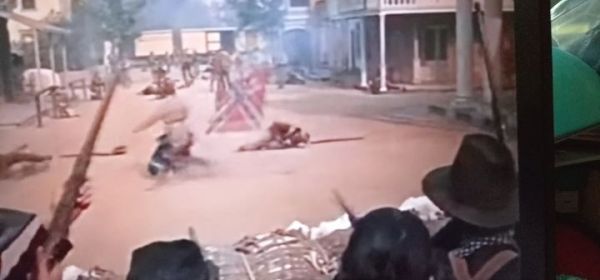
Battle of Newton Station

CSA: Battle at Newton Station – April 24th 1863! (1.7.2026)

Although I am no fan of the right-wing (racist) actor – John Wayne – the 1959 film entitled “The Horse Soldiers” covers the so-called “Battle at Newton Station” which unfolded on April 24th, 1863 – and took place in Mississippi. This involved the penetration of the South in the Western Theatre by Col. Benjamin Grierson (1826-1911) and his Union Cavalry Unit. The idea was to commit acts of terrorism and sabotage toward the CSA and its train network – so that it could not easily transport troops and supplies around the country. As Cavalry acted as a light and highly mobile infantry – these troops often turned-out to be highly effective in this role. The clip I have added above is from the film “The Horse Soldiers” and depicts Confederate troops arriving by train at the station and launching what they thought to be a surprise attack. From what records survive, it is said that the CSA lost around 25 men – but this number could have been higher. I am told that Confederate charges like this – from trains – did take place on more than one occasion. 

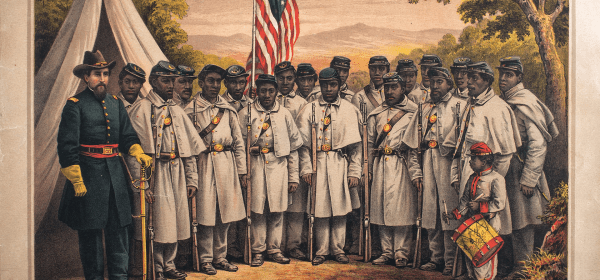
Above: Early recruiting poster for United States Colored Troops.  Click photo to read about the USCT’s history during the Battle of Nashville

CSA: When Confederate General James Thadeus Holtzclaw Complimented a “Black “ Union Regiment! (10.11.2025)

General Holzclaw Stated, “Five separate colour-bearers, one after the other, seized the fallen flag and attempted to plant it over our works. Each one was shot-down. Urged on by their White Officers – these Black soldiers repeatedly surged against the breastworks. They came only to die!” Indeed, so impressed by the bravery of these Black soldiers was General Holzclaw, that he cited their bravery in his official “Battle Report”. This would be read by the likes of Robert E Lee and Jefferson Davis – so such a report contained much significance. Although the Union would win this battle overall – it did not prevail on this small part of the Nashville battlefield. Of course, such stubborn Confederate action only delayed the inevitable defeat – but it did give the Black Regiments (there others that fought during this battle and even around this area) a chance to show the world what they were capable of doing. The Irish-British (Confederate) General Patrick Clayburne 9who had died at the Battle of Franklin) had suggested to Jefferson Davis that the slaves of the South should be “freed” and co-opted into the Confederate Army – but his idea fell on deaf-ears.

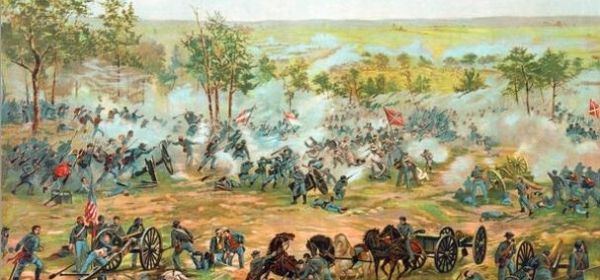
Battle of Gettysburg - Painting by Paul Philippoteaux

CSA: Confederate Army Uniforms, Hats, Ranks & Badges c. 1861! (27.4.2025)

Sometimes, CSA Units proudly wore “Blue” – whilst certain Union Units proudly wore “Grey”. Both sides also possessed Units that dressed (and acted) like English Red-Coats – a designation that then sent shudders through most people due to the reputation the Red-Coats possessed – namely that of strict discipline and ruthless close-quarter-fighting (all wounded were bayoneted as an act of compassion – due to the lack of any reliable medical treatment). English Red-Coats would march indifferently into enemy-fire – safe in the belief that once the distance was closed – the enemy would pay the price. The CSA Units attempted to replicate this attitude and make the Union pay for the damage its forces inflicted upon the Southern States.

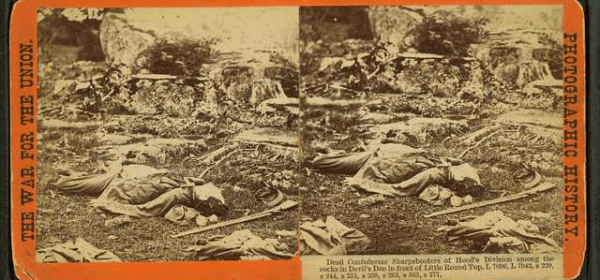
Dead Confederate sharpshooters of Hood's Division among the rocks in Devil's Den in front of Little Round Top.

CSA: Remembering the Bravery of “Irish” Company “K” – 15th Alabama – Little Round-Top [2.7.1863] – Gettysburg! (3.4.2025)

The weather was hot – and the Confederates had to advance over open ground before storming an inclined slope (in the form of a steep hill) – with the intention of sweeping the Federals off its top and consolidating the victory. The previous day had seen the Confederates sweep the Federals out of West and Central Gettysburg – and into the hills to its East. Washington was just 80 miles to the South – and legend has it that Lincoln was packing his belongings to flee! I have audio-typed part of a chapter from Stephen Sears’ book – carefully reproducing the text from an Audible edition (in my native British English). This provides a general background to the battle – but does not mention the Irish specifically – other than one or two fighting for the Union. For the story of “Company K” of the 15th Alabama Regiment of the Confederate States of America (CSA) – we must turn to the excellent work of Phillip Thomas Tucker – who has produced an excellent book examining the contribution to the Confederate cause made by the Irish!

Stephen Spencer West Co. I “the Granville Stars” 23rd NC Infantry CSA. He was born in Oxford, Granville County, North Carolina in 1837. He was killed in action during the Battle of Chancellorsville on May 2, 1863

CSA: Remembering the [1863] Bravery of the 23rd North Carolina Infantry Regiment [and Other Carolina Men] – at Gettysburg! (27.3.2025)

Jefferson had to draw from a limited pool of men (compared to the North – which possessed an endless supply of recruits – as every newly arrived migrant was enrolled into the US Army) – Jefferson managed to assemble around 80,000 (aged 12-60) – gave every man a uniform, hat and pair of boots, and ensured all were armed and fed. The idea was to Punish the Lincoln Administration that had tried on numerous occasions to militarily invade and subjugate the South. It was General Lee who suggested to Jefferson Davis that an invasion into the North – and a decisive military victory near Washington – might force Lincoln to sue for peace. Lincoln, however, had other ideas, and refused any such compromise, stating that he strove for the utter destruction of the South.

1 2 3