Translated by Adrian Chan-Wyles PhD
Translator’s Note: Having accessed British news articles from 1848 – I not that the Press refer to the ship discussed below as being named the ‘Keying’. Within the Qing Dynasty Court at this time there was a well-known Chinese Government Minister known as ‘Qi Ying’ (耆英) [1787-1858] – who was a member of the ruling ‘Aixinjueluo’ (爱新觉罗) ‘Manchurian’ (or ‘Jurchen’) family – originally from ‘Manchuria’ – Northeast China. Within the Manchurian dialect – the ideograms ‘耆英’ are pronounced ‘Ki-Ing’ – which appears to have entered the English language as ‘Ke Ying’ or ‘Keying’, etc. Of course, within ‘Pu Tong Hua’ (Language of the Common People) (i.e. referred to as ‘Mandarin’ in the West) the ideograms ‘耆英’ are rendered as ‘Qi Ying’. I have held to this spelling as it is officially correct. As for ‘号’ (hao4) – this suffix literally means ‘name’ or ‘known as’ and is used here simply to mean something like ‘Qi Ying Known As’, or ‘Qi Ying Referred As’. Its usage represents a solemn ‘order’ from upon high – in this instance – the Emperor of China. Perhaps more succinctly, this could means the ‘Qi Ying Ship’ – but as can be seen – this convention (which makes perfect sense in the Chinese language) is probably not required when translated into the English Language. Finally, Qi Ying was NOT the first Chinese ship to sail around the tip of Southern Africa. It could well have happened over four-hundred years previously, but Chinese language sources are littered with stories of Chinese ships making it to the West as early as the Zhou Dynasty (1050–221 BCE) – and all the way up to the Ming Dynasty (1368-1644 BCE) and beyond! ACW (11.3.2024)
The “Qi Ying Hao” (耆英号) was the first “official” Chinese ship to visit the UK (and the United States) in the modern-age – and yet its itinerary was mysterious – and it never returned to its Chinese homeland!
“Huangpu Cultural Heritage” [黄埔文化遗产] (ID: hpwhyc)
The name “Qi Ying Hao” (耆英号) was written into the history books within the context of national “disgrace”. The events (explained below) unfolded because of the forced signing of the (unequal) “Treaty of Nanjing”. Regardless of these events, the ship known as the “Qi Ying Hao” did eventually arrived in London after setting sail from Guangzhou – where it stole the show and became famous! In the end, despite its notoriety in the West, this ship failed to return to China – being dismantled and its ruins left to rot in the UK.
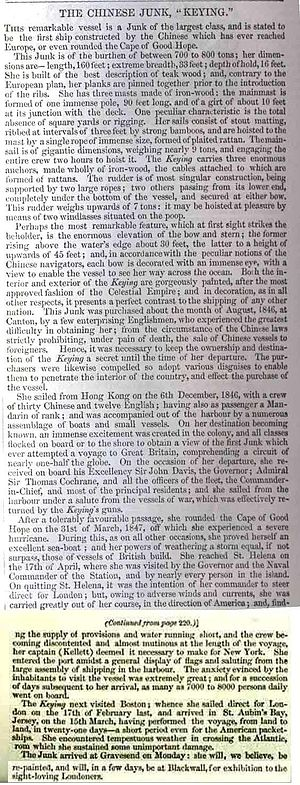
On October 19th, 1846, the “Qi Ying Hao” quietly sailed out of Huangpu Port and began a final long voyage from which it would never return. This vessel was a typical “Chinese-style” wooden sailing ship carrying 30 Chinese and 12 British people. It was commanded by British Captain Charles A. Kellet. Its first destination was British-controlled Hong Kong. After berthing and repairing there, it sailed from Hong Kong on December 7th, 1846 and sailed through the Pacific Ocean into the Indian Ocean.
Mysterious Voyage
The purpose of the “Qi Ying Hao” voyage is not very clear – based upon the extant information available. Certain information suggests that the driving force behind the scenes was a British business group. These investment capitalists intended to have a Chinese sailing ship sail around the Cape of Good Hope – and then sail to the United Kingdom – as a symbolic gift for Queen Victoria!
According to researchers, the “Qi Ying Hao” was secretly sold to the British in August of 1846, because at that time China had legal restrictions that prohibited the sale of ships to foreigners. In order to keep it secret, all the British people changed into Chinese clothes and a Chinese person was temporarily appointed as the Captain. He also used the ship as his personal yacht – and sailed the boat from Guangzhou to Hong Kong.
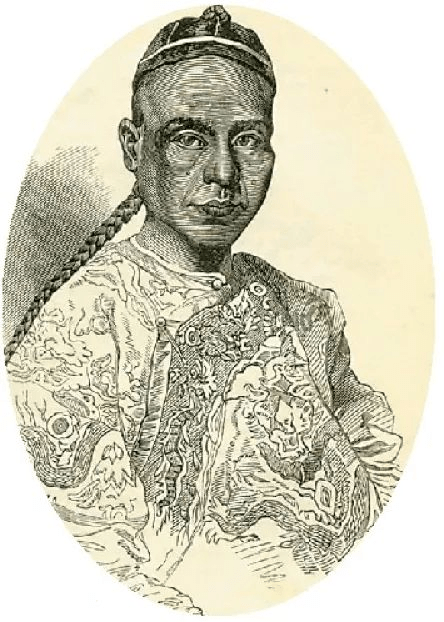
There was a Chinese person on the ship named “Xi Sheng” (希生), who claimed to be a Fourth-Grade Official of the Qing Court, but he did not understand English (other researchers believe that this person was merely an agent from a local trading house). There was also a Chinese painter who was responsible for maintaining the decorative markings both inside and outside the ship. In order to showcase Chinese culture to Westerners, the “Qi Ying Hao” carried many handicrafts, including statues of the Manchurian Emperor Dao Guang (道光) and Qing Statesman “Qi Ying” [Ke Ying] (耆英) – after whom the ship was named – as well a type of (verticle) Chinese “flute” (萧 – Xiao) and a traditional Chinese “lute” (三弦 – San Xian) – amongst other musical instruments.

The Sailing Schedule of the “Qi Ying Hao”:
December 6th, 1846: The ship headed towards the Indian Ocean, passed the Java Cape on January 26th, 1847, anchored in the Java Sea and Sudan Strait for six weeks, and then continued sailing South.
January 26th, 1847: Passed Cape Java, anchored in the Java Sea and Sudan Strait for six weeks, and continued sailing South.
March 22nd, 1847: Encountered a Southwest Typhoon.
March 30th, 1847: Rounded the Cape of Good Hope.
April 17th, 1847: Arrived at St. Helena in the South Atlantic, where she remains until April 23rd, 1847.
The locals were very interested in the ship, but the Guangdong only signed an eight-month voyage contract to Singapore and Jakarta – and were not informed that they were going to the UK. In addition, there were problems with supplies and wind direction. The Captain had no choice but to compromise – and temporarily set sail to New York on the East Coast of the Atlantic Ocean – instead of heading straight to London, the original destination. The Chinese crew were promised that they could return to Guangzhou from the United States.
Want to Visit? Buy Tickets First!
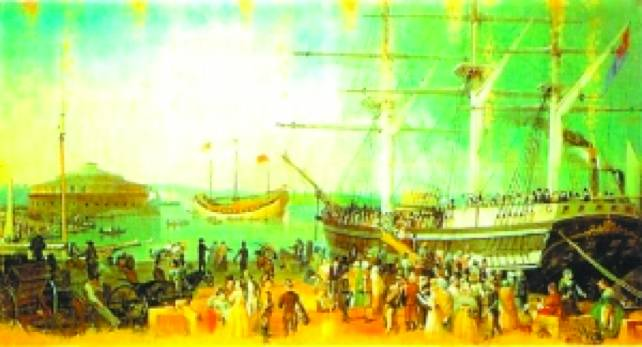
The “Qi Ying Hao” was the first (modern) Chinese ship to visit New York. On July 9th, 1847, she arrived and anchored in Battery Park, located at the Southern tip of Manhattan. A warm welcoming ceremony was held by the locals. In the following months, as many as 4,000 people visited the “Qi Ying Hao” every day, even if they had to pay a high ticket price of 25 cents! Later, in Boston it was met with much the same enthusiasm.
On October 6th, 1847 – 26 Chinese crew members returned to China aboard the “Candace”. Prior to thid, the Chinese crew pursued a lawsuit with the Captain over remuneration. Xi Sheng (and two or three other crew members) decided to stay and continue to London (meaning at least three or four ethnic Chinese people arrived in London on the “Chinese” ship).
On February 17th, 1848, the “Qi Ying Hao” set sail from Boston bound for England. The ship encountered bad weather throughout its journey to the UK. A storm in the Atlantic destroyed two of its lifeboats and tore-off the foremast sail – before the rudder ropes came free – damaging the rudder.
Even so, the “Qi Ying Hao” arrived in Jersey on March 15th, 1848. The entire voyage took 21 days, which was considered fast for the time – as this speed was quicker than an American steam ship. After a short rest, the ship was towed into London by a tugboat – up the River Thames – on March 28th, 1848.
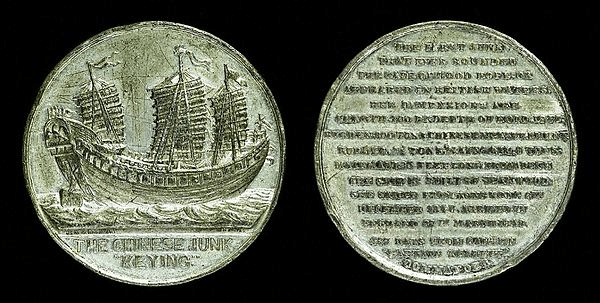
The British commemorated the arrival of the “Qi Ying Hao” in a much more solemn and reserved manner. They had specially made Commemorative Medals for the occasion – carrying the inscription:
‘The first Chinese sailing ship to cross the Cape of Good Hope and appear in British waters. The length is 160 feet, the height is 19 feet, the load capacity is 300 tons, the rudder is 7.5 tons, the mainsail is 9 tons, and the mainmast is 85 feet high from the deck. The boat is made of teak wood. It set off from Hong Kong on December 6th, 1846, and arrived in England on March 27th, 1848, which lasted 16 months (477 days). Captain Charles A. Kellet’
Many people came to visit the “Qi Ying Hao”, including Queen Victoria and many members of the royal family. Xi Sheng, who was still on the ship, became a popular figure and everyone regarded him as the “Official” Representative of China. “The Times” wrote:
“There is nothing more interesting in the exhibition near London than Chinese sailing ships. As long as you take one step into the entrance, you have entered the Chinese world. With just one step, you have crossed the Thames River and arrived in Guangzhou.”
“The Qi Ying Hao… opens a window to the world for the profound and long-standing Chinese culture.”
Just as many scenic spots possess dense walls surrounding them – the British hastily built a wooden fence around Blackwall’s Pier to prevent (free) glimpses. They then charged 1 shilling per person to board the ship. To buy a brochure on board cost an additional 6p. In the following years, the “Qi Ying Hao” traveled between ports such as Liverpool, satisfying people’s curiosity. In 1855, she was finally sold and scrapped amongst two shipyards. The teak planks became two ferries – whilst others were made into packing and work boxes, or acted as “souvenirs” here and there. A sad and disrespectful ending to a noble Chinese ship…
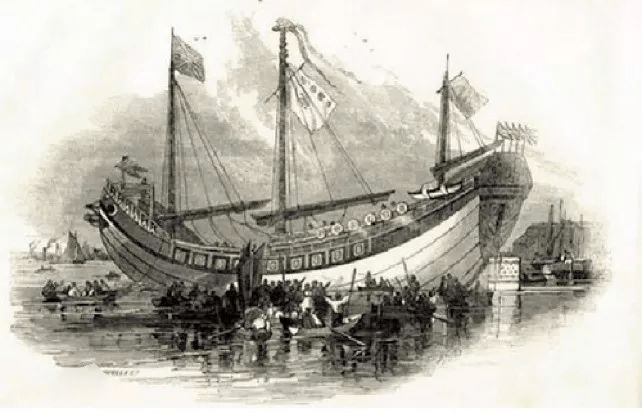
The Sail Weighs 9 Tons!
Some people say that what the presence of the “Qi Ying Hao” in the UK and the United States is demonstrative of a type of Chinese civilization that was already (gradually) drifting away. In the same year that the “Qi Ying Hao” sailed out of Huangpu Port (1847), the Englishman “Coby” had already been allowed to set up a Ship Repair Workshop in Huangpu Port, Guangzhou – this was the birth of China’s first stone dock – and also marked the beginning of China’s modern shipbuilding industry – two foreign ships were also “Approved” to operate in a business capacity between Hong Kong and Guangzhou. Fast and comfortable – the cheap steam-powered ships quickly replaced the ancient Chinese sailing ships in almost all aspects.
Regarding the “Qi Ying Hao”, British newspapers at the time (and later) believed that it was a typical traditional Chinese three-masted sailing ship. It was also equipped with a perforated rudder (commonly used by Guangzhou ships) – so that it could navigate throughout the vast South China Sea. It was said that the entire ship was divided into 15 watertight compartments by 14 watertight partitions. The joints of the wooden structure were caulked using oyster shell powder and tung (桐 – Tong) oil – which are heated and mixed with hemp silk. After drying – they are very strong.
There is a narrow bridge down each side of the ship – travrsing through the front and rear – which is about 1 metre wide. The main deck has beam arches – whilst the stern of the ship is raised high. The main hall in the stern is 30 feet long, 25 feet wide, and 12 feet high. The main sail is a bamboo and rattan mat, which is lighter than linen canvas. There are bamboo stays every 2 to 4 feet, a total of 18, which are fastened to the mast to form a rigid heavy sail.
It takes almost two hours to raise the 9-ton sail using man-power. The mainmast is made of a whole piece of teak wood, not completely straight. The British believe that it makes sense for traditional Chinese sailboats to pay more attention to the natural grain state of the wood. The fishtail weather vane on the masthead is engraved with the inscription “Unified Sails – Wind Compliant” (一帆风顺 – Yi Fan Feng Shun) – the equivalent of the English saying “Plain Sailing” or “Smooth Sailing”.
On May 1st, 1851, at the Opening Ceremony of the first London World Expo – Xi Sheng, as the only Chinese “Representative” – was solemnly received by Queen Victoria and the royal family. “He stood side-on, with a somewhat proud expression, amongst a group of Western gentlemen in tuxedos and top hats.”
At this time, the “Qi Ying Hao” was anchored somewhere along the River Thames – not far away.
Statement: The compilation and promotion of this article is a non-commercial activity. If there are copyright issues, please contact us as the copyright owner or copyright holder.
Contact email: 3461003623@qq.com (this QQ is a work account, no friends are added), and we will take appropriate measures. When reprinting, please indicate that it is from “Huangpu Cultural Heritage” (ID: hpwhyc).
Chinese Language Text:
它是第一艘访问欧美的中国船,但行程神秘且一去不返
2019-03-23 23:23
“耆英号”,中国第一艘驶向欧美的中国木帆船。
耆英这个名字,因为签订《南京条约》的缘故,被很不光彩地写进了历史书中。但“耆英号”这艘船,却从广州到达伦敦,在那里名声大振,出尽风头。最终这艘船也没能回到中国,而是被拆解后留在了欧洲。
1846年10月19日,“耆英号”静悄悄地驶出了黄埔港,开始了它永不回头的航程。这是一艘典型中国式的木帆船,载有30名中国人和12名英国人。由英国船长查理斯·阿尔佛雷得·奥克兰·凯勒特(Charles A. Kellet)指挥。它的第一个目的地是香港,在那里停泊、整修之后,当年12月7日驶离香港,从太平洋航向印度洋。
神秘的远航
“耆英号”远航的目的,依现在能查阅到的资料看,似乎并不能弄得很清楚。一些资料显示,幕后推动者应该是一个英国的商业集团,他们希望让这艘中国帆船绕过好望角,航行到英国,作为献给维多利亚女王的象征性礼物。
按照研究者的说法,“耆英号”是在当年8月被秘密地卖给英国人的,因为当时中国有严禁船只出售给外国人的法律限定。为了保密,所有的英国人都换上了中国服装,临时指定了一位中国人任船长。又将船作为游艇使用,才把船从广州开到香港。
船上有一位中国人叫“希生”,号称是四品官员,但并不懂英文(另一些研究者认为,他应该是商行里的一位买办)。还有一位中国画家,负责养护船内外的装饰画。出于向西方人展示中国文化的考虑,“耆英号”运载了很多手工艺品,包括道光皇帝和耆英的雕像,还有萧、三弦等乐器。
我们来看一下“耆英号”航行的日程:
1846年12月6日:它朝着印度洋进发,于1847年1月26日经过爪哇海角,在爪哇海和苏丹海峡停泊了六周,继续向南航行。
1847年1月26日:经过爪哇海角,在爪哇海和苏丹海峡停泊了六周,继续向南航行。
1847年3月22日:遭遇了西南台风。
1847年3月30日:绕过好望角。
1847年4月17日:抵达在南大西洋上的圣赫勒拿岛,在这里停留直到4月23日。
当地人对这艘船产生了很大兴趣,但船上的广东船员因为只签了到新加坡及雅加达的八个月的航程合同,并没有被告知要前往英国,加上补给、风向都出现问题。船长只好做出妥协,暂时驶往位于大西洋东岸的纽约,而不去最初的目的地伦敦。并且答应中国船员,到达美国之后他们就可以回广州了。
要参观?先买票
“耆英号”是第一艘访问纽约的中国船。1847年7月9日,它抵达并停泊于位于曼哈顿南端的巴特里公园。当地举行了一个热烈的仪式来欢迎它。之后的几个月里,即使要付出25美分的不低门票,每天仍然有多达约4000人参观“耆英号”。之后在波士顿,它也遭遇了几乎相同的热情。
10月6日,26名中国船员乘坐“坎迪斯号船”回国了。在此之前,他们和船长还因为报酬打了一场官司。希生和其他两三位船员则决定留下来,继续前往伦敦。
1848年2月17日,“耆英号”驶离波士顿,开往英国。 “耆英号”在驶往英国的全程都遇到恶劣天气。大西洋上的一场暴风雨摧毁了它的两艘救生小船,撕裂了前桅帆,之后勒舵索脱开,破坏了船舵。
即使这样,“耆英号”还是在3月15日抵达了泽西岛。整个航程用时21天,是一个相当漂亮的数字——这个速度比美国蒸汽邮轮还要快。稍作休整后,它沿泰晤士河,于3月28日被拖船拖进伦敦。
英国人以更隆重的形式纪念“耆英号”的到来。他们为其抵达特意制作了纪念章,刻着这样的铭文:
第一艘跨过好望角并出现在英国水域的中国帆船。船长160英尺,高19英尺,载重300吨,舵7.5吨,主帆9吨,主桅自甲板高85英尺。该船由柚木制造。它于1846年12月6日自香港出发,1848年3月27日抵达英格兰,历时16个月(477天)。
凯勒特船长
很多人来参观“耆英号”,当中包括了维多利亚女王和许多王室成员。仍在船上的希生成了热门人物,大家都将他看做来自中国的官方代表。
《泰晤士报》这样写道:“在伦敦附近的展览中没有比中国帆船更有趣的了。只要跨进入口一步,你就进入了中国世界。仅此一步你就跨越了泰晤士河,到了广州”,“耆英号……为深厚悠久的中国文化打开了一个通向世界的窗口。”
和今天一些为人诟病的景区用高大密实的围墙围住景点的做法一样,英国人在布莱克沃尔的码头上草草建起了一圈木栅栏,以防备偷窥者。然后,他们向每位登船者收取1先令的门票钱。如果要在船上买本宣传册,还要再额外付出6便士。
之后的几年间,“耆英号”辗转于利物浦等各地港口之间,满足着人们的好奇心。1855年,它终于被卖掉,并被两家船厂拆解。柚木板材变成了两艘渡船、一些工作箱,以及零零碎碎的小纪念品。这真是一个令人唏嘘的结局。
船帆就有9吨重
有人说,“耆英号”在欧美展示的,其实是一种渐行渐远的文明。就在它驶出黄埔港的同年,英国人柯拜获准在广州黄埔兴办轮船修理业——这诞生了中国第一个石船坞,也标志着中国近代造船业的开端——两艘外轮也被获准经营香港到广州间的航运业务。快捷、舒适、便宜的蒸汽动力轮船在很多方面,迅速取代了古老的风帆船的地位。
关于“耆英号”,英国当时和后来的报刊都认为它是一艘典型的中华传统三桅帆船。它又装有广船惯用的穿孔舵,以便适合在广阔的南海海域航行。全船由14道水密隔壁,分割为15个水密舱。木结构接合部处采用牡蛎壳粉末和桐油加热并与麻丝混合进行捻缝,干后很结实。
船舷有廓桥,贯通前后,宽约1米,主甲板有梁拱,船艉部都向上翘。艉楼中的主厅长30英尺,宽25英尺,高12英尺。主帆是竹藤织的席,比麻帆布还轻,每隔2到4英尺有一道竹撑条,共有18道,都套牢在桅杆,形成硬式重帆。
9吨重的帆,全部用人力升起,要差不多两小时。主桅由一整根柚木制成,并不全直,英国人认为中华传统帆船更注重木材的自然纹理状态是有道理的。桅顶鱼尾风向标,上面刻有“一帆风顺”。
1851年5月1日在首届伦敦世博会的开幕式上,希生作为唯一的中国“代表”,受到了维多利亚女王和王室的庄重接待。“他侧身而立,神态有几分昂然,在一群穿燕尾服、戴礼帽的西方绅士中间显得很醒目”。
此时,“耆英号”就停泊在不远处的泰晤士河上。
声明:本文编撰推送属非商业行为,如涉及著作权问题,请著作权人或著作权持有人与我们联系,联系邮箱:3461003623@qq.com(本QQ为工作号,不加好友),我们将妥善处理。转载请注明转自“黄埔文化遗产”(ID:hpwhyc)。
 SANGHA KOMMUNE (SSR)