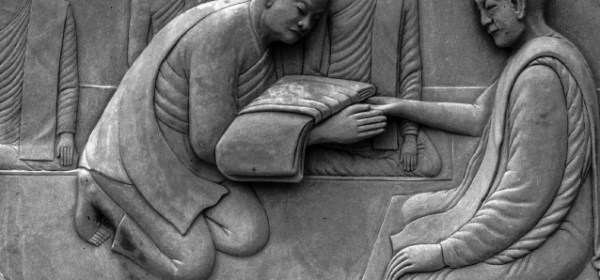
Whilst visiting the Ganga Ramaya Temple in Beruwela, Sri Lanka in 1996, I saw Theravada Buddhist monks continuously exercising ‘metta’ (loving kindness) and ‘karuna’ (compassion). The surface and
Tag: theravada
Definition: Mahayana Term ‘True Self-Nature’ (自我真性)
As the Mahayana Buddhist tradition adheres to the Buddha’s teaching of ‘anatman’, or ‘non-self’, this term cannot be used to refer to a permanent self, or ‘soul’. T
Buddhism: Pali Bhavana and Chinese Ch’an
Chinese transliterations and translations are useful as the early Chinese scholars had to understand the Indian Pali and Sanskrit terms before they could be rendered effectively into the Chinese language. Obviously, some of the early transliteration of Indian Buddhist terms are purely ‘phonetic’ in nature and in themselves do not convey much meaning as ideograms. This represents an initial process of a slow, careful and gradual building-up of knowledge in China about a thoroughly ‘foreign’ Indian philosophy that had to develop an ‘interface’ with existing Chinese culture.
Buddha’s Material (Atomic) Theory
Although the different Buddhist schools argued over the existence or nature of the atom, the Theravada thinkers conceived of an atom comprised of ‘space’ and ‘sub-particles’ (dravya-paramanu) which is physically complex (rupa-kalapa), whilst its constituent parts exist in a state on constant flux (kalapanga).
Email: Buddha, Nagarjuna, Plotinus and the World of Matter (6.9.2017)
Dear N Thank you for your very interesting Plotinus quotation and Nagarjuna-related question. The tetralemma of the Indian Buddhist monk Nagarjuna states: 1) All exists.
The Buddha, Non-Literate Wisdom, and Why Ch’an is Beyond Words and Letters
Enlightenment is not the acceptance of, or practical experience of rebirth. Enlightenment is not the acceptance of, or practical experience of a ‘soul’ theory. In other words, a fully enlightened and rational mind, is a mind ‘emptied’ of all delusion and irrationality.