Socialist Science Triumphs!

China: Socialist Light Shone on “Big Bang”! (26.1.2025)

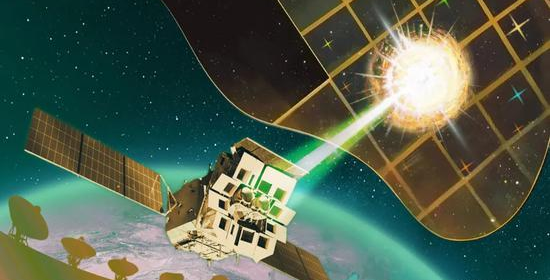
Many experts at home and abroad said that the observation results of EP240315a by the EP satellite have deepened humanity’s understanding of early universe gamma-ray bursts, offer fresh insights into the origins and evolution of the universe, Xinhua reported.

The EP mission is one of a series of space science missions led by CAS. This is an international collaboration effort, featuring contributions from the European Space Agency (ESA), the Max Planck Institute for Extra-terrestrial Physics (MPE) in Germany, and the French space agency CNES.

Launched into space in January 2024, the satellite has achieved several initial discoveries, such as an uncommon transient phenomenon, advancing understanding of the universe and extreme physical phenomena, Xinhua reported.

Supersonic Aeroplane!

China: Socialist Technology Develops “Super-Sonic” Aeroplane”! (21.1.2025)

Concorde, the first supersonic passenger-carrying commercial airplane, was built jointly by aircraft manufacturers in the United Kingdom and France. It was first flown in 1969 and was put into commercial operation in 1976. However, the epochal jetliner did not fit well in the civil aviation industry due to its loud noise, high fares, stringent requirements for airports and environmental impact.

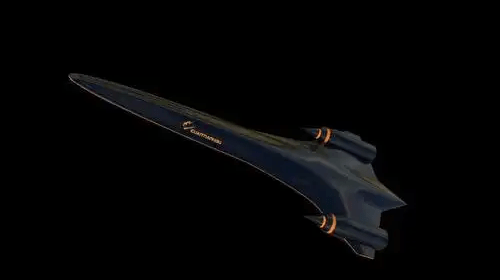
If everything goes according to plan, the prototype for a commercial-use supersonic airliner named Dasheng — or Monkey King, a legendary hero in Chinese mythology — is expected to conduct its maiden flight in 2030. If that becomes reality, Dasheng will revolutionize the global air transportation sector, he added.

“Just imagine making an intercontinental flight within just two to three hours that you would now spend 10 hours or longer on,” Deng said.

Internationally, enterprises in the United States and Europe have been racing to design and construct a new generation of supersonic airliners to meet the potential demand of fast intercontinental travel.

China Manned Space Agency (CMSA)

China: Logos Unveiled for 3 “Socialist” Space Missions in 2025! (20.1.2025)

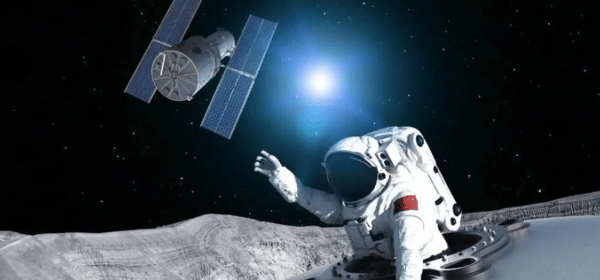
According to the CMSA, crews for the Shenzhou-20 and Shenzhou-21 missions will consist of three astronauts each. Shenzhou-20 is set to dock with the radial port of the space station’s core module, while Shenzhou-21 will dock with its front port.

The main tasks of the astronauts will include extravehicular activities, cargo outbound deliveries via the station’s cargo airlock module, and the conducting of space science experiments and technology tests.

In the second half of 2025, China plans to launch the Tianzhou-9 cargo spacecraft from the Wenchang Space Launch Site in its southern Hainan Province. This mission will deliver supplies for astronauts, propellants to ensure the space station’s operation, various types of payloads, and more.

China’s manned space station project has entered its application and development stage — with two manned spacecraft missions and one to two cargo missions planned annually.

Lunar Magnetic Field

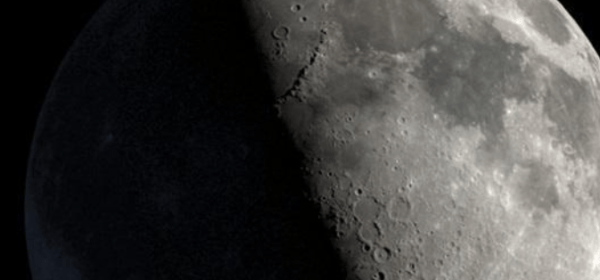
China: Chang’e 6 Samples Shed Light on Lunar Magnetism! (23.12.2024)

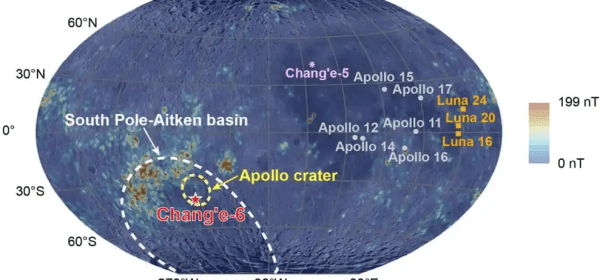
They discovered that the Moon’s magnetic field may have experienced a rebound around 2.8 billion years ago, suggesting that the Moon’s generator may have been reinforced after an early sharp decline.

“The reason for this rebound could be a change in the primary energy source of the generator or a restrengthening of the initial driving mechanism,” Cai said.

“The data fill in a billion-year gap in the evolution of the lunar paleomagnetic record and provide the first paleomagnetic measurements from the lunar far side,” a reviewer for the journal Nature said. “The authors are to be congratulated on a historic study that provides a major advance in our understanding of lunar magnetism.”

The evolution history of the Moon’s magnetic field is markedly different from that of the Earth’s, the research team said.

Dark Side Moon

PRC: Lunar Samples Indicate Previous Magma Activity! (19.11.2024)

am lunar soils.

The study published on Science, conducted by a team led by Xu Yigang, an academician of the CAS and a researcher at the Guangzhou Institute of Geochemistry of the CAS, also confirmed magma activity on the lunar far side 2.8 billion years ago.

The study also indicates that the eruption of lunar mare basalt is influenced by the internal composition of the moon, explaining why the South Pole-Aitken Basin on the lunar far side lacks abundant volcanic activity.

“These samples are the first to be collected on the lunar far side so it provided a unique view to the moon’s global geological history. The results are novel and are deserving of publication in Science. They will be of interest to a broad readership,” Science reviewer Katherine Joy said.

PRC Reusable Space Shuttle!

China: Greater Efficiency Space Shuttle! (13.11.2024)

A model of the spacecraft will be displayed at the 15th China International Aviation and Aerospace Exhibition, which opens on Tuesday in Zhuhai and runs through Sunday.

Currently, China has only one model of cargo spaceship, Tianzhou, which is a product of the China Academy of Space Technology in Beijing. So far, seven Tianzhou vessels have been launched and six of them were used to transport supplies to the Tiangong space station.

Orbiting Earth at a distance of about 400 kilometres, the Chinese space station has three permanent parts — a core module and two science capsules — and is regularly connected to several visiting crew and cargo spaceships.

It has been manned by eight Chinese crews, including the incumbent Shenzhou XIX team. All of the crews’ living and work necessities need to be transported by cargo vessels.

1 2 3 4 5 6 8