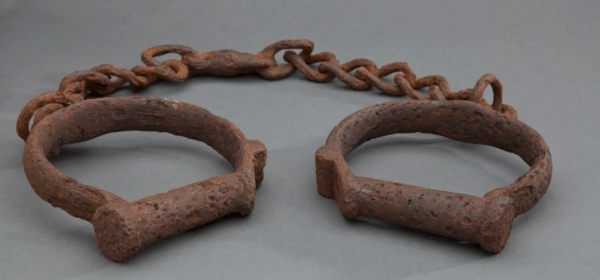
The Captains were paid for the slaves, purchased sugar with some of this money, and then set-sail for England. The slaves, of course, particularly in the West Indies, were forced to work on the sugar plantations, but were further exported into the American hinterland – where they would farm cotton. The Americas consisted of vast open spaces but there were not enough White workers to exploit this space. Slavery was the answer – with thousands of slaves controlled by a handful of Whites. Until 1648 – the slaves branded with a “Crown” meant that they were the personal property of the (absolute) British Monarchy. After the 1648-49 Execution of Charles I (and the overthrow of the aristocracy by the bourgeoisie) – the absolute monarchy was abolished and the “Crown” symbol was re-directed to refer to the bourgeoisie (which now controlled the means of production) and the elected government that was voted-in by the masses to represent its interests. Of course, the “Crown” simply designated those slaves acquired and sold by the British – as opposed to those slaves acquired by other European nations. It was a marker of dominance – rather than direct ownership – as each slave was owned by whoever had provided money to purchase the rights of ownership (like a car or a house).