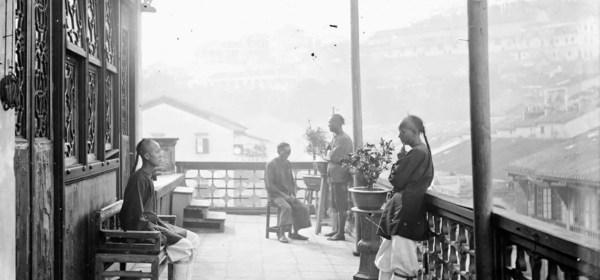
Hong Kong Tea House - 1868-1871

UK: How a 14-Year Old “Sir Harry Parkes” Witnessed the First [1842] “British” Photograph Taken in China! (26.10.2026)

As with all things – the “devil is in the detail” – so-to-speak. It is ironic that the British government’s attitude toward the photographic technology invented by English scientist – Walter Talbot – made it so expensive that virtually no-one British could afford to use it either in (or outside) the UK! Instead, British citizens travelling abroad often had to use the French photographic technology developed by Louis Daguerre. We can see this contradiction in operation as Western photography unfolded in China during the early 1840s. It would seem that the British took the first photograph in China (of themselves) during 1842 – but no known example of this picture exists today. Of course, a copy might exist somewhere, as of yet undiscovered. Nevertheless, there is a diary extract recording this event written by a 14-year old Harry Parkes – who would go on to be a very important British diplomat.
ALEXANDER WERTH [PART II]: RUSSIAN ARCTIC CONVOY PQ-16 – Reykjavik (Iceland) TO MURMANSK (USSR) – MERCHANT NAVY SHIP “EMPIRE BAFFIN”! (2.9.2023)

Alexander Werth’s 1947 book, ‘The Year of Stalingrad’, details the journey of Merchant Navy Ship “Empire Baffin” during WWII. The ship left Middlesborough, UK, for Reykjavik on May 1, 1942, arriving ten days later, and then sailed to Murmansk, USSR, on May 20th. Despite Nazi Germany’s control of the sea, air, and land, and losing seven ships, the Convoy PQ-16 of 36 international ships managed to reach port under the protection of naval fleets.

Alexander Werth [Part I]: Russian Arctic Convoy PQ-16 – Middlesborough (UK) to Murmansk (USSR) – Merchant Navy Ship “Empire Baffin”! (2.9.2023)

The Russian Arctic Convoy, PQ-16, sailed from Iceland to the Soviet Union in late May 1942, providing vital military and civilian aid amid attacks by Nazi Germany. The fleet comprised British, American, and Allied ships, including the Empire Baffin that Alexander Werth traveled on for four weeks as recorded in his book ‘The Year of Stalingrad’. This account, along with further research, allows for a timeline to be reconstructed for these events, however, full details are limited due to the secrecy required during wartime. Convoy PQ-16 consisted of 36 Merchant Navy vessels, some armed for self-defense, and a number of Royal Navy ships acting as protection. Werth’s account also mentions controversial language used to describe the African-descendent members of the Merchant Navy crew.