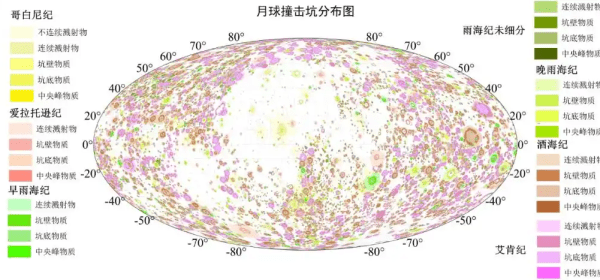
Global lunar crater distribution map. (Photo provided by the Institute of Geology, Chinese Academy of Geological Sciences)

China: PRC Develops Independent “Lunar Surface Map” for Future Missions! (7.8.2026)

A Chinese research team has completed an updated geologic map of the entire moon featuring a scale of 1:5 million, the Institute of Geology, Chinese Academy of Geological Sciences (IGCAGS), said on Thursday.

Representing a significant scientific iteration from the 2024 version, this map effectively rewrites the moon’s geologic history based on the latest research findings. “The lunar geologic history has indeed been rewritten — more precisely, refined and systematized,” said Yang Zhiming, director of the IGCAGS.

Specifically, a primary achievement of this update is the recalibration of the moon’s ancient geologic eras. The new map systematically updates the age boundaries of the moon’s three ancient geologic periods, namely the Aitkenian, Nectarian and Imbrian periods, drawing on recent advances in international chronology.
Samples from Dark-Side Returns!

China: Spacecraft Returns with first Samples from Lunar Far-Side! (4.6.2024)

The control system of Chang’e-6 has also been enhanced to improve its autonomy, enabling it to complete lunar take-off and ascent with reduced reliance on the Queqiao-2 relay satellite and ground support, said Huang Hao, another space expert from the CASC.

The ascender is expected to carry out unmanned rendezvous and docking with the orbiter-returner combination in lunar orbit, and the samples will be transferred to the returner.

The orbiter-returner combination will orbit the moon, awaiting the optimal time to transfer back to Earth. When it approaches Earth, the returner carrying the lunar samples will re-enter the atmosphere, aiming for a touchdown at Siziwang Banner in north China’s Inner Mongolia Autonomous Region, the CNSA said.

Chinese Cosmonauts!

China: Lunar Space Programme Targets Resources! (12.3.2024)

Yang is widely known for leading the design work on the Chang’e 5 robotic spacecraft that fulfilled China’s first lunar sample retrieval mission.

He was speaking on the side-lines of the second session of the 14th National Committee of the Chinese People’s Political Consultative Conference, which concluded in Beijing on Sunday. He is a member of the CPPCC National Committee, the top political advisory body in China.

China began its lunar programme in 2004 and has launched six robotic probes since 2007. The most recent mission, Chang’e 5, landed on the moon in December 2020 and soon brought 1,731 grams of lunar rocks and soil back to Earth, achieving a historic accomplishment about 44 years after the last lunar substances were brought back from our nearest celestial neighbour.

China: Socialist Science to 3D Print Structures on Moon! (24.4.2023)

After Chang’e 6, the Chang’e 7 robotic probe will be sent to land on the moon’s South Pole to perform “high-precision investigations”, Wu said.

“The Chang’e 7 mission is meant to look for traces of water on the South Pole, investigate the environment and weather there, and survey the landform. The probe will carry a ‘flyby craft’ tasked with flying into pits on the lunar surface to look for ice,” the scientist said.

“Chang’e 7 will also be tasked with detecting the natural resources beneath the lunar South Pole’s surface. Mission planners are trying to assess if we can use the probe to dig into the surface and study underground structures and their composition,” he said.

In the long run, scientists will use components of the three upcoming missions — the orbiters, landers, rovers and sensors — to form the prototype of a robotic scientific outpost, which will act as a platform for international collaboration on lunar exploration, he added.