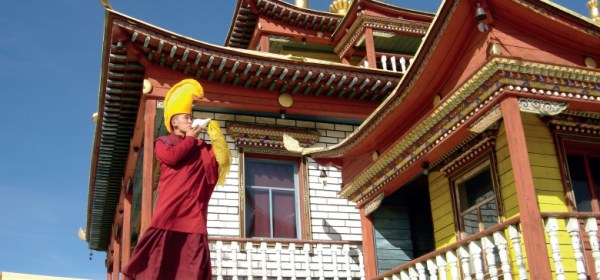
What Stcherbatsky describes from personal experience, is that the Buryats Buddhists supported a) Socialism, and b) Science, apparently because of the similarities between these two systems, and that of certain aspects of Buddhist philosophy.
Proletariat Blogging in the Heart of (UK) Predatory Capitalism! Exploring the Interface between Matter and Perception, Chinese Buddhism, Daoism, Hakka Ethnography, and All Aspects of Radical Politics, History, Psychology and Philosophy – 全世界无产者联合起来!
Exploring the philosophy (and practice) of Early and Later Buddhism.
What Stcherbatsky describes from personal experience, is that the Buryats Buddhists supported a) Socialism, and b) Science, apparently because of the similarities between these two systems, and that of certain aspects of Buddhist philosophy.
Moreover, the Buddha clearly states that conscious awareness cannot exist without the conditions associated with a physical body and its functioning biological processes. Within the Buddha’s interpretation of reality, there does not exist any notion of a ‘dis-embodied’ conscious awareness.
One major difference between the Buddha’s system and any modern parallel is that simply ‘knowing’ things (as is evident in the modern, Western academic tradition) is not enough to escape suffering.

Although the different Buddhist schools argued over the existence or nature of the atom, the Theravada thinkers conceived of an atom comprised of ‘space’ and ‘sub-particles’ (dravya-paramanu) which is physically complex (rupa-kalapa), whilst its constituent parts exist in a state on constant flux (kalapanga).
Within the received chain of dependent origination (paticca-samuppāda), the Buddha uses the term ‘namo-rupa’ or ‘mind-body’ – to explain that these two otherwise distinctive entities are inherently ‘linked’ or ‘entwined’ at source, and within his schematic of interpreting reality, cannot be considered ‘separate’ in any manner.
Author: Stcherbatskay F.I. – Title: Theory of knowledge and logic according to the teachings of later Buddhists. Part 1: Dharmakirti’s “Textbook of Logic” with Dharmottara
 SANGHA KOMMUNE (SSR)