

Blogger’s Note: When I was at school, I had some very good English-language teachers. At the time. We – as attending “children” – hated the fact that we had to sit-down, stop talking and randomly fidgeting for at least 90-minutes (today lessons are 30 or 60 minutes) – whilst being subjected to a harsh (and required) linguistic discipline. English was just “English” in those heady days of British isolationism. Every so often the odd “Americanism” that had crept into the language of Shakespeare was discussed – but never from a positive perspective. We were bust defending our linguistic inheritance from the vulgarities of “Americanism” – whilst simultaneous importing foreign words (with impunity) from India (“gymkhana”) and “China” (“tea”) outposts of the British Empire – amongst many others. For instance, the Western term “Ketchup” (Tomato Sauce) derives from the Fujian dialect of Southern China – as that ethnic group uses a type of tomato puree in its cooking. Within Putonghua, “Tomato Sauce” is wtitten as “番茄酱” (Fan Qie Jiang):
番 (Fan) = Palmful of Seeds
茄 (Qie) = Foreign Eggplant
酱 (Jiang) = Sauce or Paste
The Fujian people were prolific sailors and visited many places – gathering all kinds of interesting things. It seems that the two ideograms – “番茄” (Fan Qie) are combined in the Fujian dialect to form the expression “Gi-eo” – whilst “Sauce” (酱 – Jiang) is pronounced “Chiau”. Together, this forms the Fujian expression of “Gi-eo Chiau” – with early English explorers recording this as “Ketchup” – whilst referring to “Tomato Sauce”. Within the nearby Cantonese dialect, (酱 – Jiang) is pronounced “Jyup” – at least in the Hakka-Cantonese language my family speaks – but you can see how confusing all this might be to an unfamiliar explorer. The point is that language is diverse and does transition. In this regard, I include an English article and a well-written US article (they refer to “Toilets” as “Restrooms”) – but I remember that even when at school – “Americans” were allowed into what we colloquially referred to as the “Bogs” – probably an ancient Celtic term.
Lastly, I would say that People with Disabilities have to use “asexual” toilets – with the idea that the ordinary “Male” and “Female” toilets should not be altered to accommodate the diverse needs of disabled people (this is viewed as inconveniencing the non-disabled). The Disabled have no right to expect single-sex toilets – as such an adaptation would cost “too much money”. However, and simultaneously, Women’s’ toilets are routinely altered to accommodate the needs of pregnant women and women with babies – sometimes with an entirely separate and spacious area designed for breast-feeding and nappy-changing (in these separate spaces – both parents are often allowed in together – [or one or the other] without comment – meaning men “share” women’s toileting areas). Quite often, the Disabled Toilets are co-opted by the able-bodied to act as spare toilets for themselves – or for mother and baby rooms – thus depriving the Disabled of the limited toilet-spaces the law has granted them after decades of campaigning for equal rights. The Disabled are continuously told it is unreasonable to expect better toileting conditions – or to keep the non-Disabled “out” of their areas. Of course, the Disabled are excluded from the “Trans” Vs “CIS” turf-war that is going on – but their plight does shed some light on this issue. (Oddly, the US author refers to the UK court quite rightly as the “High Court” – avoiding the use of “Supreme Court” – an American import popularised by Tony Blair). Anyone interested in an early British scifi story that covers Trans ideas – can reference the 1920 book entitled “A Voyage to Arcturus” penned by David Lindsay (You can also explore Plato’s “Symposium”). ACW (14.2.2026)
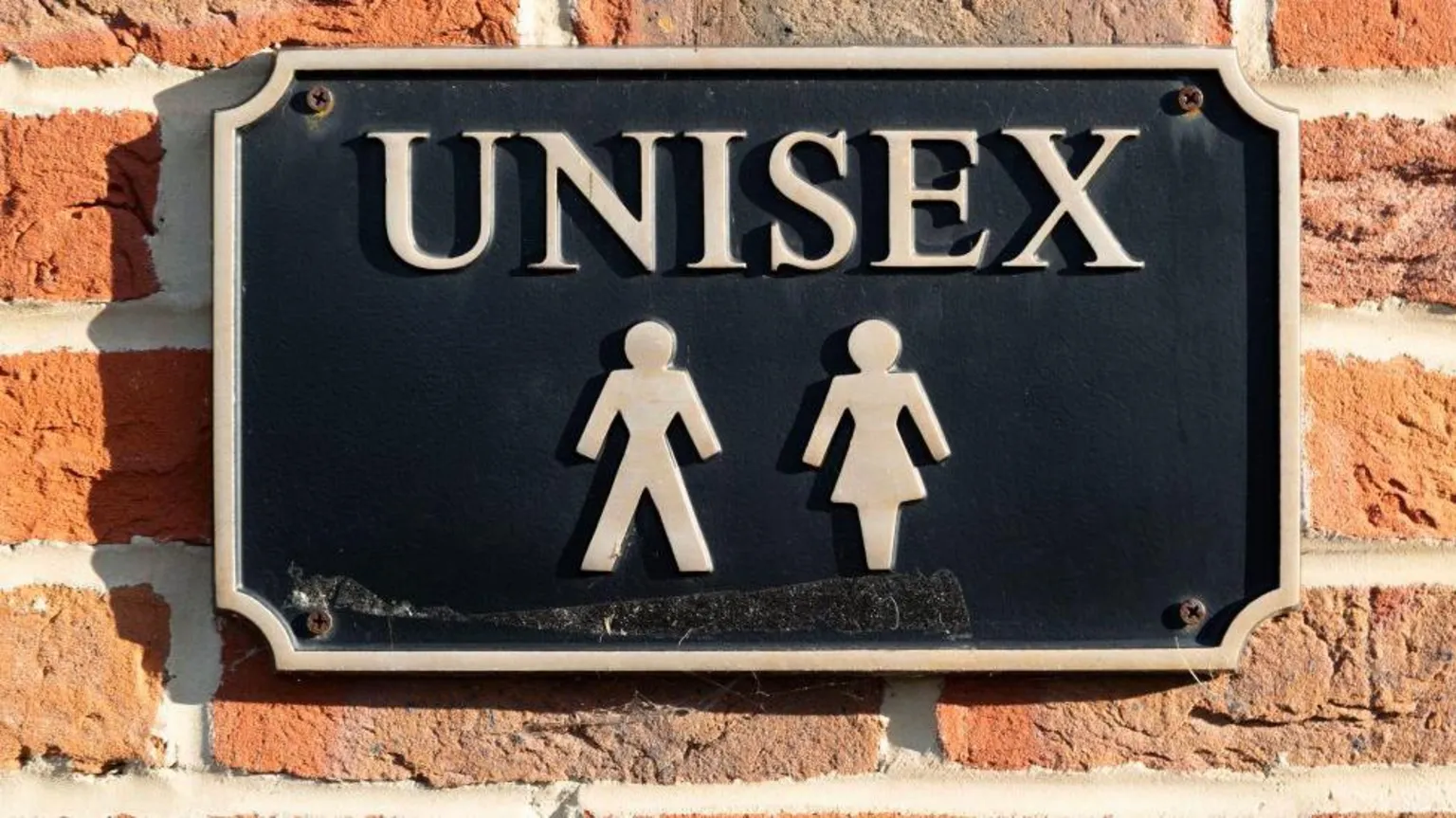
A High Court judge has dismissed a legal challenge to the equality watchdog’s guidance on which public or workplace toilets and changing rooms transgender people should use.
The judgment urged businesses and services to follow the law, seek specialist advice, but also use “common sense” in how they organised facilities such as toilets.
The Equality and Human Rights Commission (EHRC) issued interim guidance last April and withdrew it six months later.
It said in situations where single sex facilities are required, they should only be used by people of the same biological sex.
It also said that, for instance, a trans woman – a biological male who identifies as a woman – would be expected to use a gender-neutral toilet or male toilets, not those for females.
Campaign group, the Good Law Project (GLP), claimed the guidance was “legally flawed” and “overly simplistic”.
Three anonymous individuals also criticised the guidance, which is for employers and public services such as hospitals, shops and restaurants.
The judge, Mr Justice Swift, said the submission made to him was that “in substance” the guidance suggested service providers can “require” a transgender person to use lavatories that correspond to their biological sex.
“I do not consider this is a reasonable reading of the guidance,” he said.
The judge continued that the decision to publish the update “promptly” contained “no error of law”.
The commission’s now withdrawn guidance was issued shortly after the Supreme Court ruled in April 2025 that under the 2010 Equality Act, the words “woman” and “sex” referred to a biological woman and biological sex.
Swift dismissed an argument from lawyers for the GLP at the hearing last year, that expecting a trans person to use a gender-neutral toilet could amount to “less favourable treatment”.
The judge also refused an application by the campaign group for a judicial review but asked for submissions from all parties on whether an appeal should be allowed.
Friday’s judgement said “one clear conclusion” reached by the Supreme Court was that if an employer or business provided a service used by both men and women “then it would not be a single sex service”.
The judge criticised “polarised language” in legal submissions made to the court that suggested a trans person “must” use the lavatory that corresponds to their biological sex, or that the guidance assumed that women’s rights “trump” the rights of trans people.
He also said that those who provide facilities should comply with the law but also be “guided by common sense and benevolence rather than allow themselves to be blinkered by unyielding ideologies”.
Jess O’Thomson, the GLP’s trans rights lead, said the group was “deeply concerned about many aspects” of the court’s ruling but that it also showed that the law “has been dangerously misrepresented”.
Gender critical campaign group, Sex Matters, also made legal submissions at the November hearing. On Friday, its chief executive Maya Forstater urged the government to issue the final guidance “without delay”.
She said: “The law is clear. There was never any excuse for the government, public bodies, regulators, charities or businesses to delay in implementing the Supreme Court judgement.”
The chair of the EHRC, Dr Mary-Ann Stephenson, welcomed the judgement’s finding that its guidance was lawful.
“It’s our job to champion everyone’s rights under the Equality Act, including those with the protected characteristics of sex, sexual orientation and gender reassignment. A shared and correct understanding of the law is essential to that endeavour,” she said.
The EHRC’s full guidance or code of practice is still being considered by the government.
In “Incoherent” Ruling, U.K. Court Says Trans Women Can Use Women’s Restrooms Except at Work
“This is a worker’s rights crisis for the trans community,” a spokesperson for the Trans Solidarity Alliance said.
By Abby Monteil – February 13, 2026
The U.K. High Court ruled on Friday, February 13, that transgender women are lawfully permitted to use public women’s restrooms, except at work.
The Court was responding to the political nonprofit the Good Law Project, which had previously disputed the U.K. Equality and Human Rights Commission’s (EHRC’s) guidance on the U.K. Supreme Court’s April 2025 ruling declaring that a person’s legal “sex” refers only to their “biological” sex as assigned at birth. Based on that judgment, the EHRC recommended that public-facing services and workplaces require trans people to use facilities based on their “biological sex.”
In its February 13 decision, the Court stated that service providers may, in fact, allow trans women to use women’s restrooms without also being legally required to open these facilities to cis men. As The Good Law Project put it in a news release, “In short, the law does not require a bathroom ban.”
Instead, a High Court judge wrote that public service providers should be “guided by common sense and benevolence” rather than be “blinkered by unyielding ideologies” when it comes to providing restroom access.
But the Court also maintained that the EHRC’s guidance was not unlawful, and upheld that workplaces must designate bathrooms based on “biological sex.” Meanwhile, it argued that requiring trans employees to use a third restroom facility as a result would “rarely” be considered discriminatory.
These comments about “unyielding ideologies” come after years of anti-trans organizing within the U.K. They also come as trans people in the U.S. grapple with similar ramifications, between the Trump administration’s declaration that there are “only two genders” assigned at birth, and its subsequent attempts to enforce that executive order across a wide range of governmental agencies.
A spokesperson for the Trans Solidarity Alliance expressed concerns over the ruling in a statement to The Independent, saying, “The legal situation for trans people, employers, and service providers is now completely incoherent. What bathroom a trans person can use in a pub may now depend whether they are there as an employer or for a drink.”
“This is a worker’s rights crisis for the trans community, and one which will cause issues for employers across the country,” the spokesperson continued. “We must be allowed to transition and move on with our lives with privacy, not be outed every day at work.”
 SANGHA KOMMUNE (SSR)