I was reading an article recently regarding the history of the “Celts” in the UK – that the Ogham alphabet was possibly premised upon a development away from the Roman alphabet. This did not seem quite right to me due to it obvious differences in structure – why not copy the alphabet as is – and proceed from there? The Greeks, of course, referred to certain non-Greeks (but not Germans) as “Keltos” (Κελτοί – or “Keltoi”) usually defined as:
‘A member of a group of peoples inhabiting much of Europe and Asia Minor in pre-Roman times. Their culture developed in the late Bronze Age around the upper Danube, and reached its height in the La Tène culture (5th to 1st centuries BC) before being overrun by the Romans and various Germanic peoples.’
These people are thought to have spread to the British Isles, the Channel Isles, and Eire. The Greeks spread their colonies as far as Southern France – with a Greek explorer even reaching Britain. When the Roman conquered France – its officials noticed that tribes living either side of the English Channel shared the same tribal names and that these groups spoke a common language when they routinely communicated via boats traversing the sea separating Britain from France.
The Romans, using “Latin”, pronounced the Greek term “Keltos” as “Celtae” – but often preferred to use the name “Galli” or “Gaelic”. Although the Greeks seem to have labelled certain non-Greeks as “Keltos” – the Romans were of the opinion that Gaelic tribes actually referred to themselves as “Celtae”. Indeed, the Greeks developed the two origin myths to describe how the Celts came into being:
Keltos (or Celtus) is a figure in Greek mythology who is considered the eponymous ancestor of the Celts. There are two main origin stories:
1) Son of Heracles and Celtine: One account states that Keltos was the son of the hero Heracles and Celtine, the daughter of the king Bretannus. Heracles had an encounter with Celtine while retrieving the cattle of Geryon, and their son Keltos became the forefather of the Celtic peoples.
2) Son of Polyphemus and Galatea: Another tradition names Keltos as one of the three sons of the cyclops Polyphemus and the sea nymph Galatea, alongside Illyrius and Galas.
There is some sources which state that king Bretannus was the ancient founder of the Britain – but this is a matter of opinion. When I was discussing this issue with one of my daughters – she pointed me in the direction of the (2005) book written by Hazel Richardson entitled “Life of the Ancient Celts” – which states the following (paraphrased) regarding a possible written language of the Celts (Page 22):
The Celts did not develop a written language until 500-years after coming into contact with the Greek people – which occurred during the late 3rd century BCE – when the Greeks established a colony in Southern France (suggesting that a Celtic alphabet was developed c. 200 CE). Considering Richardson also states that by 400 CE (just two-hundred years after the Celts developed that alphabet) – most of the Celtic languages were nolonger spoken (due to the successful Roman Conquest of Western Europe and Britain) – this must be considered a relatively late date for a Celtic written language (considering the Celtic languages were existent for thousands of years prior to this). Richardson says:
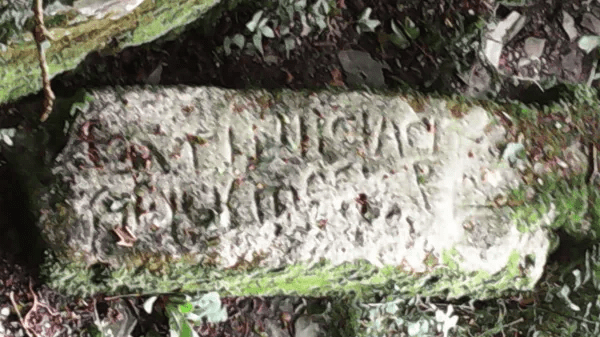
‘At least 500 years after the Celts were introduced to the Greek alphabet, they developed their own alphabet for writing called the Ogham script. The Ogham alphabet was made up of 25 letters, with consonants written as a series of vertical or horizontal lines. Vowels were written as dots. Archaeologists have found many gravestones and stones used to mark boundaries engraved with Ogham script in Britain and Ireland.’
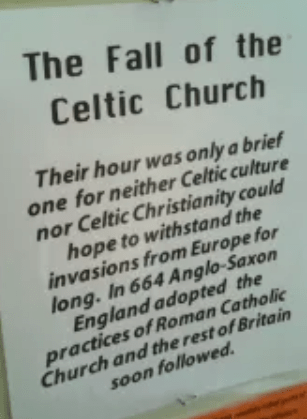
Having visited many and numerous Celtic sites around Southwest of England – I have witnessed Ogham script first-hand (including “Arthur’s Stone” near Camelford in Cornwall) – and I can say it looks nothing like either Greek or Roman script. Furthermore, neither Greece nor Rome conquered Eire – and as far as I can ascertain – Ogham developed in a non-Greek and non-Roman Eire (Ireland). Either that – or the Celts in Britain developed Ogham and then transmitted it to Eire – but I think this is the wrong direction of travel. Egyptian Christianity was transmitted to Eire – from which it spread to the Western side of the UK – where all the monastic ruins now reside. The Celtic Church lasted into the 12th century in Britain – when it was destroyed by a State-sponsored Roman Catholic Church brought by the Norman Conquest (prior to this, some of the early Anglo-Saxon Christians in England adopted Catholic practices in 664 CE – but there was no England, or English State religion at the time – and Roman Catholicism had to co-exist alongside Paganism and different types of Christianity, including the Celtic variety. It was the Normans who introduced the concept of the permanent State and Catholicism as the preferred religion of that State).
 SANGHA KOMMUNE (SSR)