Researchers have helped to unearth the earliest known evidence of human existence in Ireland

Eire: Ancient Land-Bridge Links Wales to Ireland! (6.9.2026)

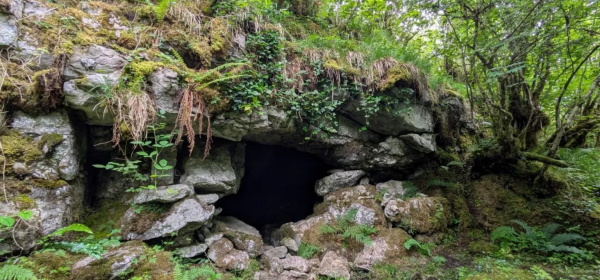
Eight of them were found to have cave art which they believe dates from at least 15,000 years ago and possibly much earlier, and around 5,000 years before the previous oldest example of humans in Ireland.

The team are currently unwilling to be more precise about the location of the caves, for fear that they may be vandalised or looted.

“We know that modern day south Wales was settled from around 35,000 to 40,000 years ago, by intrepid early modern humans from southern England, France and Spain, crossing the then dried-up land bridges of the English and Bristol Channels – seasonally settling in caves along the inhabitable strip of land stretching from Chepstow to St Davids,” said Nash.

“Over 20,000 years their art progressed from primitive line drawings which may have been early tally charts, to more figurative and representative depictions of the world around them, and what we’ve found in Ireland is yet another progression from that.”

The rock art which the Lost Land Bridge Project has uncovered includes engravings on the cave walls, paintings in ochre and charcoal and line sketches indented into clay and earth by fingertips.

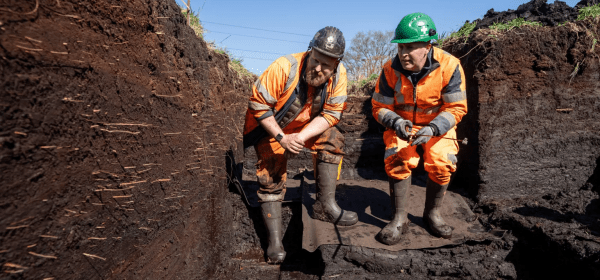
Archaeologists made the discovery underneath layers of peat on Honeygar Farm in Westhay

UK: Neolithic “Trackway” Discovered by Archaeologists in Honeygar Farm [Somerset]! (22.3.2026)

Britain used to be full of marshes through which the Celts built trackways to travel about – probably between the various tribes. Presumably, these marshes ran through (and around) forests – as the UK used to be covered in dense foliage. Therefore, the Celts did build their own type of natural pathways – but these were “natural” and very different to the roads constructed by the Roman engineers – which seemed “severe” and “unnatural” by comparison. Furthermore, the Romans destroyed the traditional landscape that Druidism and Celtic culture developed and grew within. The Romans cleared the forests and drained the marshes – thus destroying the very essence of the British Celt culture that had existed for thousands of years. The Romans committed genocide, forcibly established their culture – and then left. Part of this Roman domination was that the Celts were “primitive” and possessed no culture of their own. A policy straight out of the imperialist play-book.

UK Celtic Christianity

UK: When Did the Celts Develop a Written Alphabet? (11.1.2026)

The Celts did not develop a written language until 500-years after coming into contact with the Greek people – which occurred during the late 3rd century BCE – when the Greeks established a colony in Southern France (suggesting that a Celtic alphabet was developed c. 200 CE). Considering Richardson also states that by 400 CE (just two-hundred years after the Celts developed that alphabet) – most of the Celtic languages were nolonger spoken (due to the successful Roman Conquest of Western Europe and Britain) – this must be considered a relatively late date for a Celtic written language (considering the Celtic languages were existent for thousands of years prior to this).

Diverse Collection of Stone Tools - Hainan!

China: 13,000 Year-Old Prehistoric Tomb Unearted in Hainan! (11.11.2025)

Archaeologists proved that the remains belong to a juvenile, with decorative textiles made from shells found near its head and waist – the earliest such findings ever reported in China – which offer rare insights into prehistoric cultural practices in Hainan and potential cultural exchanges with Southeast Asia.

Excavations at the Luobidong site are ongoing, trying to fully reveal the cultural significance of the site and provide a scientific foundation for both prehistoric research in Hainan and the development of the Luobidong National Archaeological Site Park.

Evidnce of Fire-Making in China!

China: Evidence of 7000 Year-Old Fire -Starting Discovered! (1.3.2025)

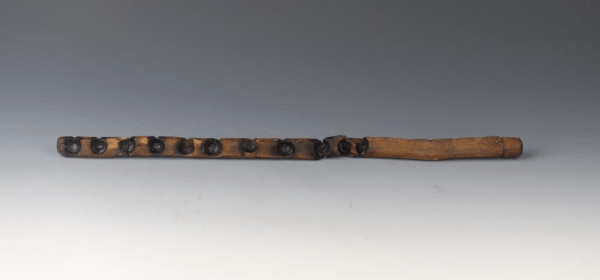
Additionally, a circular groove, likely used for tying a rope, was found on one end of the fireboard, suggesting it was designed for easy carrying or hanging.

The Caoyangang site, spanning over 80,000 square metres, has unearthed a wealth of items beyond the fire-making tools. More than 3,000 items, including pottery, bone tools, wooden objects, animal remains from deer, pigs, cattle, dogs, and various birds, and aquatic plant remains, have been discovered at the site.

These findings show a vivid picture of the daily lives and aesthetic sensibilities of the ancient people who once thrived in the region, archaeologists said.