by Sandee Oster, Phys.org December 30, 2025
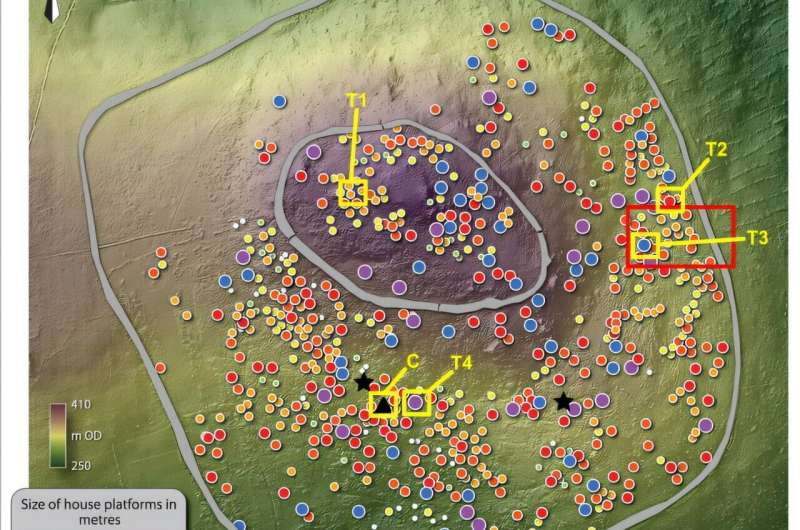
In a recent study published in Antiquity, Dr. Dirk Brandherm and his colleagues identified more than 600 suspected house platforms in the Brusselstown Ring hillfort, making it the largest nucleated settlement ever discovered in the entirety of prehistoric Britain and Ireland thus far. Subsequent test excavations revealed evidence of Late Bronze Age and Early Iron Age occupation as well as a potential water cistern, which may be the very first of its kind in an Irish hillfort.
The Brusselstown Ring hillfort
The hillfort is part of the Baltinglass hillfort cluster located in County Wicklow, Ireland. Comprising up to 13 large hilltop enclosures, the area has evidence of continuous use and monumental construction from the Early Neolithic through to the Bronze Age (ca. 3700 to 800 BC).
Brusselstown Ring is unique for its size and density, characterized by two widely spaced ramparts encompassing the enclosure. The outermost enclosing element encompasses both the Brusselstown Ring and the Neolithic enclosure of Spinas Hill 1, hillforts that encompass more than a single hill are exceedingly rare in Britain and Ireland, and uncommon even on continental Late Iron Age (150–50 BC) Europe.
What makes it unique
Subsequent airborne surveys of the Brusselstown Ring revealed more than 600 suspected house platforms, of which 98 were within the inner enclosure and the remaining 509 between the inner and outer enclosing elements, making it the largest nucleated hillfort settlement in prehistoric Ireland and Britain to date.
Dr. Cherie Edwards emphasized the significance, stating that, “Brusselstown Ring presents an intriguing case for understanding settlement dynamics in Ireland during the Bronze Age. This site—along with a small number of other nucleated settlements situated on hilltops—appears to have emerged around 1200 BC. This pattern contrasts sharply with the more typical form of prehistoric Irish settlements, which generally consist of one to five dwellings. Such evidence suggests that proto-urban development in Northern Europe may have occurred nearly 500 years earlier than traditionally recognized.”
Preliminary results
To gain better insights into the nature of the site, radiocarbon dates were analyzed, and four test excavations were conducted, Dr. Edwards elaborated, “The settlement clearly dates to the Late Bronze Age and Early Iron Age (c. 1193–410 BC) and represents a nucleated or agglomerated site characterized by a high density of dwellings.
“Excavation trenches were deliberately positioned over house platforms of varying diameters (6 m, 7 m, 8 m, and 12 m) to assess potential correlations between house size and indicators of social differentiation. Specifically, this approach sought to determine whether architectural variation corresponded with differences in the quantity or type of artifacts recovered.
“Radiocarbon dating results demonstrate that houses of all sizes were occupied contemporaneously, and no discernible differences were found in the artifactual assemblages associated with each structure. Although preliminary, these findings align with broader patterns observed at other Bronze Age domestic sites in Ireland, which similarly lack material evidence for wealth differentiation or social hierarchy.”
Additional survey work revealed a unique structure near one of the trenches. The flat interior outlined by large stones, uncommon for roundhouses at the site, made it unlikely to be a prehistoric roundhouse itself. From previous surveys, it was known that a stream flowed into the structure from a rocky outcrop uphill.
Given its shape and size, it is hypothesized that this might be a Bronze and Iron Age water cistern like those found elsewhere in Europe. Because Brusselstown Hill would have had to accommodate a large population, a source of freshwater would make sense. If further investigations confirm the structure to be a water cistern, it would represent the first of its kind in an Irish hillfort.
More research is needed to better understand the extent and nature of Brusselstown Hill’s potential water cistern, establishing the nature and chronology of the enclosing elements and better understanding how and why the settlement may have been abandoned.
“The site’s chronological trajectory aligns closely with that of other, albeit smaller, hilltop nucleated sites in Ireland, implying that its abandonment followed a broader regional pattern of gradual decline during the Iron Age, around the third century BC. This decline also appears unrelated to the climatic shift toward cooler and wetter conditions that began during the Bronze Age–Iron Age transition, ca. 750 BC,” says Dr. Edwards.

